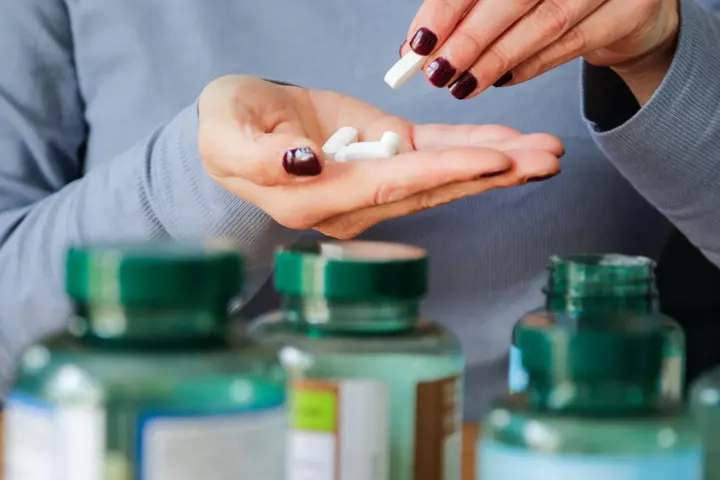
A low-cost vitamin could stop symptoms of psoriasis, a painful skin condition experienced by Kim Kardashian. Psoriasis impacts 1.8 million people in Britain, triggering itchy and scaly patches of skin often found on the scalp, hands, feet, and genitals, along with stiff and tender joints. While an overactive immune system causes the condition and leaves no known cure, it causes pain, disrupts sleep, and harms mental health. Scientists now report that a vitamin named pantethine can reduce skin inflammation. In tests involving mice with psoriasis, the substance showed promising results by stopping the condition from developing. Furthermore, individuals who took the vitamin alongside other treatments experienced symptom relief, based on a new study by Chinese researchers. Pantethine stems from vitamin B5, which aids blood cell production and turns food into energy. It is sold widely as a nutritional supplement, priced at £18.74 on iHerb, which equals 31p per pill. People often use it to reduce blood cholesterol because it blocks fatty substance formation. High blood cholesterol can also raise the risk of developing psoriasis. Investigators published their results in the Journal of Experimental Medicine, discovering that pantethine restricts the activity of immune cells driving autoimmune diseases like psoriasis.
Dendritic cells represent specialised immune cells that help coordinate different parts of the immune system. These cells capture germs and foreign objects while sparking an immune response and inflammation. Because they direct body immune defences, accidental activation can trigger autoimmune conditions like psoriasis. Study co-lead author Dr Wei-Na Zhang stated, "Emerging evidence highlights that metabolic pathways and their associated metabolites play vital roles in regulating immune cell function and autoimmune progression. But therapeutic strategies targeting metabolism in inflammatory diseases remain underexplored." Chinese researchers discovered elevated levels of enzymes named Vanins inside dendritic cells of patients suffering from psoriasis and other autoimmune diseases. Removing those enzymes prevented dendritic cells from activating, which restricted their capacity to trigger an immune reaction. Treating mice with a drug blocking Vanins achieved this exact result, stopping the animals from developing psoriasis. Dr Zhang, affiliated with the State Key Laboratory of Biomedical Analysis in Beijing, explained that Vanin enzymes convert pantethine into vitamin B5.
ASK DR ZOE
THE SUN'S RESIDENT GP DR ZOE WILLIAMS SAYS...
Do you have a question you wish you could ask a doctor?
Whether you are worrying about a new symptom, stuck on a long NHS waiting list, or struggling to get a face-to-face appointment with your GP, I am here to help guide you through it.
Whatever is on your mind, send an email to health@thesun.co.uk.
Perhaps you have recently received a confusing new diagnosis, have questions about a newly prescribed medication, or are simply feeling anxious about a partner's declining health and don't know where to turn.
I will do my best to help answer your question anonymously.
I answer readers every week in the Sun on Sunday, and in Sun Health on a Tuesday. Find my previous answers online, here.
Get in touch!
High cholesterol is already known to trigger dendritic cells and increase psoriasis risk. When Vanin becomes overly active within these cells, pantethine levels drop, as researchers discovered. Low pantethine causes cells to produce excessive cholesterol, driving them into overdrive. Restoring pantethine resolved the issue by halting excess cholesterol buildup and calming immune cells. Dr Zhang stated, "We found that pantethine administration effectively alleviated psoriasis in mice, suggesting that insufficient pantethine levels may be the crucial contributor to hyperactivation of dendritic cells and autoimmune inflammation following the up-regulation of Vanins." Researchers also examined 24 psoriasis patients to evaluate pantethine performance. Every patient received standard psoriasis ointments, while half also received pantethine tablets. Across 12 weeks, patients receiving extra pantethine showed symptom improvement, particularly those with high initial cholesterol levels. Although results look encouraging, researchers stressed the need for further testing before people rely on pantethine to treat psoriasis. Dr Zhang added, "Our investigator-initiated clinical trial demonstrated encouraging therapeutic efficacy of pantethine as an adjunctive therapy in psoriasis, but these findings should be interpreted as proof-of-concept for clinical feasibility rather than direct mechanistic validation. Our study provides a foundation for therapeutic strategies targeting several dendritic cell–mediated autoimmune diseases.">