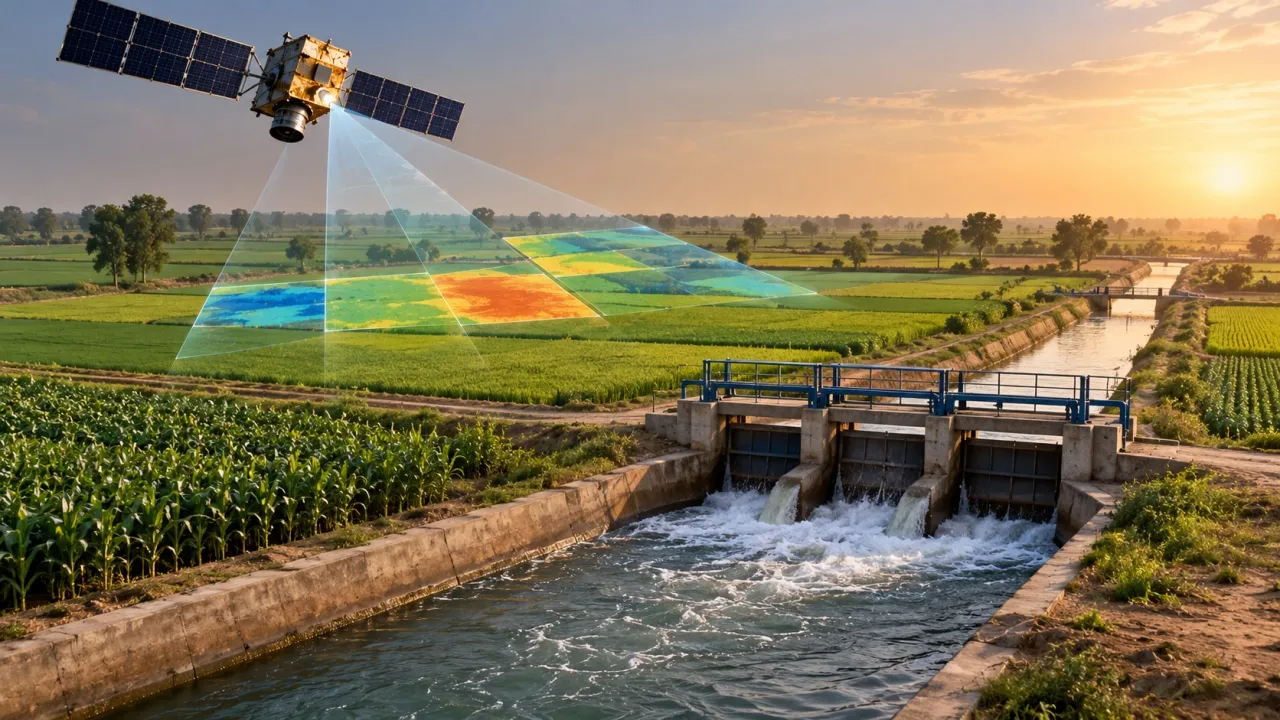
Experts gathered at a workshop at the Lahore University of Management Sciences stating that Pakistan could boost the fairness and efficiency of irrigation water distribution by merging satellite data with mathematical optimization to match allocations with crop demands.
Initial testing for the pilot took place across a canal group in the Balloki–Okara division before expanding to every rotation channel within the Lower Bari Doab Canal network, supplying approximately 675,000 hectares, equivalent to 13.3 million kanals, of agricultural land in Punjab.
This gathering marked the finish of phase three within a three-year initiative backed by the Asian Development Bank.
The project seeks to upgrade operational guidelines for water distribution by uniting satellite-derived Relative Water Deficit estimates alongside mathematical optimization.
Suggestions for allocations come from crop water needs while factoring in current rotation priorities and practical limitations.
During his keynote speech, Asian Development Bank water management consultant Dr. S. A. Prathapar stated that upgrading irrigation needed more than funding physical canal infrastructure, requiring updates to water allocation rules as well.
"When we think about modernizing the irrigation system, we only think about building a canal. But we have to modernize the software behind it. The rules behind it. And that's what this project is about," he said.
Dr. Prathapar noted that traditional delivery indicators showed if authorities provided scheduled water amounts, but failed to confirm if crops received adequate moisture to satisfy requirements.
Water deficit estimates from satellites can bridge this shortfall by guiding allocation suggestions for upcoming irrigation rotations.
Dr. Abubakr Muhammad from LUMS explained that the country's irrigation grid remains vital for food production and survival while confronting growing strains from climate shifts, unpredictable water supplies, and high farming expenses, particularly energy.
He mentioned that progress in satellite remote sensing, near-real-time observation, and smart decision tools presented chances to supply irrigation directors with useful guidance tied to water deficits at field and canal levels.
"These tools also allow us to be equitable, to be just, to be fair," Dr. Muhammad said, emphasizing that technological interventions must also account for social considerations, water governance and fairness in distribution.
Ryutaro Takaku-Bessho, principal water resource specialist representing the Asian Development Bank, emphasized the bank's ongoing involvement in local agriculture and water industries, covering efforts against climate risks, strengthening food safety, and boosting rural resilience.
"In addition to physical infrastructure, ADB is proud to support the current project, which targets the critical software of the sector, the operational rules that govern the government's vast water networks," he said.
Technical sessions reviewed system parts, with Waqas Karim Awan from the Food and Agriculture Organization speaking on satellite-based crop water needs, while Dr. Hassan Jaleel from LUMS covered the near-real-time Rotation Advisory Module.
Dr. Athar Ashraf talked about combining the Rotation Advisory Module with the Punjab Irrigation Department Irrigation Decision Support System, including potential uses in daily operations.
High-ranking personnel attended from the Punjab Irrigation and Agriculture Departments, the Water and Power Development Authority, the Ministry of Water Resources, the Space and Upper Atmosphere Research Commission, and the Pakistan Agricultural Research Council.
Attendees talked over methods for broader implementation, covering institutional setups, extra testing, grower involvement, and using rainfall predictions to adjust recommendations based on shifting field situations.