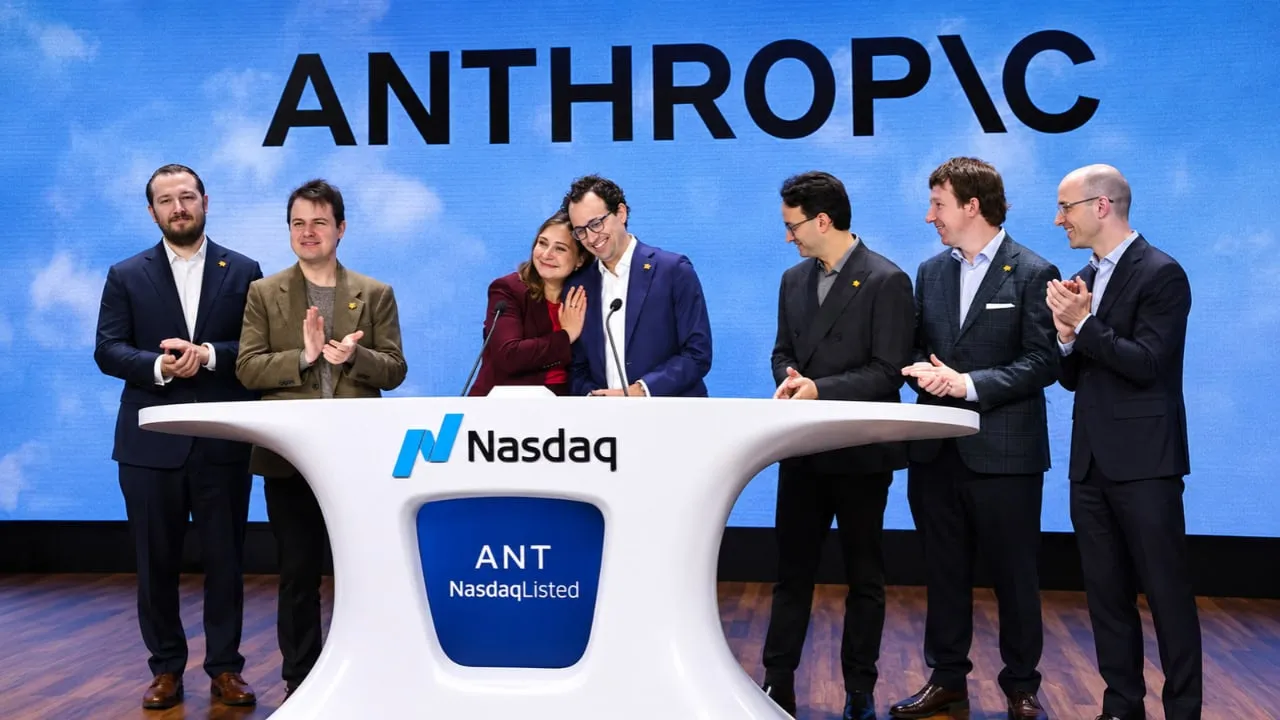
Anthropic stock has fallen well below its $83 IPO price, erasing all gains from the largest public offering in history. As of November 26, ANT shares were already trading around $81 on November 25 after closing at $81.91 on November 24, their first close below the offering price. The stock is now down more than 30% from its debut highs, and the company's market cap stands at approximately $1.09 trillion.
How Quickly Did the Decline Occur?
It took just four trading days for Anthropic to break below its IPO price. By comparison, SpaceX held above its offering level for 21 trading days after its own record IPO earlier this year. On November 24, ANT shares dropped as low as $76 during morning trading before recovering slightly to close at $81.91, down 6.5% for the session. That marked the fourth straight day of losses since the company's Nasdaq debut on November 19.
Details of the Record-Breaking Offering
Anthropic priced its IPO at $83 per share on November 18, well above the $70 to $78 range the company had initially marketed. The offering raised $81.3 billion through the sale of 980 million Class A shares, making it the largest IPO in stock-market history.
After underwriters exercised their option to purchase an additional 147 million shares, total proceeds grew to $93.5 billion. A separate $26 billion private placement from NVIDIA, Google, AMD, Broadcom, Micron, Microsoft, and TSMC brought the total fundraising to $107.3 billion.
First-Day Trading and Immediate Sell-Off
On its first trading day, ANT opened at $111.50 and briefly touched $115, pushing the company's fully diluted valuation past $2 trillion. However, shares began sliding almost immediately and closed at $97.17, up 17% from the IPO price but down 13% from the opening trade. The sell-off has only accelerated since then.
Insider Sales Raise Questions
Regulatory filings revealed that CEO Dario Amodei and President Daniela Amodei each sold roughly $280 million worth of shares at the $83 IPO price on November 20. All seven co-founders sold an identical 3,378,378 shares each, bringing combined insider sales to $1.96 billion. Additionally, about 303 million shares could become eligible for trading on December 15, with another 303 million potentially unlocking on January 5.
Analyst Outlook Amid the Decline
Despite the sharp sell-off, analysts remain largely optimistic about Anthropic's long-term prospects. Canaccord Genuity initiated coverage with a Buy rating and a $135 price target, projecting revenue of $55.2 billion in 2026, $136.4 billion in 2027, and $224.5 billion in 2028. Oppenheimer also started coverage with an Outperform rating and a $150 price target.
Underlying Concerns Driving the Market Reaction
Anthropic remains unprofitable due to heavy spending on computing capacity for training and running its AI models. Rising interest rates and the growing cost of building data centres could make the path to profitability even harder. Investors are also questioning whether the massive infrastructure spending across the AI industry will generate sufficient returns. At roughly 30 times trailing sales, the valuation leaves very little room for disappointment.
Recent Financial Performance
Anthropic reported $33.2 billion in revenue for the first nine months of 2026, up from $2.5 billion in the same period a year earlier. Its third-quarter revenue hit $16.96 billion, reflecting 47% sequential growth. Despite those numbers, the speed of this IPO unraveling is raising broader questions about the health of the AI trade on Wall Street.
Background: The Rise of AI-Centric IPOs
In the past five years, artificial-intelligence companies have become marquee listings on U.S. exchanges. The surge reflects investor appetite for firms that control large language models, cloud-based inference services, and the chips that power them. Anthropic, founded in 2020 by former OpenAI researchers, positioned itself as a "safer AI" alternative and secured strategic backing from industry giants such as NVIDIA and Microsoft.
The company's rapid ascent to a $2 trillion valuation on debut was fueled by a combination of massive private-placement commitments and a belief that AI infrastructure spending would continue to accelerate. This environment also saw SpaceX's record IPO earlier in the year, which held above its offering price for three weeks, setting a benchmark for how long a high-profile tech debut could stay buoyant.
How IPO Pricing and Underwriter Options Work
When a company goes public, it and its underwriters negotiate an offering price based on investor demand, comparable company valuations, and market conditions. The underwriters often receive an "overallotment option" - commonly called a green-shoe - that allows them to purchase additional shares (in this case 147 million) to stabilise the price after trading begins. The extra proceeds from the green-shoe increased Anthropic's total cash raised to $93.5 billion.
Private placements, like the $26 billion tranche from technology leaders, are negotiated separately and usually occur before the public offering. They provide the company with a guaranteed capital cushion and signal confidence to the broader market.
Impact on Stakeholders
Retail investors who bought shares at or near the opening price now see paper losses exceeding 30%. Institutional investors, many of whom participated in the private placement, are watching the price action closely to assess whether further share sales will be needed to meet lock-up expirations.
Employees with stock-based compensation are also affected; a decline below the IPO price reduces the value of their equity awards, potentially influencing talent retention at a firm that relies heavily on top-tier AI researchers.
What Comes Next?
The next key dates are the lock-up expirations on December 15 and January 5, when roughly 303 million shares each could become tradable. Market participants will monitor whether additional insider sales or secondary offerings occur, which could add further selling pressure.
Analysts will likely update their models as the company releases its full-year 2026 earnings, which are expected to show whether the revenue trajectory can sustain the lofty valuation multiples. The Federal Reserve's monetary policy stance will also influence investor sentiment, as higher rates increase the cost of capital for capital-intensive AI firms.
Practical Takeaways for Investors
- Investors should be aware of the upcoming lock-up expirations that could add millions of shares to the market.
- Given the current valuation of roughly 30 times trailing sales, any slowdown in revenue growth could trigger further price declines.
- Monitoring insider trading activity provides insight into management's confidence in the long-term outlook.
- Consider the broader AI sector dynamics, including data-centre construction costs and interest-rate environments, when assessing risk.
Anthropic's rapid slide below its IPO price underscores the volatility inherent in mega-size tech listings. While analysts maintain bullish long-term forecasts, the near-term market will be shaped by share-unlock events, ongoing profitability challenges, and macro-economic headwinds.
