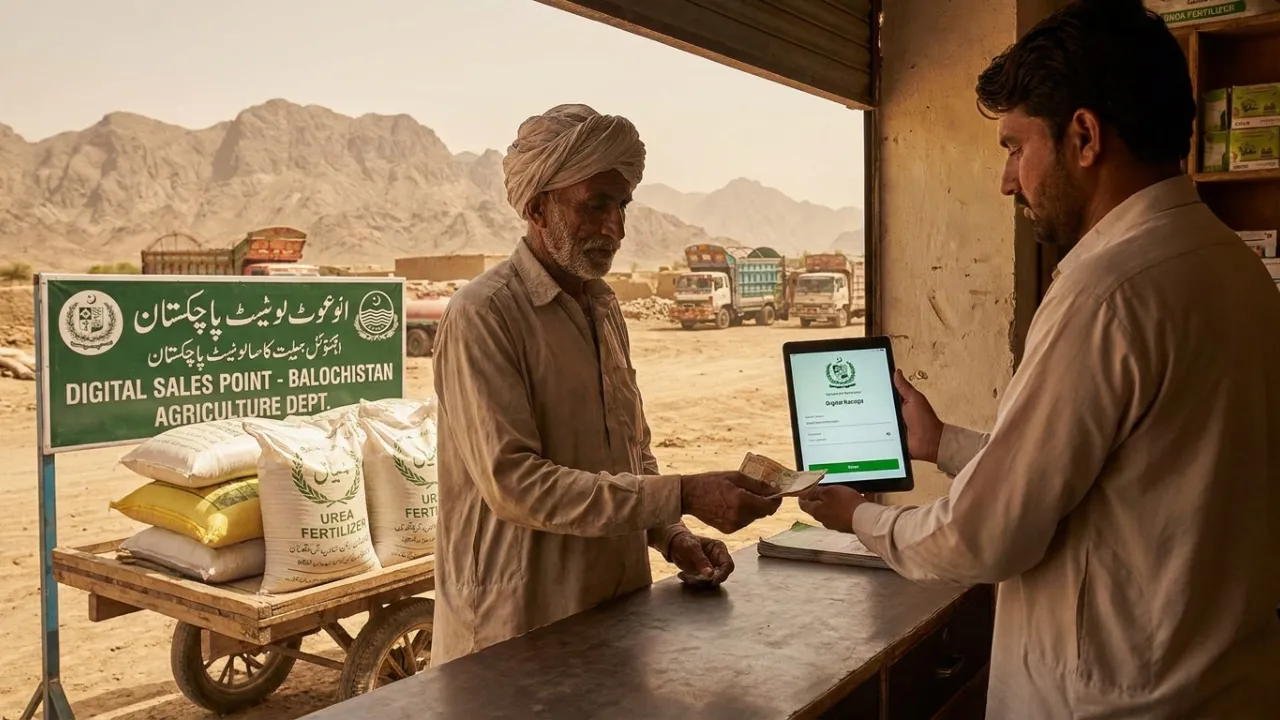
The Balochistan Agriculture Department has lifted fertilizer restrictions in 17 districts, but every sale must now be recorded through the province's PTTS login system, turning a routine supply decision into a major digitisation push.
Which Districts Are Affected and What Is the New Rule?
The conditional easing covers Hub, Jaffarabad, Sohbatpur, Usta Muhammad, Jhal Magsi, Dera Bugti, Barkhan, Sibi, Kachhi, Khuzdar, Kharan, Loralai, Qila Saifullah, Quetta, Pishin, Kalat, Panjgur, Lasbela and Naseerabad. Dealers in these areas may resume business, but the department has made the PTTS login system compulsory for every fertilizer transaction.
Under the arrangement, manual dealings, sales outside the system and undocumented purchases are banned outright. Each bag of fertilizer that moves through a dealer must leave a digital footprint from point of sale to final purchaser.
What Is the PTTS Login System and How Does It Work?
PTTS stands for Provincial Trade and Transaction System, an online portal launched by the Balochistan government in 2022 to track agricultural inputs. Dealers create a user account, obtain a secure login, and record each sale by entering the product type, quantity, batch number, buyer's National Identity Card (NIC) or farm registration number, and the date of transaction.
The system generates a unique transaction ID that is printed on a receipt for the farmer. All entries are stored in a central database managed by the Agriculture Department, which can be accessed in real time by inspectors.
- Login is required before any sale can be completed.
- Data entry must be completed within 30 minutes of the sale.
- Any discrepancy triggers an automatic alert to the district agriculture officer.
Why Is the Government Insisting on Digital Tracking?
The province has long struggled with fertilizer hoarding, undocumented sales, and leakage that drive up prices for farmers. Previous attempts to curb the grey market relied on periodic inspections, which proved ineffective because records were kept on paper and could be altered.
By forcing every transaction through PTTS, authorities hope to create a tamper-proof paper trail that will:
- Reduce opportunities for dealers to divert stock to the black market.
- Enable quick identification of supply chain bottlenecks.
- Provide accurate data for future policy planning, such as subsidy allocation.
What Are the Penalties for Non-Compliance?
The department has warned that any dealership violating the rules could face suspension or cancellation of its licence. Enforcement officers will conduct spot checks, compare physical stock with PTTS records, and issue notices within 48 hours of any breach.
Repeated violations may lead to a permanent ban from the provincial fertilizer market, a loss of credit facilities, and potential legal action under the Balochistan Agricultural Inputs Regulation Act.
How Will Farmers Be Affected?
For farmers in the 17 districts, the immediate effect is restored access to fertilizer supplies that were previously unavailable due to the ban. At the same time, the digital requirement eliminates the grey market's room to operate, meaning farmers will receive the exact quantity they purchase, with a receipt that can be verified online.
Farmers must present a valid NIC or farm registration number at the point of sale. The receipt generated by PTTS can be used to claim any government subsidies or to resolve disputes with dealers.
What Does This Mean for Dealers?
Dealers now face a binary choice: adopt the PTTS system or lose their licence. The department has offered a one-week training window, during which dealers can attend workshops in Quetta and regional hubs to learn the login process.
Dealers who fail to register on PTTS by the deadline of 15 November 2024 will be deemed non-compliant. The department will then issue a formal notice, followed by a suspension period of 30 days if the issue is not rectified.
What Is the Historical Context Behind Fertilizer Restrictions in Balochistan?
Since 2019, Balochistan has imposed periodic bans on the sale of urea and DAP in response to rising global prices and concerns over hoarding. The bans were intended to protect smallholder farmers but often resulted in black-market activity and price spikes.
In early 2023, the province introduced a pilot digital tracking system in three districts, which reduced undocumented sales by an estimated 12 per cent, according to a report by the Provincial Planning Commission. The current rollout expands that pilot to 17 districts, representing the most aggressive digitisation effort to date.
What Are the Next Steps and What Should Stakeholders Watch For?
The Agriculture Department will monitor PTTS data weekly and publish a summary report on the provincial website every month. Any significant mismatches between reported sales and physical stock will trigger an audit.
Stakeholders should watch for:
- Official circulars detailing the exact documentation required from farmers.
- Updates on the number of dealers who successfully complete PTTS registration.
- Potential amendments to the penalty framework based on audit findings.
While the system is new, the department has pledged to provide technical support through a 24-hour helpline and a mobile app that allows dealers to upload data offline when internet connectivity is poor.
Practical Takeaways for Farmers and Dealers
Farmers should keep their NIC or farm registration documents handy and request a PTTS receipt for every purchase. Dealers must ensure that all staff are trained on the login process, maintain a backup of daily transaction logs, and regularly verify that the quantities in stock match PTTS records.
By adhering to the digital protocol, both parties can avoid disruptions, protect their licences, and contribute to a more transparent fertilizer market in Balochistan.





