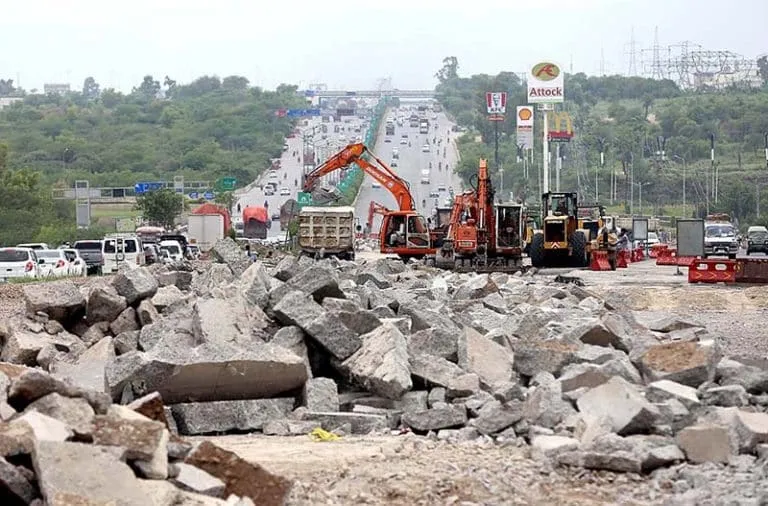
Islamabad Expressway Encroachment Operation Demolishes 124 Structures
The Capital Development Authority has demolished 124 structures and sealed 58 buildings along Islamabad Expressway as part of an enforcement operation targeting illegal constructions and encroachments. This decisive action by municipal authorities aims to clear the right of way for an ongoing, large-scale infrastructure upgrade designed to transform transit corridors in the region. As heavy commercial machinery moves into the sector, urban planners and civic administrators are pressing forward with long-delayed transportation overhauls intended to alleviate chronic urban gridlock.
The action was carried out between Sohan and Khanna Bridge along the Expressway Service Road (East), where a major road expansion project is also underway. Municipal enforcement teams, backed by heavy equipment and security personnel, descended on the targeted commercial and residential plots to dismantle unauthorized concrete additions, boundary walls, and temporary extensions that had encroached upon public land for years. This zone represents a critical bottleneck for daily commuters travelling between satellite towns and the central business district, making the clearance operation a necessary precursor to civil engineering works.
Progress Report on the 9.3-Kilometre Expansion Project
More than 28 percent of the 9.3-kilometre project stretching from Faizabad to Gulberg has been completed. Engineering crews have maintained steady momentum despite logistical hurdles and the complex nature of working within a heavily congested urban corridor. The overarching objective of this infrastructure initiative is to modernize the aging transport artery, bringing its capacity in line with the surging volume of private and commercial vehicles registered in the metropolitan area over the past decade.
The project involves developing a dual carriageway with three lanes on each side to improve traffic movement and provide better access to nearby residential areas. By widening the existing lanes and adding dedicated service roads, municipal planners expect to separate high-speed through traffic from local commuter traffic entering and exiting adjacent housing societies. This segregation of vehicular streams is a standard civil engineering practice intended to minimize friction points and reduce the frequency of collisions along high-speed corridors.
Current Construction Activities Along the Expressway
Construction work is continuing on several sections, including excavation, road foundations, bridges and drainage facilities. All 153 piles for a major underpass have also been completed. Specialized contractors are working around the clock to lay down robust sub-bases capable of withstanding heavy freight traffic without developing premature ruts or structural failures.
Drainage installation forms a crucial component of the current phase to prevent monsoon waterlogging, which has historically caused severe damage to asphalt surfaces and halted traffic for hours. The completed underpass piles will soon support concrete deck slabs, creating a grade-separated intersection that eliminates waiting times at surface-level traffic signals. Engineers are monitoring the structural integrity of every poured foundation to ensure compliance with national highway standards.
Rationale Behind the Capital Development Authority Enforcement Drive
CDA said the enforcement drive was targeting unauthorised commercial activities, illegal constructions, encroachments and violations of building regulations. Over the years, numerous property owners expanded their commercial premises beyond legal land titles, annexing state-owned setbacks and right-of-way zones for parking, storage, and retail displays. These unauthorized land uses contributed significantly to the daily traffic slowdowns by choking service roads and forcing delivery trucks to park on active lanes.
Municipal laws prohibit any permanent or semi-permanent construction within designated highway margins to preserve space for future utility corridors and expansion projects. By removing these illegal structures, the civic agency reclaims valuable public property and restores order to urban zoning regulations that had been widely flouted by commercial operators seeking higher visibility and customer foot traffic.
Expected Benefits for Commuters and Motorists
The authority expects the completed project to reduce traffic congestion, commuting time and fuel consumption for motorists using the Expressway. Thousands of residents who travel daily from outlying residential districts to offices, educational institutions, and commercial hubs in the capital will experience smoother journeys once the full six-lane dual carriageway becomes operational.
Shorter travel times translate directly into lower fuel expenditures for private car owners and commercial transport operators alike, easing the financial burden of daily commuting amid rising energy costs. Furthermore, the reduction in vehicle idling time at congested intersections will contribute to lower vehicular emissions, improving overall air quality along the busy transport corridor.