CERN Researchers Observe Rare Particle Decay Process
Scientists working at CERN have reported evidence of an extremely rare particle decay process after more than four decades of research. This discovery potentially offers another way to test the foundations of modern physics and understand the fundamental laws governing the universe.
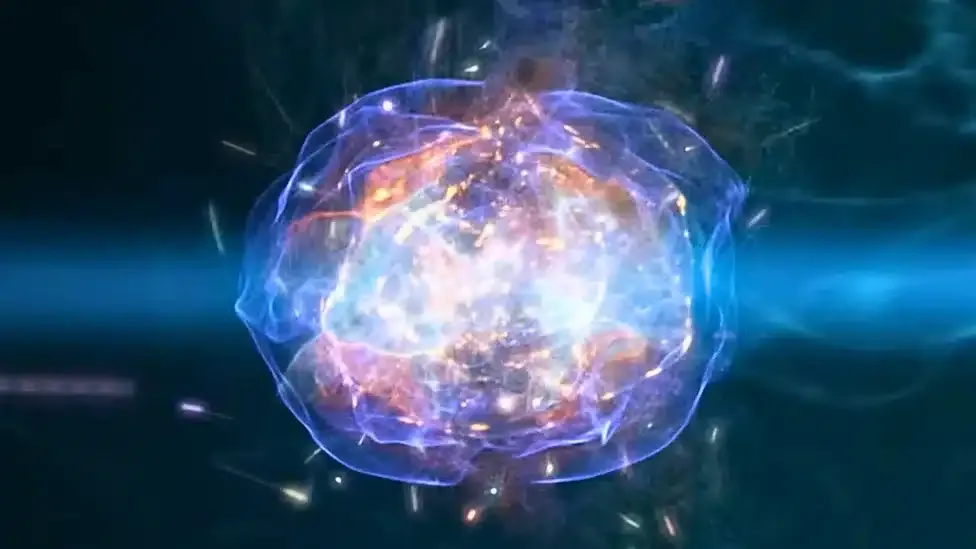
The observation was made through the Large Hadron Collider's LHCb experiment. It involves a specific particle known as a B-d meson decaying into two particles, which are a muon and an antimuon.
Understanding the Rare B-d Meson Decay Process
The process observed by the research team is exceptionally uncommon. According to physics measurements, this specific transformation occurs approximately once in every 10 billion relevant particle decays.
To capture this elusive event, researchers combined data collected during 2024 and 2025 with measurements from earlier experiments conducted between 2011 and 2018. Combining these extensive datasets allowed the team to identify the weak signal hidden within massive amounts of collision data.
The findings reached a statistical significance of 3.2 sigma. While this represents strong evidence of the decay process, it falls short of the five-sigma standard generally required for a confirmed discovery in particle physics. The result is therefore not yet considered a definitive discovery.
Testing the Standard Model of Particle Physics
Scientists are intensely interested in this process because rare particle decays help test the Standard Model. This established framework describes the fundamental particles and forces governing the universe, from electromagnetism to the strong and weak nuclear forces.
The Standard Model has successfully predicted numerous phenomena over the decades. However, physicists know it is incomplete because it does not account for gravity or dark matter.
Any significant deviation from its predictions could point toward previously unknown particles or hidden interactions. Researchers use precision measurements of rare decays to look for cracks in the current theoretical structure.
The Role of the Large Hadron Collider and LHCb
The Large Hadron Collider is the world's largest and highest-energy particle accelerator, built by the European Organization for Nuclear Research. Situated in a tunnel beneath the French-Swiss border, it smashes protons together at nearly the speed of light.
The LHCb experiment is one of the major particle detector experiments at the collider. It focuses on the asymmetry between matter and antimatter by studying particles containing bottom quarks, known as beauty quarks.
Detecting rare decays requires massive amounts of collision data and highly sensitive equipment. The upgraded LHCb detector is expected to collect more data in the near future and let researchers investigate this phenomenon further.
Future Outlook for Particle Physics Research
The pursuit of rare decays remains a primary objective for experimental physicists around the world. As detectors improve and data collection continues, researchers hope to push the statistical significance of their findings past the rigorous five-sigma threshold.
Reaching that milestone would confirm the existence of the decay process beyond standard statistical doubt. Until then, the scientific community will continue analyzing the combined datasets and preparing for upcoming data runs at the particle accelerator.





