China Completes First Piloted Flight of CE-25A Electric Passenger Plane
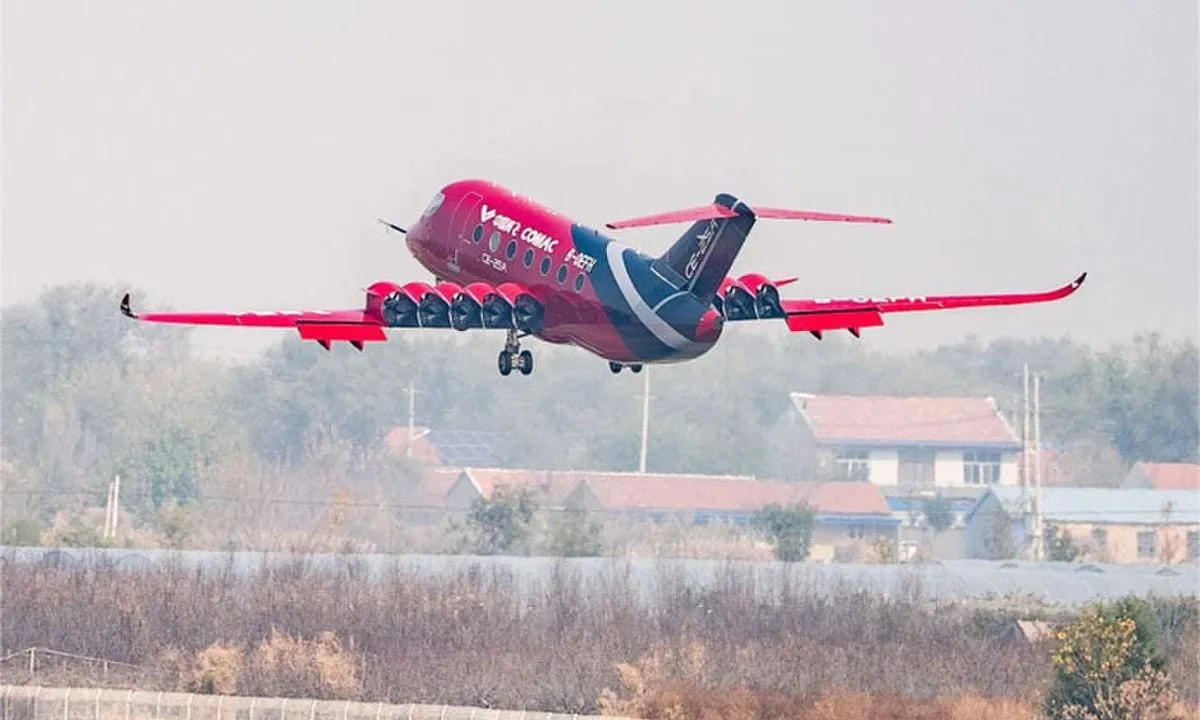
The CE-25A, a 10-ton electric commercial aircraft developed by China, completed its maiden piloted flight on Saturday in Binzhou, in the eastern Chinese province of Shandong, the Commercial Aircraft Corporation of China announced.
According to media reports, two pilots and one flight-test engineer were on board. The Commercial Aircraft Corporation of China said the aircraft operated normally and all performance indicators met expectations.
Technical Specifications of the CE-25A Electric Aircraft
The CE-25A is the first electric commercial aircraft of the Commercial Aircraft Corporation of China and is designed mainly for intercity flights. It seats 19 passengers and has a maximum takeoff weight of 10 metric tons. Its cruising speed is 300 km per hour, its cruising altitude is 2,400 metres, and its range is 400 km.
The aircraft uses a distributed electric propulsion system instead of conventional turbofan or turboprop engines. The system consists of 10 electric ducted fans mounted along the top of the wings, a layout intended to reduce noise and allow takeoffs and landings on shorter runways.
Partnerships and Development History
The Commercial Aircraft Corporation of China developed the aircraft jointly with Chinese battery maker CATL, Shanghai Jiao Tong University and other partners. It completed its first unmanned autonomous flight on Feb 2 this year and has since completed 19 unmanned autonomous flight validations.
Electric aviation has become a primary focus for research institutions and aerospace manufacturers worldwide seeking to reduce carbon emissions from regional transit. Traditional jet fuel accounts for a significant portion of airline operational costs and environmental impact, prompting engineering teams to explore battery-powered alternatives for shorter routes.
The collaboration between aerospace designers and battery specialists highlights the cross-industry cooperation required to advance heavy-duty energy storage systems. Aviation batteries must meet stringent safety, weight, and energy density criteria that differ substantially from automotive requirements, necessitating dedicated research programs at institutions like Shanghai Jiao Tong University.
Regulatory Process and Certification
The Civil Aviation Administration of China has formally accepted the Commercial Aircraft Corporation of China type certificate application under transport-category regulations. This begins the inspection process required before commercial passenger service can start.
A type certificate is an official design approval issued by a civil aviation authority once an aircraft model has demonstrated compliance with applicable airworthiness standards. The rigorous regulatory review involves examining engineering drawings, conducting ground tests, and overseeing flight test campaigns to verify safety under various operational conditions.
Transport-category regulations apply to larger aircraft intended for fare-paying passengers, ensuring that the electric propulsion system and battery arrays meet the same rigorous safety margins applied to conventional jetliners.
Impact on Intercity Travel and Regional Aviation
Regional aviation networks stand to experience substantial changes if electric aircraft successfully transition from flight testing to commercial operations. Intercity routes spanning up to 400 km often connect smaller regional hubs where traditional jet operations are economically unviable or excessively noisy for nearby communities.
By using a distributed electric propulsion system with 10 electric ducted fans, the CE-25A aims to operate quietly and access shorter runways. This capability allows regional airports closer to city centres to handle passenger traffic, potentially reducing total travel times for commuters.
Passengers traveling between nearby cities could benefit from lower ticket prices due to reduced energy and maintenance costs associated with electric motors compared to complex combustion engines. Local economies linked by short-haul routes may see improved connectivity as operators test environmentally friendly transit options.
Next Steps for the Commercial Aircraft Corporation of China
Following the successful maiden piloted flight in Binzhou, the development program will continue through the multi-stage certification process overseen by the Civil Aviation Administration of China. Engineers will analyze data gathered during the flight-test campaign to refine performance parameters.
Observers of the aerospace sector should monitor further flight tests, ground endurance evaluations, and updates regarding the type certification timeline. The transition from unmanned autonomous validations to crewed test flights represents a critical milestone in establishing the airworthiness of new propulsion technologies.