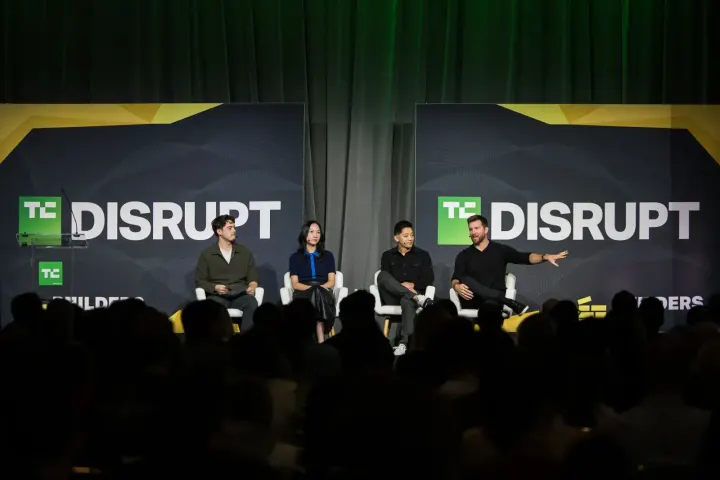
Startups face intense pressure to scale quickly, often needing to secure large enterprises as customers. Arsalan Tavakoli-Shiraji, co-founder and senior vice president of field engineering at Databricks, says younger firms mistakenly rely on technology alone to win such contracts.
He notes that while the product must function well, that alone does not close deals. Databricks, now valued at $190 billion and serving over 70% of the Fortune 500, began as a modest startup, and Tavakoli-Shiraji helped land its first major agreements.
"Everybody when they're selling to enterprises at startups ... we think it's all about the tech and having the best tech," he told attendees at TechCrunch Disrupt last week. He added that he learned "people and processes matter the most."
Recalling an early meeting with a prospect who had just signed a massive contract with a rival, he said, "He has no interest in listening to me because he bet his career on that competitor." He also cited early deals that fell apart because the startup could not answer legal, contractual, or security queries, prompting him to share his top tips for winning large customers.
Sell under a bigger tech company's umbrella
Databricks initially failed to secure a meeting with Swiss bank UBS. It then formed a partnership with Microsoft, becoming an Azure cloud partner, which allowed sales agreements to fall under Microsoft's terms.
This alliance meant Microsoft's sales team booked meetings and advocated for Databricks. "All of a sudden, that meeting that wasn't hard to get," the founder recalled, "was a huge boon to us that we were able to partner with somebody who had that access and distribution."
With Microsoft's support, "we started getting pulled everywhere," he said, noting that new challenges emerged, such as prospects requesting features for regions Databricks had not yet entered, good problems to have.
Today Databricks sells other startups' products under its own terms and security framework, citing examples like Hightouch, Addepar, and Tecton, the latter later acquired by Databricks.
When selling AI, address the "four C's"
Tavakoli-Shiraji groups enterprise concerns into four categories: context, choice, cost and control. Context refers to AI that can be trained like a new employee, learning a company's language, processes and priorities.
Choice means giving customers the ability to switch AI models rather than being locked in. Cost focuses on managing the expense of running AI, while control covers safeguards that govern AI behavior and protect sensitive data.
Attack the expensive legacy systems enterprises think they're stuck with
He jokes that CIOs rate their AI maturity on a scale of one to five, where one means only ChatGPT access and five indicates AI-driven business-process change. "And everybody loves picking, 'I'm three leaning towards four.' But 99% of the ones I talk to are in bucket one and two."
Enterprises still struggle to deploy AI agents beyond simple code-writing assistance, and he predicts it will take many years before AI is meaningfully embedded in enterprise operations.
One major opening for startups is modernizing costly legacy systems. "If you go to any bank today, they still have [an IBM] AS/400 and mainframes," he said. "Nobody wanted to touch it because nobody knew what that code did."
AI agents can now analyze and decompose that code, opening possibilities for new interfaces or complete replacement of antiquated systems.
He also offered a future outlook on enterprise AI adoption and recounted an anecdote about posing as a lawyer to secure a large contract when Databricks was young. See the full interview below.