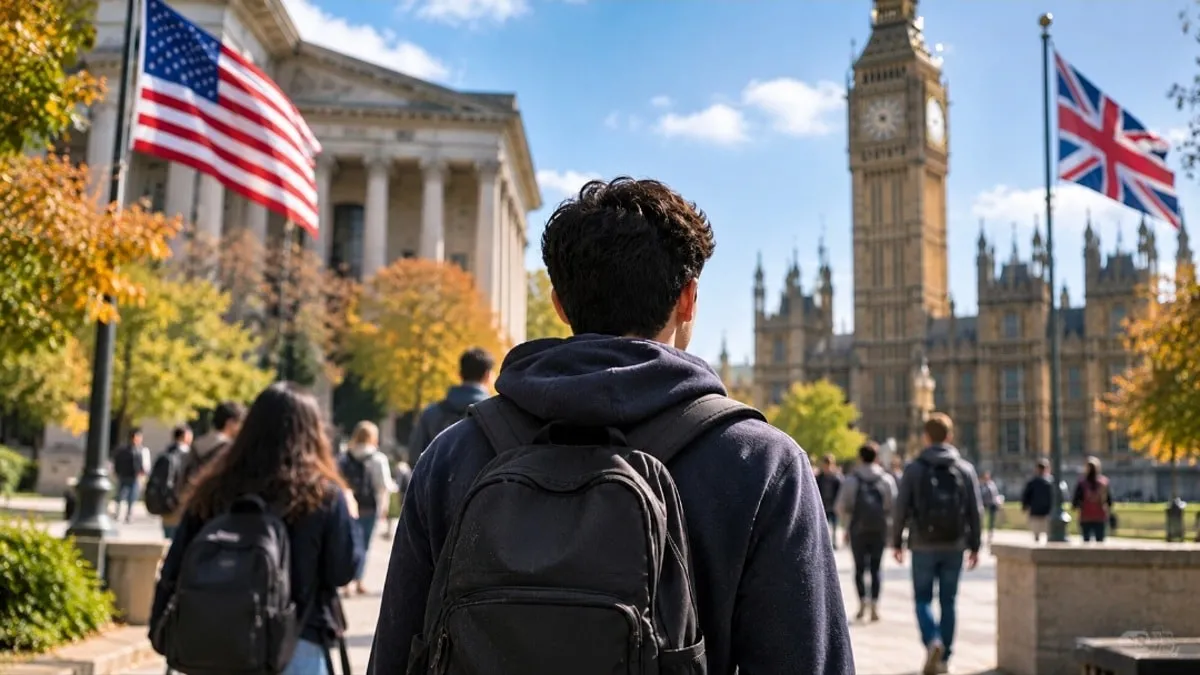
International students are increasingly choosing universities in Asia and continental Europe instead of institutions in the United States and Britain as tighter visa and immigration policies reshape global higher education, a new survey shows.
Studyportals, NAFSA and Oxford Test of English surveyed 437 universities across 63 countries. The survey found that international undergraduate enrolments in Britain and the US fell 19% and 13%, respectively, between October and August compared with the same period a year earlier.
Canada and Australia also saw weaker demand, while universities across Asia and Europe attracted more international students.
The survey identified visa restrictions and government policies as the biggest obstacles to international student enrolment. Processing delays, tougher screening and changes to post-study work options have prompted students to postpone or abandon their study plans.
The findings come as US President Donald Trump tightens immigration measures, including expanded social media checks and visa revocations. Britain has also restricted most international students from bringing dependants and plans to shorten the period graduates can remain in the country to seek employment.
NAFSA Chief Executive Fanta Aw said national policies influence international students' decisions about where to study, conduct research and begin their careers.
What the Survey Reveals About Shifting Student Flows
The combined data set covers 437 institutions in 63 nations, representing a cross-section of public and private higher-education providers. By comparing enrolment figures for the October-August window in 2020-21 with the same window in 2021-22, the researchers calculated a 13% drop in US undergraduate international enrolments and a 19% drop in British enrolments.
In contrast, universities in countries such as Germany, the Netherlands, Singapore, and Malaysia reported growth ranging from 5% to 22% in the same period. The survey did not break down the exact numbers by country, but the overall trend points to a rebalancing of student destinations.
Why Visa Policies Matter to Students
Visa and immigration rules affect three stages of a student's journey: entry, stay and post-study work. In the United States, the administration introduced more stringent background checks that include social-media reviews and a higher rate of visa revocation for non-compliance. Processing times for F-1 visas lengthened from an average of 14 days to over 30 days, according to data from the Department of State.
In Britain, the removal of the dependant visa route for most international students means families cannot accompany them, raising living-cost concerns. The post-study work visa, previously allowing graduates to remain for up to two years, is set to be reduced to 12 months, cutting the window for gaining UK work experience.
These policy shifts increase uncertainty and cost, prompting students to seek alternatives where entry is smoother and post-study opportunities are clearer.
Historical Context: How the US and UK Became Student Magnets
For decades the United States and United Kingdom attracted the largest shares of global student mobility. In 2010, the US hosted roughly 1 million international undergraduates, while the UK enrolled about 500 000. Their appeal rested on world-ranked universities, English-language instruction, and robust post-study work schemes.
However, the past five years have seen incremental policy tightening. The US introduced the SEVIS fee increase and the 2017 travel ban affecting several Muslim-majority countries. Britain introduced a points-based immigration system in 2021 that placed higher thresholds on earnings and sponsorship.
These changes, combined with the COVID-19 pandemic's disruption of travel, set the stage for the current decline.
Impact on Universities and Host Countries
International tuition fees are a major revenue stream. In the US, foreign undergraduates contribute an estimated US$30 billion annually, while in the UK the figure is around £14 billion. A 13% drop in US enrolments could translate to a loss of roughly US$3.9 billion in tuition revenue for the period surveyed. British institutions may see a shortfall of about £2.7 billion.
Beyond finances, campuses lose cultural diversity, research collaborations, and future alumni networks. Departments that rely heavily on international students, such as engineering, business, and computer science, face the risk of reduced class sizes and potential program cuts.
Conversely, Asian and European universities stand to gain both financially and academically. Increased enrolments can justify expansion of facilities, attract more research funding, and enhance global rankings.
What Policymakers Are Saying
NAFSA Chief Executive Fanta Aw emphasized that "national policies influence international students' decisions about where to study, conduct research and begin their careers." She called for a coordinated approach that balances security concerns with the economic and educational benefits of a vibrant international student community.
In Washington, officials have defended the tighter checks as necessary for national security, while noting that the administration remains open to "targeted reforms" that could streamline processing for high-value students.
In London, the Department for Education has indicated that the dependant restriction will be reviewed after a six-month trial period, and that the shortened post-study work window is part of a broader effort to prioritize domestic graduates.
What Students Can Do Now
Prospective students are advised to start visa applications early, keep documentation up to date, and consider backup destinations. Many universities in Asia and Europe now offer dedicated international student support offices that assist with visa guidance, housing, and language services.
Students should also monitor changes to post-study work schemes, as these affect long-term career planning. For example, Germany's "Blue Card" system allows graduates to stay for up to 18 months to seek employment, a feature that many applicants find attractive.
What to Watch in the Coming Months
The next enrolment cycle begins in September 2022. Analysts will watch whether the decline deepens or stabilises as institutions adjust recruitment strategies. Policy reviews in both the US and UK are scheduled for early 2023, and any amendment to visa rules could shift the trend.
Stakeholders, including university leaders, government officials, and student organisations, are expected to submit recommendations during upcoming consultations. The outcomes of those consultations will shape the competitive landscape for international education for years to come.