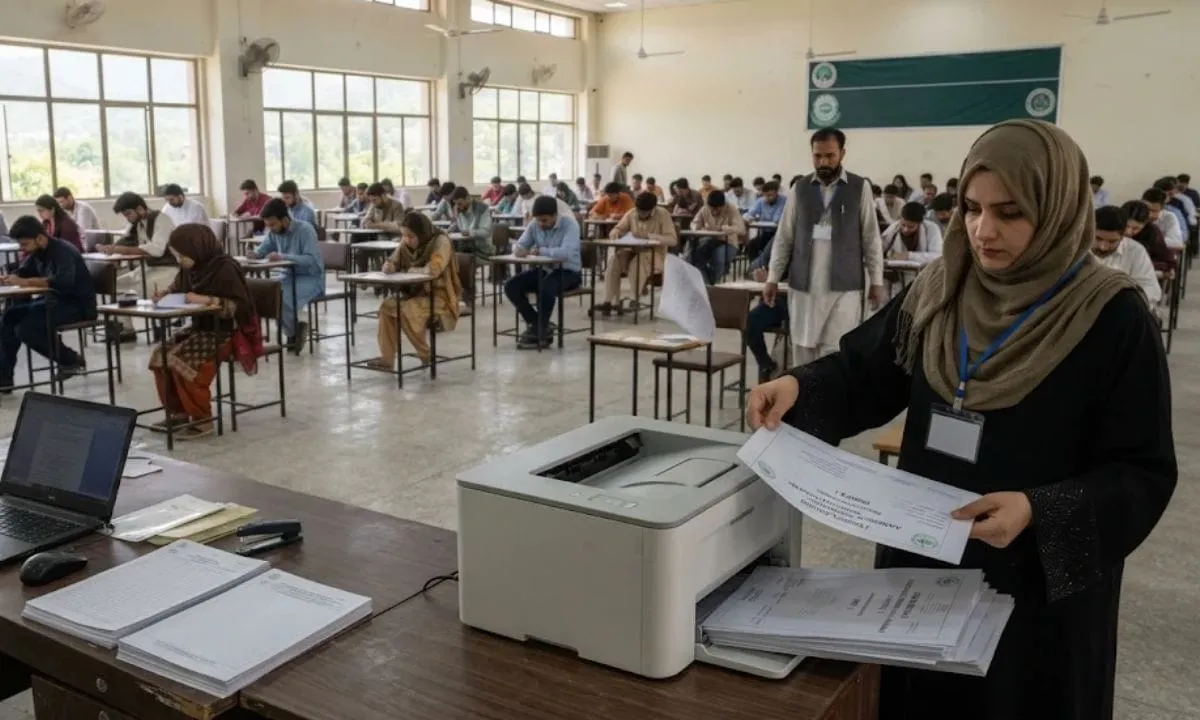
Islamabad - The Federal Board of Intermediate and Secondary Education (FBISE) has begun printing question papers directly at 35 examination centres, a move designed to stop paper leaks and lower transportation and bank-storage expenses.
The board, which conducts the second annual examinations for secondary and intermediate students across Pakistan, will expand the on-the-spot printing system to all 1,000 centres within the next year.
How the New Printing System Works
Under the new procedure, question papers are uploaded to a secure online portal fifteen minutes before the start of each exam. Only two officials - the centre superintendent and the head of the school - can log in, each using a distinct password. They then print the required number of copies on the school's own printers.
FBISE Chairman Dr Ikram Ali Malik told reporters that the board will reimburse schools for each paper printed, ensuring that the cost burden does not fall on the institutions.
Why On-Site Printing Is Considered a Breakthrough
Paper leaks have plagued Pakistan's public examinations for years, often leading to widespread protests and legal challenges. Traditionally, exam papers were printed at central facilities, stored in bank vaults and transported to distant centres. Each step introduced opportunities for unauthorized access.
By shifting the printing process to the examination venue, the board eliminates the need for physical transport and reduces the time papers spend in unsecured locations. The approach also cuts the board's reliance on bank storage, saving an estimated Rs. 1.6 billion annually in fees and logistics.
Feedback from the First 35 Centres
Dr Malik said the feedback from the pilot centres has been "very good." Schools reported smooth access to the digital files, reliable printing, and no incidents of paper leakage since the system's launch.
Technical issues have been minimal. The board consulted each centre about internet connectivity before the pilot began, and schools with weaker broadband were provided mobile data hotspots to guarantee a stable link during the critical fifteen-minute window.
Historical Context: From Bank Distribution to Digital Delivery
FBISE first experimented with on-site printing at its foreign centres in 2018. Those overseas locations, often spread across the United Arab Emirates, Saudi Arabia and the United Kingdom, faced higher shipping costs and stricter customs regulations, prompting the board to adopt a digital hand-off model.
Domestically, the board tried a similar system a few years ago but discontinued it due to inconsistent internet infrastructure and concerns about printer reliability in remote schools. Recent upgrades to the national broadband network and increased availability of high-speed fiber have addressed many of those earlier obstacles.
Roadmap to Full Implementation
The board's rollout plan includes three phases:
- Phase 1 (Current): On-site printing at 35 pilot centres during the ongoing second annual examinations.
- Phase 2 (Next 6 months): Expansion to an additional 300 centres, prioritising districts with strong internet coverage and existing printer fleets.
- Phase 3 (Within a year): Complete coverage of all 1,000 centres, with the board providing technical assistance and financial reimbursement for printing costs.
Schools and colleges are being consulted on internet availability at their examination centres. Where connectivity is lacking, the board will explore satellite-based solutions or dedicated leased lines.
Future Vision: Computer-Based Testing for MCQs
Beyond paper printing, FBISE is preparing to introduce computer-based testing (CBT) for the multiple-choice (MCQ) portion of examinations. The proposed format would split each paper into 50 % descriptive questions and 50 % MCQs, with the MCQ segment delivered via computers.
Dr Malik announced that the CBT system is slated for the 2027 annual examinations, initially targeting Class 9 and first-year intermediate students. The pilot will cover MCQs in Physics, Chemistry, Biology, Mathematics and Computer Science.
Key benefits outlined by the board include:
- Elimination of human involvement in checking MCQs, reducing grading errors.
- Same-day result delivery, allowing students to know their scores instantly.
- Potential for adaptive testing in the future, tailoring question difficulty to individual performance.
Dr Malik explained that a single computer laboratory shared by a cluster of four to five schools would be sufficient to conduct the tests. The board is negotiating with schools on shared-resource models and on alternative energy sources, such as solar panels and backup generators, to keep computer labs running without interruption.
Impact on Stakeholders
Students stand to benefit from a more secure examination environment and faster result turnaround. Schools will receive reimbursement for printing costs and may gain access to shared computer labs, reducing the need for individual institutions to invest heavily in hardware.
Teachers and administrative staff will experience a streamlined workflow, with fewer paper-handling steps and reduced risk of disciplinary action stemming from leaked papers.
What to Watch for Next
In the coming months, FBISE will publish detailed guidelines on printer specifications, internet bandwidth requirements and reimbursement procedures. The board will also release a schedule for the phased expansion, indicating which districts will join the programme and when.
Stakeholders should monitor official communications for updates on the CBT pilot, including the procurement of secure testing software, data-privacy safeguards and the timeline for full-scale implementation.
For schools considering participation, the board recommends conducting a readiness audit that covers network stability, printer maintenance contracts and power-backup capacity. Early compliance will smooth the transition and ensure that students across Pakistan experience a uniform, leak-free examination process.
Overall, FBISE's dual strategy of on-site paper printing and future computer-based testing marks a significant shift toward digitisation in Pakistan's public education assessment system, promising greater integrity, cost efficiency and speed.