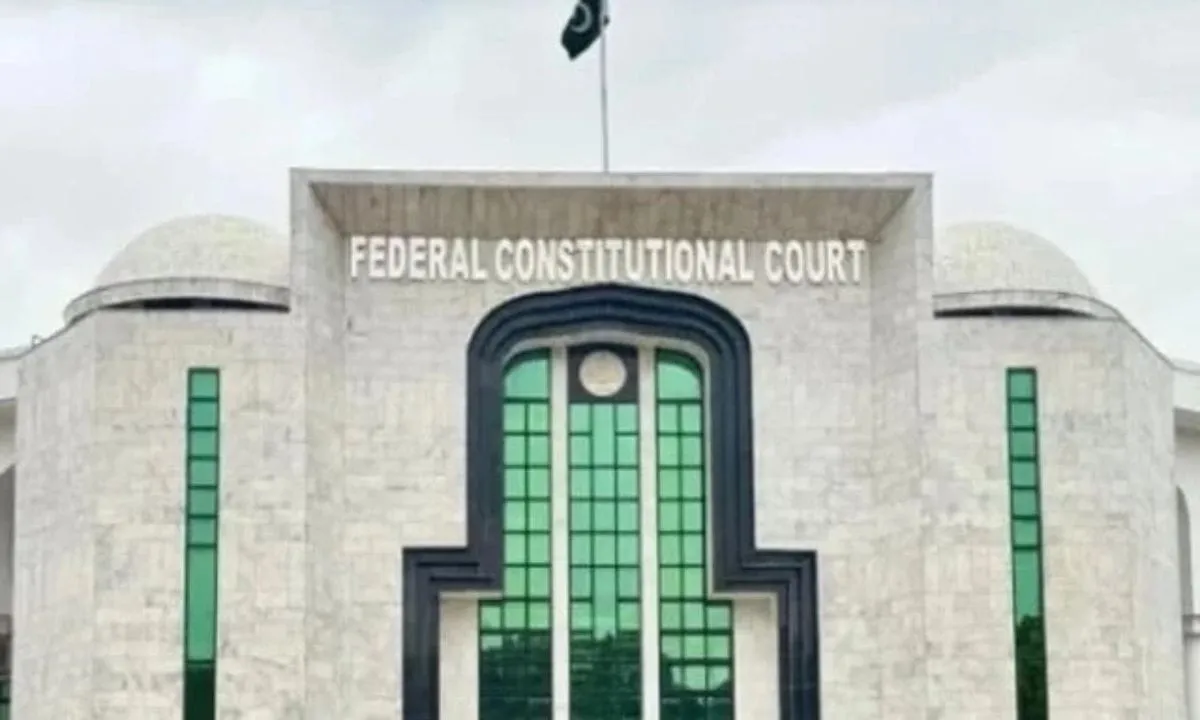
The Federal Constitutional Court (FCC) on Monday reserved its decision on a set of petitions seeking a review of its Jan 27 judgement that upheld the legality of the Super Tax. A three-judge bench headed by Chief Justice Aminuddin Khan, and comprising Justice Syed Hasan Azhar Rizvi and Justice Syed Arshad Hussain Shah, heard the petitions during a day-long hearing.
What the Jan 27 Ruling Stated
In its Jan 27 ruling, the court held that the legislature was fully competent to impose, abolish, remit, alter or regulate the tax through a Finance Act as part of a Money Bill under Article 73(2)(a) of the Constitution. The court also said that Sections 4B and 4C of the Income Tax Ordinance (ITO), 2001, would apply from the dates on which they were levied.
Who Filed the Review Petitions
Review petitions were filed by several companies, including Fauji Fertiliser Company Ltd, Fauji Fertiliser Bin Qasim (Pvt) Ltd, Thar Power Company Ltd, Colgate-Palmolive Pakistan Limited, The Searle Company Limited, JS Bank Ltd, Total Parco Pakistan Limited, Gas & Oil Pakistan Ltd, Arif Habib Corporation Limited, Pakistan Refinery Limited and Engro Corporation Ltd. The Defence Housing Authority, Lahore, was also among the petitioners.
Legal Teams Presented Arguments
Senior counsel Dr Farogh Nasim, Khalid Javed Khan, Sardar Ahmed Jamal Sukhera, Rashid Anwar and Imtiaz Ali Siddiqui presented arguments on Monday. Their submissions focused on the alleged unconstitutionality of the retrospective application of Section 4C and the broader fiscal impact of the Super Tax on large taxpayers.
Background of the Super Tax
The government introduced the Super Tax in 2015. It applies to individuals, associations of persons and companies with income above Rs500 million. The rate is 4 per cent for banking companies and 3 per cent for other sectors. The stated purpose was to fund the rehabilitation of temporarily displaced persons.
Key Arguments from Petitioners
Sardar Ahmed Jamal Sukhera, counsel for Fauji Fertiliser, told media that the bench reserved its ruling after the hearing. He asked the court to strike down Section 4C of the ITO as unconstitutional, arguing that the Jan 27 judgement gave no reasons for upholding it.
In the alternative, he requested a declaration that Section 4C does not apply to tax year 2022 or to income subject to final tax, and that brought-forward losses, depreciation and amortisation be excluded.
Sukhera said the Finance Act, 2022, took effect on July 2, 2022, and imposed a charge on income earned in a tax year that had already closed. He noted that taxpayers had by then closed their accounts, held annual general meetings and distributed dividends under the law then in force. He argued that a liability that could not have been foreseen was arbitrary and unreasonable.
He also pointed out that the levy was meant to raise about Rs215 billion, while losses of state-owned enterprises amount to Rs650bn a year and electricity theft causes annual losses of about Rs600bn. He added that continued federal spending on devolved subjects stands at about Rs328bn, and borrowing from a single treasury account beyond limits set by the Fiscal Responsibility and Debt Limitation Act, 2005, amounts to Rs404bn.
Constitutional Grounds Cited
The review petition states that the FCC overlooked the constitutional bar on retrospective imposition of a fresh tax charge under Articles 10A, 18, 23 and 24. It further argues that denying the carry-forward of losses, depreciation and amortisation amounts to taxing expenses or losses, which Entry 47 does not permit, as it allows the federation to tax income only.
Implications for Tax Policy and the Economy
If the FCC were to overturn or modify the Jan 27 ruling, the immediate effect would be a change in the tax liability of firms whose annual accounts were already closed for the 2022 fiscal year. Companies would potentially receive relief on the 3-4 per cent charge, and could restore the ability to offset prior losses against future profits.
Beyond individual firms, a shift in the legal interpretation of Article 73(2)(a) could set a precedent for future finance legislation, influencing how Parliament drafts Money Bills that affect taxation. A stricter view on retrospective taxes might limit the government's fiscal flexibility, especially in times of budgetary shortfall.
What Comes Next
The FCC has reserved its decision, meaning the bench will issue a written judgment at a later date. No timeline has been announced, but historically the court releases its written orders within a few weeks to a couple of months after reserving judgment. Stakeholders are advised to monitor official FCC releases and any subsequent orders from the Ministry of Finance.
In the meantime, the Finance Ministry has reiterated that the Super Tax remains in force and that all taxpayers must comply with the existing provisions until a court order says otherwise.
Practical Takeaways for Taxpayers
- Companies with taxable income above Rs500 million should continue to calculate the Super Tax at 3 per cent (or 4 per cent for banks) for the current fiscal year.
- Firms that have already closed their 2022 accounts should retain documentation of the timing of dividend distributions and AGM resolutions, as these may be relevant if the FCC later rules the retrospective charge invalid.
- Tax advisors are urged to review the language of Sections 4B and 4C of the ITO, 2001, to ensure compliance while preparing for any possible judicial clarification.
Overall, the pending FCC decision represents a critical juncture in Pakistan's tax jurisprudence, balancing constitutional safeguards against the government's revenue-raising objectives.