What the New Proposal Entails
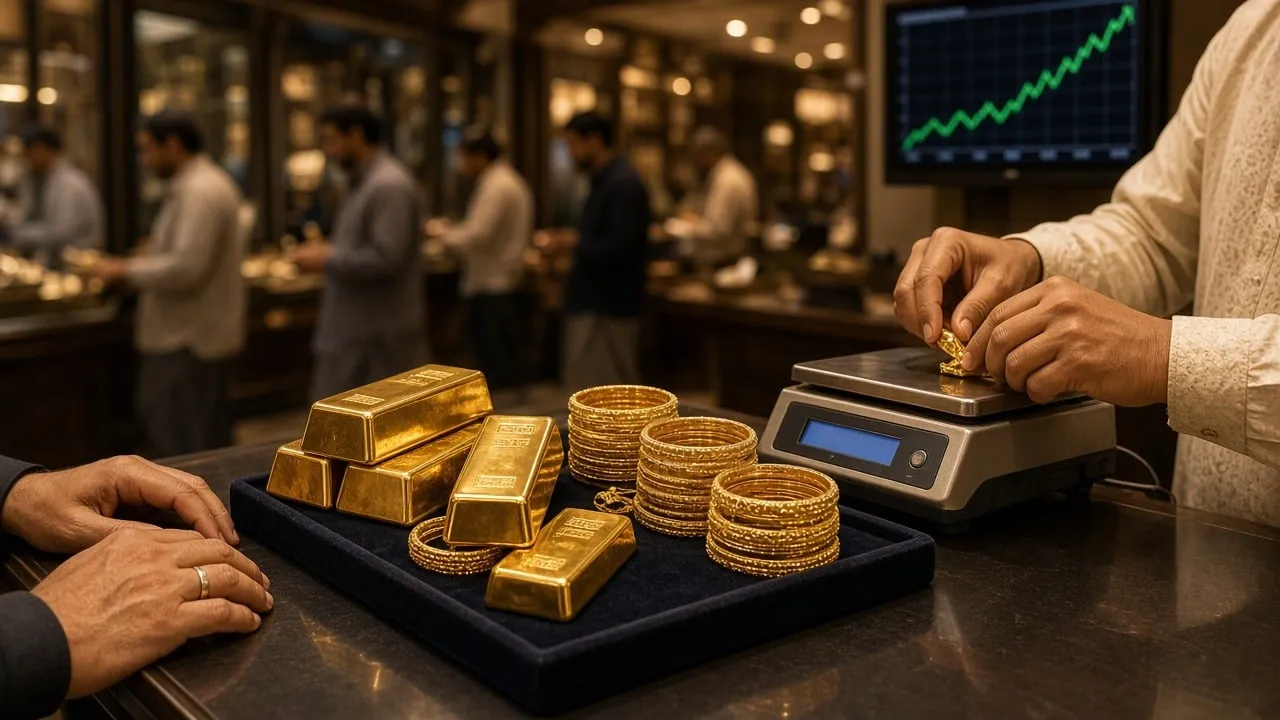
The Ministry of Commerce has drafted amendments to SRO 760(I)/2013 that would set fixed dollar values for value addition on exported jewellery. Under the draft, exporters would add $1.50 per gram to bangles and chains, $2 per gram to other plain jewellery, and $4 per gram to studded or embedded pieces. These figures would replace the existing percentage-based requirements of 8 percent, 12 percent and 13 percent respectively.
Why the Government Wants to Change the Rules
According to official documents, the Ministry of Commerce has submitted the revised framework to the Economic Coordination Committee (ECC) of the Cabinet for consideration and approval. The proposal follows consultations involving government departments, industry representatives, and parliamentary stakeholders.
The ministry said the existing system, which links minimum value addition to international gold prices, has become increasingly difficult for exporters to meet because of fluctuations in global gold prices and the dollar-to-rupee exchange rate. It added that the percentage-based mechanism has become misaligned with regional and international practices, increasing the compliance burden on exporters.
Imports and exports of precious metals and jewellery are regulated under SRO 760(I)/2013, dated September 2 2013. The regulation provides for Entrustment and Self Consignment Schemes designed to facilitate export-oriented jewellery manufacturing.
How the Regulatory Review Began
The issue was raised by the National Assembly Standing Committee on Commerce after private-sector stakeholders complained about rising compliance costs. On April 30 2025, the Ministry of Commerce submitted a summary to the Federal Cabinet highlighting exchange-rate volatility, foreign-exchange implications, limited value addition under existing schemes, and fragmented data maintained by different government agencies.
The government subsequently approved a 60-day suspension of SRO 760(I)/2013 and established a committee chaired by the Secretary of Commerce to review the regulatory framework, identify loopholes, and recommend a more effective mechanism.
After several meetings and an examination of relevant data, the committee found no discrepancies and recommended restoring the SRO. It also proposed automating procedures through integration with the Pakistan Single Window (PSW) and introducing amendments to streamline the regulatory framework.
The recommendations were endorsed by the Prime Minister's Office and referred to the ECC, which approved them following the submission of a summary dated October 16 2025. However, the value-addition requirements remained under review after further intervention by the National Assembly Standing Committee on Commerce.
Industry Stakeholders Disagree Over Proposed Rates
In a meeting on February 4 2026, the parliamentary committee directed the Ministry of Commerce to convene a joint meeting of stakeholders and examine the value-addition mechanism under SRO 760(I)/2013 against regional practices, including comparisons with competing countries.
During subsequent consultations, industry representatives argued that percentage-based requirements no longer reflected regional and international practices. They proposed replacing the existing system with fixed dollar amounts per gram.
However, the Minister for Industries and Production supported retaining the percentage-based mechanism, highlighting differences among stakeholders over the proposed regulatory changes.
At its September 3 2026 meeting, the National Assembly Standing Committee on Commerce recommended that the Ministry of Commerce forward the agreed proposals concerning SRO 760(I)/2013 to the Cabinet for approval while addressing the remaining outstanding issues.
The Ministry of Commerce has now submitted the revised value-addition rates to the ECC, seeking approval to incorporate the proposed changes into SRO 760(I)/2013.
Background: Jewellery Export Regulation in Pakistan
Pakistan's jewellery export sector has grown steadily over the past decade, contributing roughly 2 percent of total export earnings. The sector relies heavily on imported gold and silver, which are subject to foreign-exchange controls. SRO 760(I)/2013 was introduced to ensure that exported pieces add a minimum domestic value, preventing pure re-export of raw precious metals.
Historically, the value-addition requirement was expressed as a percentage of the prevailing international gold price. When gold prices surged in 2022, exporters reported margin compression because the required domestic value rose faster than their ability to price finished jewellery competitively in overseas markets.
Internationally, many countries use fixed per-gram or per-piece value-addition criteria, which provide predictability for manufacturers and customs authorities. The shift proposed by Pakistan mirrors practices in Bangladesh, Sri Lanka and parts of the Middle East, where fixed dollar rates are standard.
How the Fixed Dollar Mechanism Works
Under the draft amendment, the calculation is straightforward: for each gram of gold in a bangle or chain, the exporter must demonstrate an additional $1.50 of value creation, documented through invoices, labour records, or design costs. The same logic applies to plain jewellery ($2 per gram) and studded or embedded pieces ($4 per gram).
Compliance would be verified at the point of export through the Pakistan Single Window, which integrates customs, the State Bank, and the Ministry of Commerce databases. Exporters would upload supporting documents, and the system would automatically flag shipments that fall short of the prescribed dollar threshold.
This approach eliminates the need to constantly recalibrate percentages based on volatile gold prices and exchange rates, reducing administrative overhead and the risk of non-compliance penalties.
Potential Impact on Exporters and the Economy
If approved, the fixed rates could lower the effective value-addition burden for many exporters, especially those producing high-volume plain jewellery where the current 12 percent rule translates into a higher dollar amount than $2 per gram. Smaller workshops that rely on modest design work may benefit from the clarity of a fixed figure.
Conversely, manufacturers of high-end studded pieces could see a modest increase in required value addition, as $4 per gram may exceed the 13 percent benchmark when gold prices are low. The overall effect is expected to be a net reduction in compliance costs, according to a survey conducted by the Pakistan Jewellery Manufacturers Association in early 2026.
From a macroeconomic perspective, the government hopes the change will encourage higher export volumes, improve foreign-exchange earnings, and align Pakistan's regulatory environment with regional peers, potentially attracting new investment in jewellery processing clusters.
What Comes Next: Approval Process and Timeline
The ECC's review is the final step before the Cabinet can issue a formal amendment to SRO 760(I)/2013. The committee is expected to issue its decision within the next 30 days, after which the Cabinet will schedule a meeting to ratify the changes.
Once approved, the Ministry of Commerce plans a 90-day transition period during which exporters can adapt their documentation and accounting systems to the new fixed-rate model. Training workshops and guidance notes will be disseminated through the Pakistan Single Window portal.
No further extensions have been announced, and the government has not indicated any intention to revert to the percentage system.
Practical Takeaways for Exporters
- Review existing export contracts to determine how the fixed rates compare with current percentage obligations.
- Prepare detailed cost breakdowns for each gram of gold used, including design, labour and overhead, to meet the $1.50-$4 per gram thresholds.
- Register for the upcoming Pakistan Single Window training sessions to ensure smooth electronic filing.
- Monitor the ECC's decision announcements, which will be published on the Ministry of Commerce website.
Expert Opinions
Dr. Ayesha Khan, a trade economist at the Institute of Business Administration, notes that "fixed dollar rates provide certainty for both exporters and regulators. The key will be ensuring that the rates are periodically reviewed to reflect long-term gold price trends."
Mahmood Ali, president of the Pakistan Jewellery Manufacturers Association, said, "Our members welcome the move because it removes the constant need to recalculate percentages every time the gold price moves. It will help us focus on design and quality rather than paperwork."
Conclusion
The proposed shift to fixed dollar value-addition rates marks a significant regulatory overhaul for Pakistan's jewellery export sector. By decoupling compliance from volatile gold prices, the government aims to reduce costs, align with regional norms, and boost export competitiveness. The next weeks will determine whether the ECC endorses the amendment, setting the stage for a new era of streamlined jewellery export procedures.