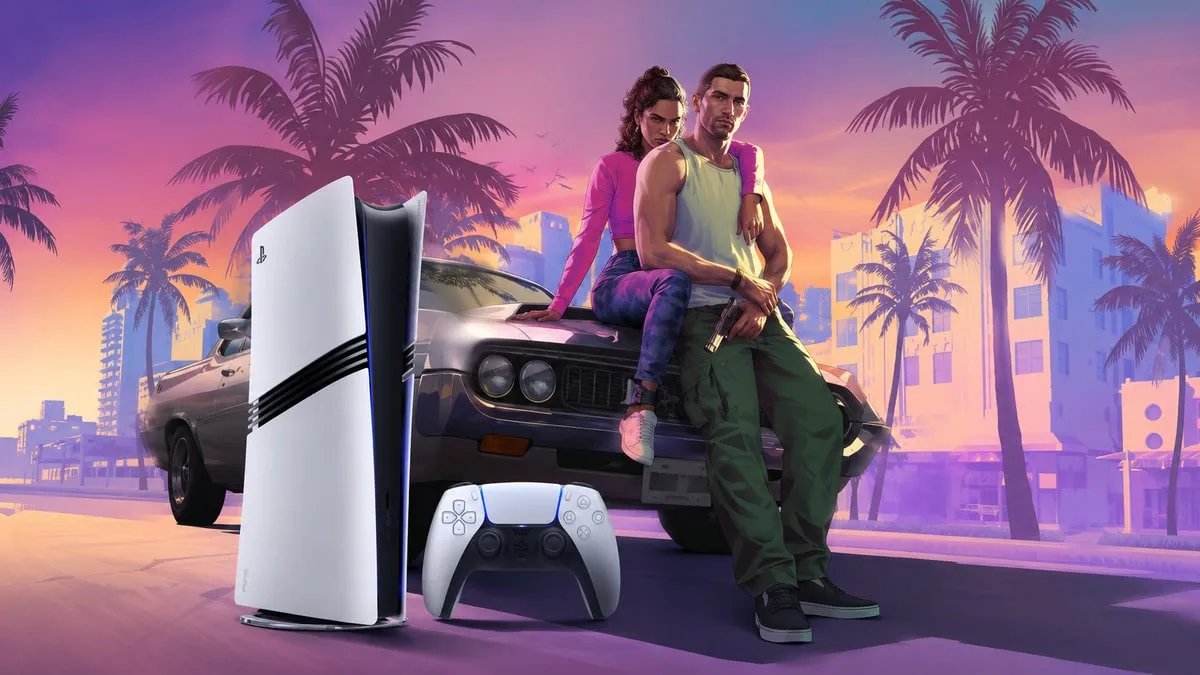
Rockstar Games has officially confirmed that Grand Theft Auto 6 will not receive a 60 FPS performance mode on current-generation gaming hardware, including the newly released PlayStation 5 Pro. The studio also dismissed the possibility of a 40 FPS alternative, closing the door on hopes that higher frame-rate choices might arrive through patches after the initial release. Speaking in an interview with Kotaku, Marc Chambers, who serves as Rockstar's technology production director, explained that the hardware bottleneck stems directly from the central processing units inside these machines rather than their graphical rendering hardware. Even though the PlayStation 5 Pro boasts a significantly upgraded graphics processing unit, its main processor lacks the required capacity to manage the title intricate open-world simulation at elevated frame rates.
This confirmation brings clarity to years of community speculation regarding how the upcoming blockbuster would perform on premium console hardware. Industry analysts and players alike had hoped that mid-generation hardware upgrades might bridge the gap between high fidelity and smooth motion. Instead, the developers have chosen to prioritize dense environmental simulation and visual complexity over raw speed, locking the title to a standard cinematic frame rate across all supported Sony and Microsoft platforms. Understanding why this technical boundary exists requires a closer look at how modern video game engines distribute workloads between different hardware components.
Why GTA 6 Is Limited to 30 FPS
According to Marc Chambers, the massive scale of the game requires immense processing power to simulate its detailed open world. This includes managing complex artificial intelligence routines, physics calculations, and the constant activity taking place throughout Vice City. While the PlayStation 5 Pro features an upgraded graphics processing unit alongside Sony proprietary PlayStation Spectral Super Resolution technology, its main processor is only slightly faster than the chip found inside the base PlayStation 5 model. Chambers stated that this minor bump in processing speed is simply not enough to run the vast simulation at double the standard frame rate. Lowering graphical settings or turning off ray tracing entirely would not solve the problem, because the processor remains the ultimate bottleneck for the software. Consequently, the software targets a strict 30 frames per second across the standard PlayStation 5, the PlayStation 5 Pro, the Xbox Series X, and the Xbox Series S.
Understanding Console Hardware Bottlenecks
To understand why a powerful machine like the PlayStation 5 Pro cannot push Grand Theft Auto 6 past 30 frames per second, players must look at how video game hardware divides labor. A console relies on two main computing components for real-time rendering. The graphics processor handles pixels, lighting effects, and geometry, while the central processor manages game logic, non-player character behavior, vehicle physics, and streaming data from the storage drive. When a virtual world is as dense and reactive as the one built by Rockstar Games, the central processor bears an enormous burden. Even if the graphics chip is capable of painting high-resolution scenes at rapid speeds, the main processor cannot feed simulation data to the engine quickly enough to maintain a faster motion rate. Upgrading the visual side of the equation yields sharper images, but it leaves the foundational processing wall untouched.
PS5 Pro Still Delivers Superior Graphics
Despite sharing the same frame-rate target as less powerful hardware, Grand Theft Auto 6 includes several distinct visual enhancements on the PlayStation 5 Pro. The base PlayStation 5 version already uses ray-traced reflections and global illumination to create realistic lighting effects across the environment. The PlayStation 5 Pro expands upon this foundation by adding ray-traced shadows and leveraging machine learning upscaling to generate a much cleaner picture. According to technical analysis published by Digital Foundry, both consoles render the title at an internal resolution of 1440p during standard gameplay sequences. However, the specialized upscaling technology enables the PlayStation 5 Pro to output an image that approaches native 4K quality, whereas the standard console produces a noticeably softer visual presentation. The extra graphical capacity is therefore dedicated entirely to fidelity rather than velocity.
Performance Consistency and Frame Pacing
Technical testing conducted by Digital Foundry revealed that the PlayStation 5 Pro maintains a remarkably steady 30 frames per second with very stable frame pacing. The standard PlayStation 5 also targets 30 frames per second, but it occasionally struggles to maintain that pace during heavy action sequences. These performance dips become apparent when the virtual environment displays multiple heavy explosions or dense particle effects for extended periods. In extreme scenarios, the standard console can see performance drop into the mid-twenty range. The PlayStation 5 Pro avoids these fluctuations, offering smoother playback alongside its sharper graphical output and advanced lighting features. Reviewers have praised the overall visual presentation of the project, labeling it a major technical achievement despite the locked frame rate.
Looking Ahead to Potential PC Releases
At this time, Rockstar Games has not officially announced a personal computer version of the title or provided a release window for such a port. If a computer adaptation eventually arrives, it could theoretically support higher frame rates when paired with high-end processors currently available on the market. For the moment, the software remains restricted to Sony and Microsoft consoles. Owners of older hardware, such as the Xbox One, can still access the experience via cloud streaming services, though operational quality depends heavily on local internet connection speeds and server loads. The latest statements from the development team make it clear that console players should not expect any future updates to unlock faster frame rates on current hardware platforms.