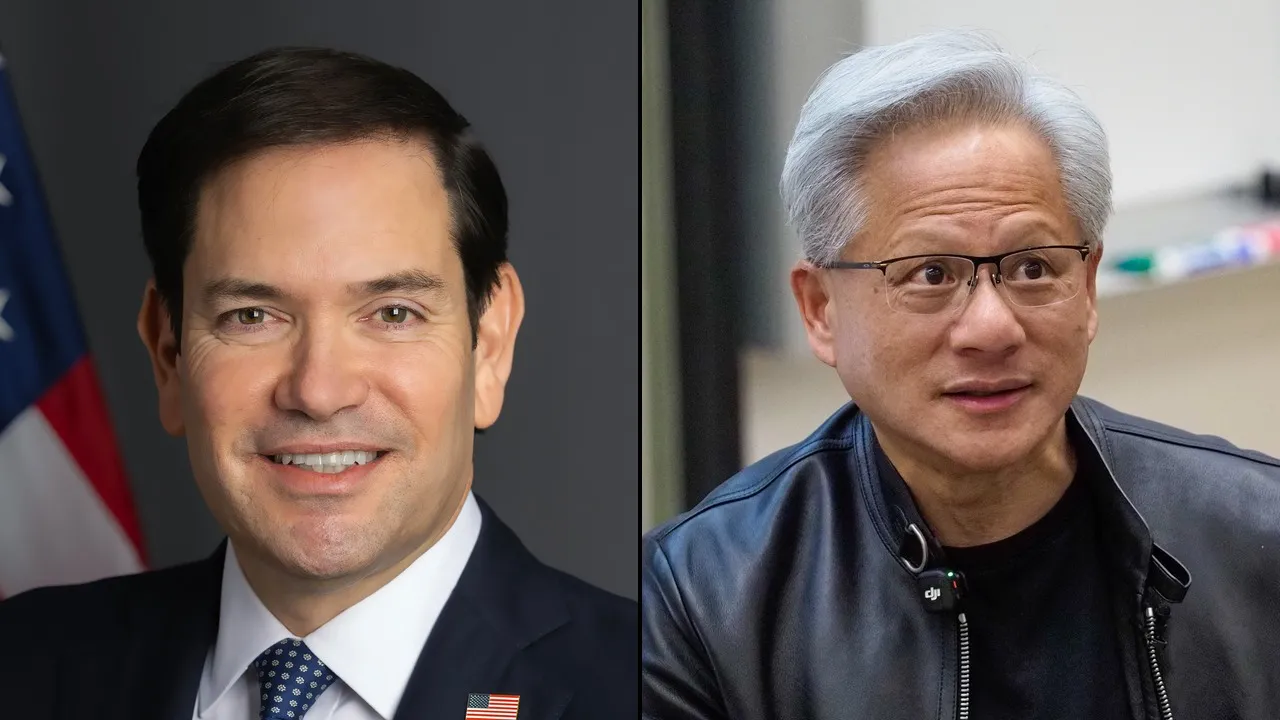
US Secretary of State Marco Rubio sent President Donald Trump a memo warning him about Nvidia CEO Jensen Huang's relationship with a woman US intelligence officials suspect of being a Chinese intelligence asset, setting off a chain of events that ended Huang's 33-year tenure at the chipmaker.
The memo, based on a CIA report, was recast by Rubio in "more assertive terms" according to a source familiar with the matter, and it later leaked to the press. The leak prompted an internal investigation at Nvidia, forced Huang to admit an affair, and culminated in his resignation on Thursday after further allegations involving a subordinate.
What the Memo Contained and How It Reached the White House
The memo referenced a classified CIA assessment that identified a woman close to Huang as a possible Chinese intelligence asset. While the assessment did not name Huang directly, it highlighted the risk that senior executives with access to advanced AI chip designs could be vulnerable to foreign influence.
Rubio's version of the assessment emphasized the "potential national-security threat" posed by Huang's personal connections, a tone that differed from the CIA's more measured language. According to the source, the memo was delivered to the Oval Office in early March 2024, weeks before the first public rumors surfaced.
How the Leak Sparked an Internal Probe at Nvidia
Within days of the memo's leak, major US media outlets reported that Huang had been involved in an undisclosed relationship with a woman under suspicion of espionage. The report forced Nvidia's board to act quickly, citing corporate-governance standards that require disclosure of any personal relationships that could affect security clearances or trade compliance.
Board chair Lisa Su, who also serves as CEO of AMD, convened an emergency meeting. The board hired an external law firm with experience in export-control investigations to review Huang's conduct and assess whether any proprietary technology had been compromised.
During the investigation, Huang publicly acknowledged an affair but denied any wrongdoing related to trade secrets. He said, "I made a mistake in my personal life, but my commitment to Nvidia and our customers remains unchanged." The admission did not satisfy the board, which continued its review while the media scrutiny intensified.
The Second Allegation and Huang's Resignation
On Thursday, a second allegation emerged, this time involving a subordinate at Nvidia. The claim was not yet substantiated, but it added pressure on the board and heightened concerns about workplace conduct and security protocols.
Faced with mounting evidence and a deteriorating public image, Huang submitted his resignation. In his farewell note, he thanked employees for "decades of shared achievement" and expressed confidence that Nvidia would continue to lead in AI innovation.
Rubio's Role at the G7 Meeting in Paris
During the G7 summit in Paris, journalists repeatedly asked Rubio about his involvement in alerting the White House. Rubio declined to comment, stating only that he was "focused on broader diplomatic priorities" and would not discuss classified briefings.
His silence fueled speculation that the memo was part of a coordinated effort by senior US officials to curb the flow of advanced AI chips to China, a policy direction that has been gaining bipartisan support.
Implications for Nvidia's China Business
Huang had cultivated close ties with Trump and was instrumental in securing approval for Nvidia's H200 AI chips to be sold to China in December 2025. The deal, which granted the US government a share of the revenue, sparked controversy among national-security officials who warned that the chips could accelerate Chinese military AI capabilities.
With Huang's exit, lawmakers see an opening to advance three provisions in the upcoming defense authorization bill:
- Restricting exports of high-performance AI chips to countries deemed adversarial.
- Mandating the development of detection technology to identify smuggled chips.
- Limiting Chinese access to advanced chip-making equipment such as extreme ultraviolet (EUV) lithography tools.
These measures could reshape Nvidia's revenue outlook, as China currently accounts for roughly 30% of the company's AI-chip sales.
Trump's Public Support and the Political Fallout
Despite the scandal, President Trump publicly praised Huang, calling him a "legend" who had "done a fantastic job." Trump's endorsement reflects the administration's broader strategy of leveraging US semiconductor leadership as a diplomatic tool.
The contrast between Trump's praise and the secret memo underscores a tension within the administration: balancing commercial interests with security concerns.
Background: US Policy on AI Chips and China
Since 2020, the US has tightened export controls on semiconductor technology deemed critical to national security. The Export Control Reform Act (ECRA) and the subsequent CHIPS Act have given the Commerce Department broad authority to block sales of advanced chips to China.
In 2023, the Department of Commerce added several AI-accelerator products to the Entity List, requiring licenses for any export. However, high-end chips like Nvidia's H200 remained exempt pending a presidential waiver, which Trump granted in late 2025.
Security officials have warned that even limited sales could enable China to develop autonomous weapons and advanced surveillance systems, prompting ongoing debates in Congress.
What Comes Next for Nvidia and US-China Tech Relations
The defense bill is expected to be debated in the House and Senate later this year. If passed, the new export restrictions could force Nvidia to seek alternative markets or redesign its chips to fall below the threshold for control.
Nvidia's board has already appointed a new interim CEO, former Intel executive Dr. Priya Raman, who is tasked with stabilizing the company's operations and reassuring investors.
Regulators will continue to monitor any disclosures related to Huang's alleged relationships, and the CIA may release further details if additional security concerns arise.
For companies operating in the AI-chip space, the episode serves as a reminder that personal conduct, foreign-policy considerations, and corporate governance are increasingly intertwined.
Practical Takeaways for Industry Stakeholders
1. Companies should review internal compliance programs to ensure that senior executives disclose any personal relationships that could pose a security risk.
2. Firms exporting AI hardware must stay current on evolving ECRA licensing requirements and be prepared for rapid policy shifts.
3. Investors should monitor legislative developments that could affect revenue streams from China, as well as board changes that may impact strategic direction.
4. Employees should be aware that allegations of misconduct can trigger swift corporate action, especially when national-security implications are involved.
The fallout from Rubio's memo illustrates how a single classified assessment can cascade through government, media, and corporate channels, ultimately reshaping the leadership of a global technology powerhouse.





