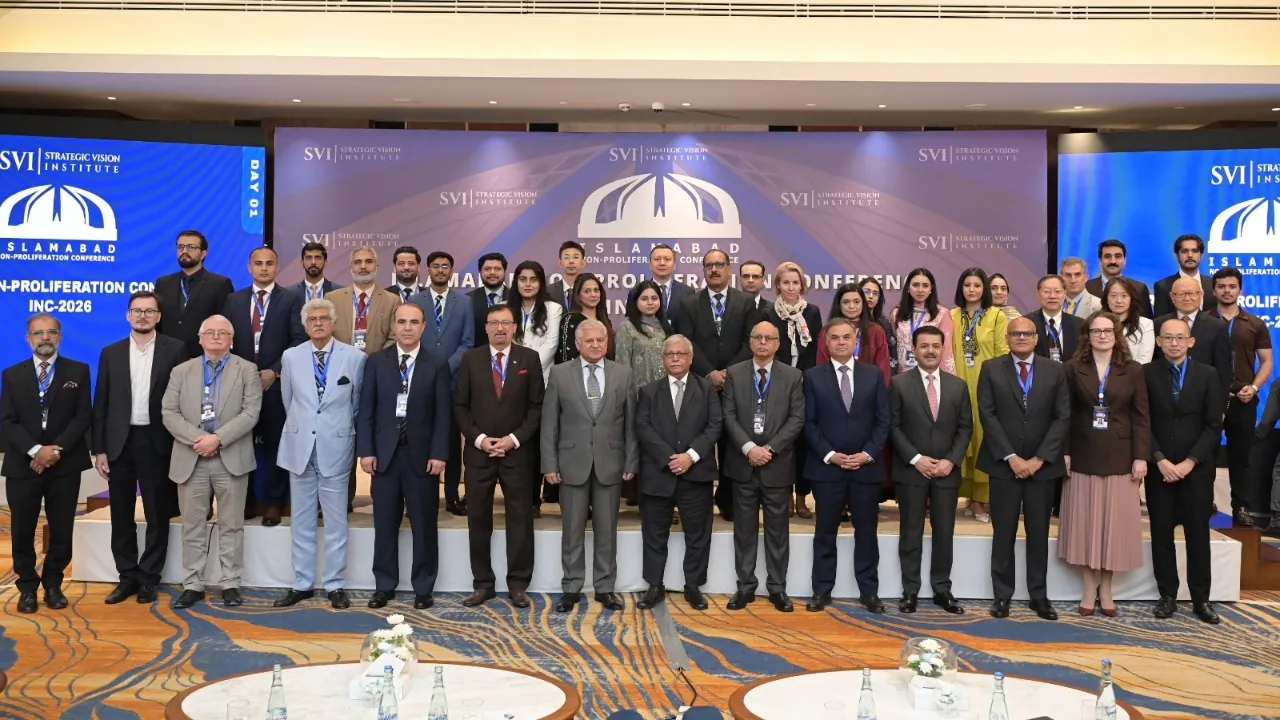
Scholars and specialists from around the world gathered in Islamabad as the Strategic Vision Institute began the two-day Islamabad Non-Proliferation Conference 2026 on its opening day.
The gathering seeks to encourage meaningful conversations about international strategic matters while presenting Pakistan policy viewpoints.
Executive Director of the Strategic Vision Institute, Dr Naeem Salik, greeted attendees at the International Nonproliferation Conference 2026, followed by an introduction of the event to the crowd by institute director Dr Nasir Hafeez.
National Command Authority advisor Lt. Gen. Sarfraz Sattar, HI (M), (Retd.), presented the opening speech. He stated that disruptive technologies drive the push for larger and superior nuclear weapons, working against stability or restraint efforts needed for disarmament and steady economic growth.
He noted that the nuclear era has transitioned, moving threat perceptions away from rogue or non-state groups acquiring nuclear weapons and toward Great Power Competition and potential interstate wars within a more contentious global framework.
He pointed to South Asia as a nuclear flashpoint driven by India and its ultranationalist inclinations, noting the presence of Hindutva ideology seeking Akhand Bharat.
He added that the taboo against using nuclear weapons appears to be fading as interstate wars grow more lethal and costly, while the global nuclear order faces intense pressure.
National Command Authority advisor for development, Lt. Gen. Khalid Ahmed Kidwai, NI, HI, HI (M), (Retd.), presented the keynote speech. He analyzed Pakistan viewpoints on credible deterrence, strategic stability, and strategic balance in South Asia, following their development before the May 2025 conflict and evaluating their effects in the post-conflict strategic setting.
Retired Lt. Gen. Kidwai stressed that Pakistan Full Spectrum Deterrence is strictly defensive, designed to stop aggression across all conflict levels and maintain strategic stability throughout South Asia.
Pakistan Full Spectrum Deterrence produced strategic impacts regionally and internationally during the May 2025 India-Pakistan conflict, showing how conventional and nuclear deterrence helps restrict escalation.
He pointed out SIPRI Yearbook 2026 data showing India deployed roughly 12 nuclear warheads on a nuclear submarine for deterrence patrols, voicing worry that a lack of pre-notification for Indian SLBM tests could threaten South Asian strategic stability, challenge India No First Use policy, and heighten dangers of miscalculation and nuclear escalation.
He reiterated Pakistan right to implement necessary steps to protect its national security and maintain the regional strategic balance, while also emphasizing the need to stop technological disparities from eroding South Asian strategic stability.
To cover the full range of challenges, the event features seven working sessions on subjects like deterrence dynamics and escalation dangers in South Asia, changing deterrence trends within a shifting global nuclear order, and the breakdown of arms control frameworks alongside threats to the non-proliferation system.
Every session allows detailed talks intended to produce policy recommendations for national and international security structures, and former Chairman Joint Chiefs of Staff Committee Gen. Zubair Mahmood Hayat, NI (M), (Retd.), will deliver the closing remarks.