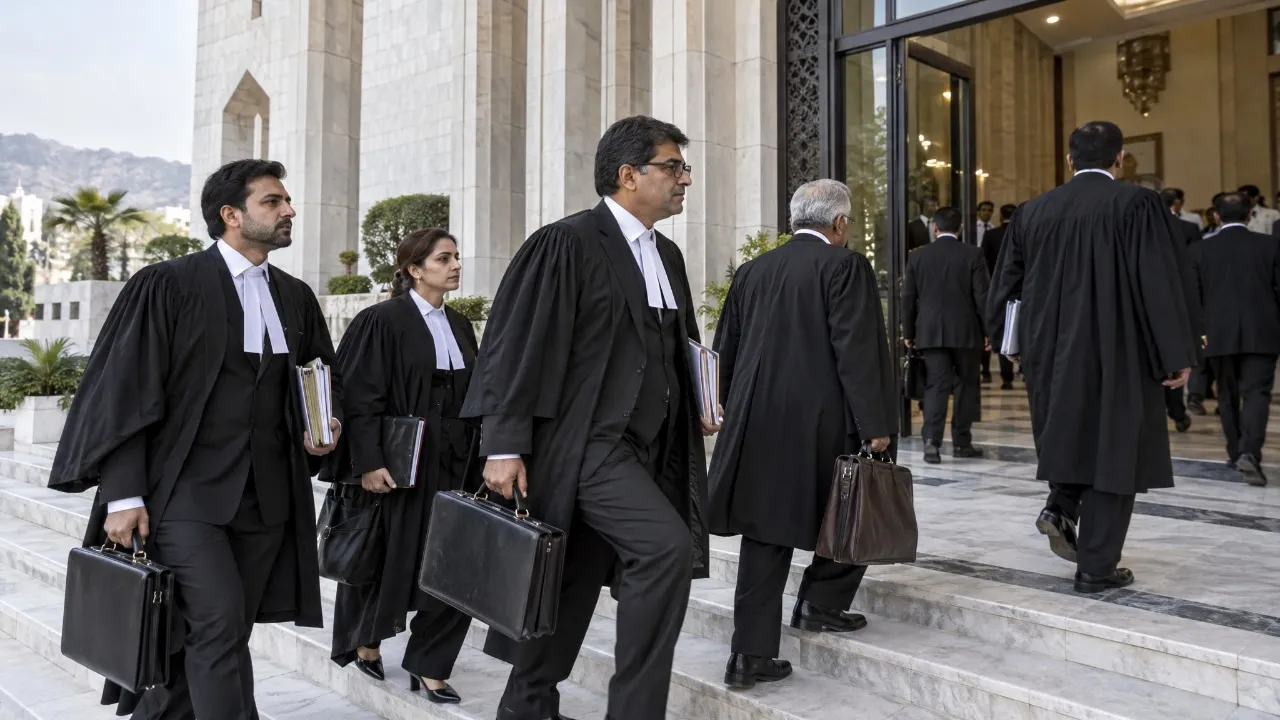
Wearing gowns has been made mandatory for lawyers appearing before the Islamabad High Court (IHC). The IHC Deputy Registrar issued an office order on the directives of the Chief Justice. According to the office order, lawyers have been directed to appear in gowns while pursuing cases from November 15 onwards, until further orders.
What the New Dress Code Entails
The order specifies that every advocate who steps into the IHC courtroom must wear the traditional black robe that is standard in many common-law jurisdictions. The requirement applies to all types of proceedings - civil, criminal, constitutional and administrative - without exception. The order does not mention any additional accessories such as wigs or collars, focusing solely on the gown itself.
Why the Court Introduced the Gown Requirement
Dress codes in courts are meant to reinforce the solemnity of judicial proceedings and to create a visual distinction between legal professionals and the public. In Pakistan, the Supreme Court and several provincial high courts already enforce gown-wearing for advocates. The Islamabad High Court, established in 2010, had previously allowed lawyers to appear in formal business attire, a practice that some judges felt diluted the courtroom's gravitas.
Legal scholars note that a uniform appearance helps maintain decorum and reduces distractions. The Chief Justice's directive, conveyed through the Deputy Registrar, aligns the IHC with the broader national judiciary's standards.
How the Order Was Communicated
The Deputy Registrar released an official office order, which is a standard administrative instrument used by the court to convey procedural changes. Such orders are posted on the court's notice board, circulated to the Bar Association of Islamabad, and emailed to registered advocates. The order states that the gown requirement will be effective from November 15 and will remain in force until the court issues further instructions.
Historical Context of Court Attire in Pakistan
Since the colonial era, Pakistani courts have adopted the British tradition of black robes for judges and lawyers. After independence in 1947, the practice continued, symbolising the rule of law and the impartial nature of the judiciary. Over the decades, some lower courts relaxed the rule, allowing lawyers to wear suits or traditional shalwar-kameez, especially in regional courts where cultural attire is common.
In 2009, the Supreme Court reaffirmed the mandatory gown rule for all advocates appearing before it, citing the need for uniformity. Provincial high courts followed suit, but the Islamabad High Court remained an outlier until this recent order.
Impact on Lawyers and Court Operations
Advocates will need to acquire a suitable gown before the November 15 deadline. Many law firms and the Islamabad Bar Association have already begun sourcing gowns from local tailors who specialise in courtroom attire. The cost of a standard black gown in Islamabad ranges from Rs. 8,000 to Rs. 15,000, depending on fabric and tailoring quality.
For senior advocates who already own gowns, the transition will be seamless. Junior lawyers and recent law graduates, however, may face a short adjustment period. The Bar Association has promised to provide a limited number of loaner gowns to members who cannot afford one immediately, ensuring that no case is delayed due to dress-code non-compliance.
From an administrative perspective, the court expects the dress code to streamline security checks. Uniform attire makes it easier for security personnel to identify authorized legal professionals, potentially reducing the time spent at entry points.
Procedures for Non-Compliance
The order does not detail punitive measures, but standard practice in Pakistani courts allows the presiding judge to reprimand or temporarily exclude an advocate who fails to meet dress requirements. Repeated violations could lead to a formal warning from the Bar Council, and in extreme cases, a temporary suspension of the right to appear before the court.
Lawyers are advised to contact the IHC Deputy Registrar's office for clarification on any ambiguities, such as acceptable variations in gown style or the inclusion of a tie or scarf.
What Lawyers Should Do Now
1. Verify that a compliant gown is in good condition before November 15.
2. Contact the Islamabad Bar Association for loaner gowns if needed.
3. Review the office order for any additional specifications that may be issued later.
4. Prepare to present the gown at the security checkpoint on the day of each hearing.
By following these steps, advocates can avoid disruptions to their case schedules and maintain professional decorum in the courtroom.
Looking Ahead: Potential Extensions and Reviews
The order states that the gown requirement will remain until further orders. This phrasing leaves open the possibility of future revisions, such as extending the rule permanently or adjusting the dress code to include additional elements like a tie or a specific cut of gown. The court may review the policy after six months to assess its impact on courtroom efficiency and public perception.
Stakeholders, including the Bar Association, legal academics, and civil-society groups, are expected to provide feedback during any review process. Their input could shape whether the dress code becomes a permanent fixture of IHC practice.
Broader Implications for the Pakistani Legal System
Uniform dress codes reinforce the visual symbolism of the judiciary, reminding all participants of the seriousness of legal proceedings. By aligning the Islamabad High Court with other high courts, the order may strengthen public confidence in the consistency of judicial standards across the country.
Moreover, the move could influence lower courts in the Islamabad Capital Territory to adopt similar attire requirements, creating a cascade effect that standardises courtroom appearance nationwide.
In summary, the Islamabad High Court's new dress code marks a decisive step toward uniformity in legal attire, with clear instructions, a defined timeline, and mechanisms for compliance and feedback.





