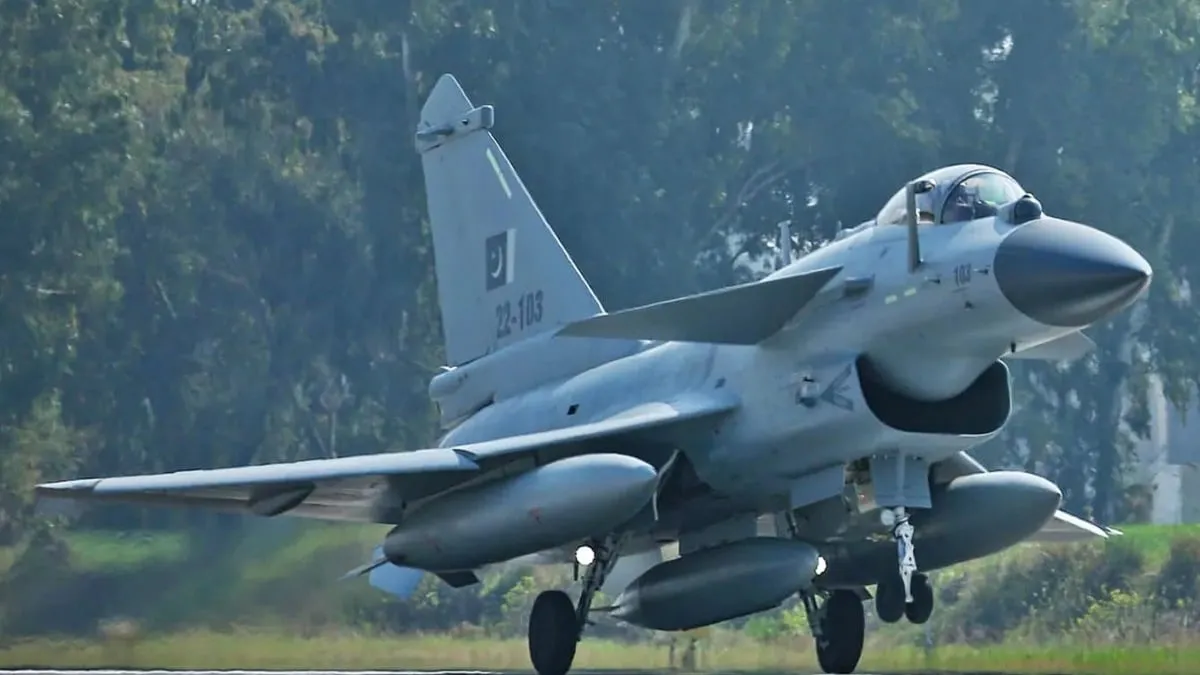
Pakistan's J-10C fighter jet, the aircraft the PAF used to shoot down French-made Indian Rafales during the May 2025 conflict, arrived in Zhuhai on November 28 ahead of Airshow China 2026. Chinese state broadcaster CCTV confirmed the arrival and said the jet will be placed on static display during the international aviation exhibition.
The 16th China International Aviation and Aerospace Exhibition will run from December 7 to 13 in Guangdong province, bringing together more than 1,100 companies from roughly 50 countries and regions. Organisers expect over 170 aircraft and 3,000 exhibits, offering visitors a broad view of China's latest aviation and aerospace projects.
Why the J-10C Draws Global Attention
The J-10C's reputation surged after its deployment by the Pakistan Air Force (PAF) in the May 2025 military clash with India. During that brief but intense confrontation, the jet was credited with downing two French-made Rafale fighters operated by the Indian Air Force. The incident marked the first confirmed combat loss of a Rafale, a platform that had entered service with several air forces worldwide.
Pakistan formally inducted the Chinese fighter into its air force in March 2022, a move that deepened the long-standing defence partnership between Islamabad and Beijing. The J-10C is a modernised version of the original J-10, featuring an active electronically scanned array (AESA) radar, upgraded avionics and a more powerful engine that improves thrust-to-weight ratio.
Technical Profile of the J-10C
The J-10C is a single-engine, multirole fighter designed by the Chengdu Aircraft Industry Group. Its key specifications include a maximum speed of Mach 2.2, a service ceiling of 20 km, and a combat radius of roughly 1,500 km when equipped with air-to-air missiles. The aircraft can carry a mix of PL-15 beyond-visual-range missiles, PL-5 short-range missiles, and a variety of precision-guided bombs.
Compared with the earlier J-10 variants, the C model incorporates a glass cockpit with large multifunction displays, a digital fly-by-wire system, and enhanced electronic warfare suites. These upgrades enable the jet to operate in contested airspace and to integrate with modern network-centric warfare concepts.
China's Airshow China: A Platform for Strategic Messaging
Airshow China, officially the China International Aviation and Aerospace Exhibition, is the nation's premier aerospace showcase. Held biennially in Zhuhai, the event serves both commercial and strategic purposes. It allows Chinese manufacturers to display new platforms, attract foreign buyers, and signal technological progress to regional rivals.
For the 2026 edition, the J-35A stealth fighter will make its first public static display. The J-35A, sometimes dubbed the "Chinese F-35," is a carrier-based, low-observable aircraft intended for the People's Liberation Army Navy. Its presence alongside the J-10C underscores China's ambition to field a full spectrum of modern fighters, from fourth-generation multiroles to fifth-generation stealth designs.
Historical Context of Pakistan-China Defence Cooperation
The PAF's acquisition of the J-10C fits into a broader pattern of Pakistan sourcing combat aircraft from China. In the 1990s, Pakistan purchased the F-7, a Chinese-built version of the MiG-21. The 2000s saw the introduction of the JF-17 Thunder, a joint venture between Pakistan and China that remains in service today.
These deals have been driven by several factors: cost-effectiveness compared with Western platforms, fewer export restrictions, and the ability to customize avionics to meet specific operational needs. The J-10C, with its advanced radar and weapons capability, represents a step up in capability for the PAF, narrowing the gap with India's fleet of Rafales, Su-30MKIs and other fourth-generation fighters.
Implications for Regional Air Power Balance
India's air force fields a mixed fleet that includes French-made Rafales, Russian-built Su-30MKIs, and domestically produced HAL Tejas. The loss of two Rafales in 2025 prompted New Delhi to reassess its air-defence posture and to accelerate procurement of additional platforms, such as the indigenous AMCA stealth fighter and additional Su-30s.
For Pakistan, the J-10C offers a credible counter to India's air superiority, especially in the contested Kashmir region where most aerial engagements have historically occurred. The aircraft's ability to engage at beyond-visual-range distances and its upgraded electronic warfare suite could alter the calculus of future skirmishes.
What Visitors Can Expect at the Exhibition
Beyond the J-10C and J-35A, the exhibition will feature a wide array of aircraft, including commercial airliners, unmanned aerial systems, and prototype drones. International exhibitors will showcase engines, avionics, simulation technologies and aerospace materials.
Industry analysts anticipate that several Chinese firms will use the platform to announce new export variants of the J-10 family, possibly targeting markets in Southeast Asia and Africa that seek affordable yet capable fighters.
Next Steps for the J-10C Program
While the static display provides a public relations boost, the PAF is expected to continue receiving additional J-10C airframes under the original contract signed in 2022. Maintenance and upgrade agreements with Chengdu Aircraft Industry Group are also in place, ensuring a steady flow of spare parts and software updates.
Pakistan's Ministry of Defence has not disclosed exact numbers of jets in service, but open-source estimates suggest a fleet of 30 to 40 J-10Cs will eventually operate from bases in Sargodha and PAF Base Faisal. Future procurement may include integration of indigenous weapons, such as the Ra'ad II cruise missile, to further extend strike capability.
For China, the exhibition offers a chance to gauge foreign interest in the J-10C and related systems. Potential buyers will be able to discuss licensing arrangements, local production options and training packages directly with Chengdu officials present at the show floor.
Practical Takeaways for Industry Stakeholders
- Airshow China 2026 provides a rare opportunity to see the J-10C up close, which may influence export negotiations.
- Pakistan's use of the jet in combat demonstrates operational reliability under high-intensity conditions.
- China's simultaneous showcase of the J-35A signals a broader shift toward stealth capabilities.
- Regional air forces will monitor the exhibition for indications of future technology transfers or joint development projects.