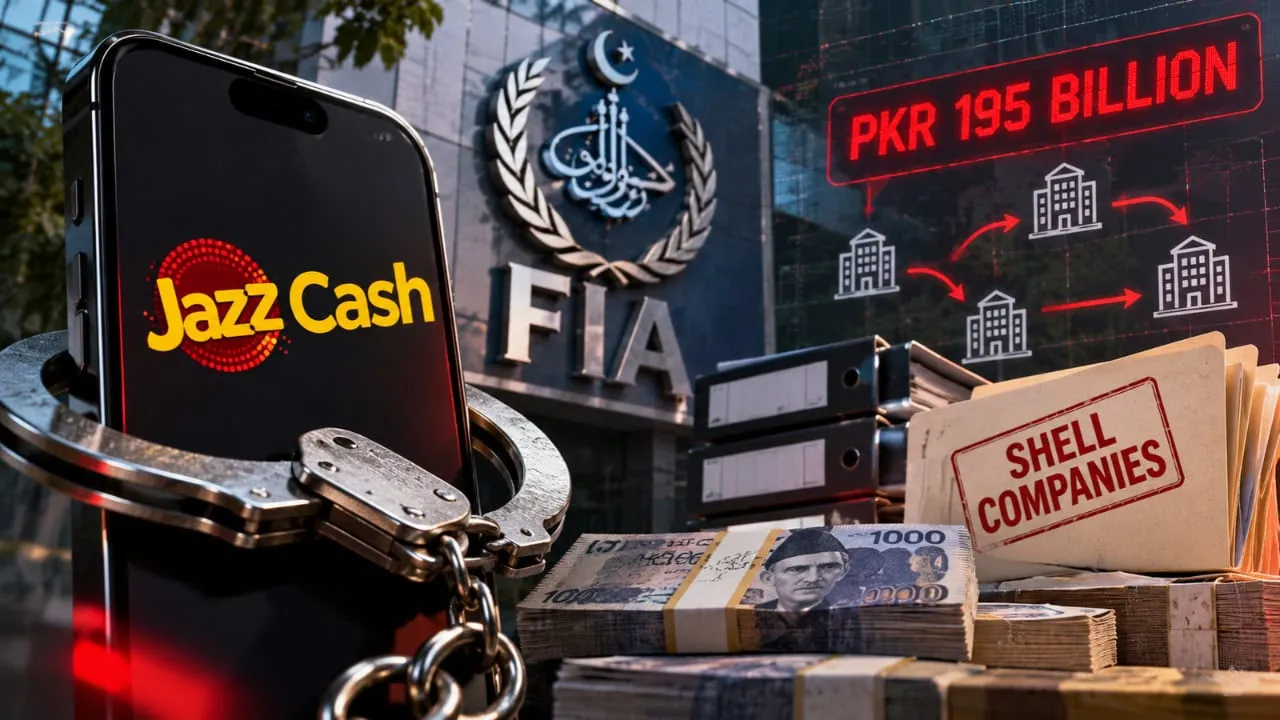
The Federal Investigation Agency (FIA) has registered a new First Information Report worth PKR 195 billion against an online gambling and money laundering (digital hawala-hundi) network that allegedly funneled billions through JazzCash accounts. This marks the second major FIA case to name Pakistan's largest branchless banking platform in connection with illegal gambling operations.
The fresh FIR adds to an earlier case worth PKR 120 billion, bringing the combined total across both investigations to a staggering PKR 315 billion. Meanwhile, the FIA has already shut down over 100 aggregator accounts linked to the platform. These accounts reportedly generated significant revenue for JazzCash, and their closure is expected to impact the company's earnings in the coming quarters.
Why the FIR Matters for Pakistan's Digital Finance Landscape
JazzCash currently dominates roughly 70% of Pakistan's branchless banking market. Its reach includes more than 30 million registered users and a network of agents that processes trillions of rupees in transactions each year. Because of that scale, any allegation of systemic abuse draws immediate attention from regulators, courts and the public.
In May 2026 the State Bank of Pakistan introduced a dedicated framework to regulate payment aggregators. The framework requires aggregators to obtain a license, maintain separate accounts for high-risk transactions and report suspicious activity within 24 hours. The new FIR tests the effectiveness of those rules and may prompt tighter oversight or additional licensing requirements.
Background on Digital Hawala-Hundi and Online Gambling in Pakistan
Hawala, a traditional informal value-transfer system, has long been used to move money across borders without formal banking channels. Digital hawala-hundi adapts that model to mobile wallets and online payment apps, allowing rapid, low-cost transfers that evade conventional AML checks.
Online gambling is prohibited under the Prevention of Gambling Act 1977, yet international betting platforms such as Betway, 1xBet and Bet365 have maintained a presence through mobile apps and web portals. Users in Pakistan often rely on local wallets like JazzCash, Easypaisa and SadaPay to fund bets because those wallets provide instant, low-fee deposits and withdrawals.
Legal scholars note that the convergence of digital hawala and illegal gambling creates a feedback loop: gambling generates large, irregular cash flows, which are then layered through multiple wallet accounts, making detection difficult. The FIA's focus on aggregator accounts reflects an understanding that those intermediaries are the primary conduits for the illicit money.
How the Investigation Unfolded
According to FIA statements, investigators traced transaction patterns that showed unusually high volumes moving from a handful of aggregator accounts into a network of end-user wallets. The pattern matched known signatures of gambling payouts - spikes after major sports events, rapid turnover, and frequent transfers to accounts linked to betting sites.
In the first case, filed earlier this year, the FIR listed PKR 120 billion in suspicious transfers. Over 100 aggregator accounts were frozen, and several individuals were detained for questioning. The second FIR, filed now, expands the scope to an additional PKR 195 billion and names new aggregator accounts that were previously operating under different brand names.
Investigators have also issued summonses to senior JazzCash employees, demanding internal documents, compliance logs and details of the aggregator onboarding process. The summonses indicate that the FIA is moving beyond passive monitoring to an active probe of the platform's internal controls.
Regulatory Response and Legal Challenges
The Pakistan Telecommunication Authority (PTA) has already blocked 46 gambling applications as part of a broader crackdown on illicit betting. The move aims to limit the supply side of the market, but the FIA's focus on payment channels addresses the demand side.
A petition before the Lahore High Court has named international betting platforms including Betway, 1xBet and Bet365 for allegedly using JazzCash, Easypaisa and SadaPay to process gambling payments inside Pakistan. The petition seeks an injunction that would force aggregators to implement stricter KYC and transaction monitoring.
The National Counter Terrorism Authority (NCCIA) has expanded its mandate under the Anti-Money Laundering Act, granting it sweeping new authority to investigate digital financial crimes. In a recent Sindh High Court proceeding, the court ordered the NCCIA to halt its investigation in certain money-laundering cases, prompting JazzCash's parent company to argue that its role is limited to providing a financial services platform, not policing illicit use.
Impact on JazzCash's Financial Performance
VEON, the parent company of Jazz, described JazzCash as a "financial giant" in its Q3 2026 earnings report. The report showed JazzCash posting 67.6% year-over-year revenue growth to PKR 43.4 billion, with a net profit of PKR 6.8 billion. The stark contrast between that growth and the allegations of billions laundered through the same infrastructure raises questions for investors.
Analysts at local brokerage firms have warned that the shutdown of over 100 aggregator accounts could shave several percentage points off quarterly earnings, depending on how much revenue those accounts contributed. The firm's share price has already shown volatility since the first FIR was announced.
What Consumers and Businesses Should Expect
For everyday users, the immediate effect may be the disappearance of certain aggregator accounts from the JazzCash app. Users who previously funded betting sites through those accounts might see transaction failures or delayed processing.
Businesses that rely on JazzCash for legitimate payments - such as retailers, utility providers and e-commerce platforms - are unlikely to face direct disruption, as the platform's core services remain operational. However, heightened scrutiny could lead to longer verification times for new merchant onboarding.
Next Steps in the Legal Process
The FIA is expected to submit a detailed charge sheet to the relevant courts within the next 30 days. If the charge sheet is accepted, formal prosecutions could follow against identified aggregators and any individuals found complicit.
Meanwhile, the Lahore High Court petition is slated for a hearing in early December 2026. The court's decision on whether to impose an injunction on payment aggregators will shape the regulatory environment for the next few years.
JazzCash has not issued a public statement on either investigation. TechJuice reached out multiple times for comment, but the company did not respond to any request. The silence adds pressure on the platform to cooperate with law-enforcement inquiries and to demonstrate compliance with the State Bank's 2026 framework.