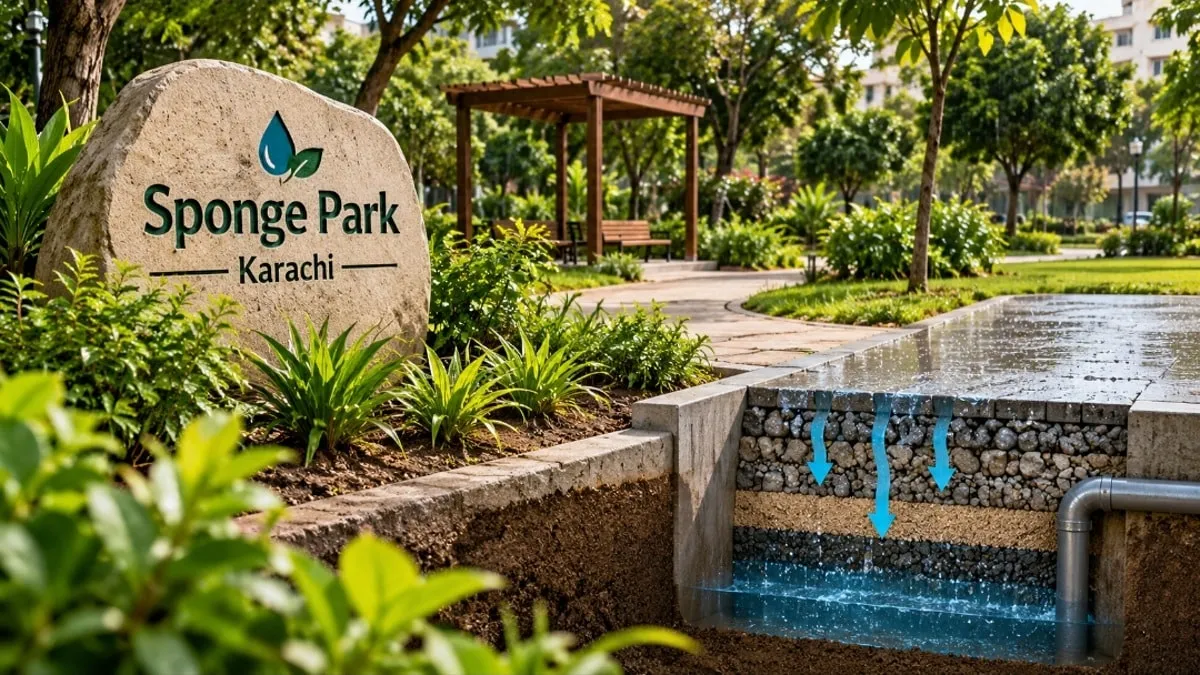
Karachi inaugurated Pakistan's first experimental sponge park at Jamali Park in Gulberg Block 2 on Thursday, launching a new rain-water management system that captures runoff, filters it and stores it underground for non-drinking uses.
The park, created through a six-month public-private partnership that includes WWF-Pakistan, the Gulberg Town Municipal Corporation and other stakeholders, is intended to address chronic water scarcity, urban flooding and the steady decline of groundwater reserves in the megacity.
What Is a Sponge Park and How Does It Work?
A sponge park is a landscape-based infrastructure that mimics natural soil and vegetation functions to absorb, filter and retain rainwater. In Karachi's case, the design combines permeable surfaces, specially engineered underground filters and a network of shallow basins that temporarily hold water after a storm.
When rain falls on the park, water passes through a layer of permeable paving and vegetation. It then moves into an underground filter system that consists of gravel, coarse aggregates, sand, silica, activated carbon, bio-char and zeolite. Each material serves a purpose: gravel and coarse aggregates slow the flow, sand removes larger particles, silica and activated carbon trap organic compounds, while bio-char and zeolite adsorb heavy metals and other chemical contaminants.
After filtration, the water is directed into a storage chamber beneath the park. The stored water is earmarked for non-drinking applications such as irrigation of the park's own plants, cleaning of public spaces and, notably, reuse of ablution water from a nearby mosque.
Why Karachi Needs a Sponge Park
Karachi, Pakistan's largest city, faces a triple challenge: rapid urban expansion, frequent monsoon-season flooding and a groundwater table that has fallen by more than 30 metres in the past two decades. The city's reliance on borewells has led to over-extraction, as highlighted by Naeem Ashraf, director of biodiversity at the Ministry of Climate Change and Environmental Coordination, who said Pakistan had "extensively exploited its underground freshwater reserves through borewells and other extraction methods."
Traditional drainage systems in Karachi are designed to move water quickly to the sea, which reduces short-term flooding but prevents natural recharge of aquifers. The sponge park model reverses that logic by retaining water on site, allowing it to percolate slowly into the ground and replenish the aquifer.
Key Features of the Jamali Park Sponge System
- Permeable Surfaces: Paving made from porous concrete lets water pass through rather than run off.
- Underground Filtration Layers: A sequence of gravel, coarse aggregates, sand, silica, activated carbon, bio-char and zeolite removes suspended solids, organic matter and selected chemicals.
- Water Reuse Loop: Ablution water from the adjacent mosque is filtered through the same system before being used to irrigate park vegetation.
- Groundwater Recharge: Filtered water is stored in a shallow underground reservoir that releases water slowly into the surrounding soil.
How the Project Was Developed
The sponge park emerged from a six-month collaboration that began in early 2024. WWF-Pakistan provided technical expertise on ecological design and filter composition, while the Gulberg Town Municipal Corporation handled site preparation, permitting and community outreach. Additional stakeholders, including local engineering firms and academic researchers, contributed to the design of the filtration media and monitoring framework.
Funding was secured through a mix of municipal budget allocations, private sector contributions and a grant from an international climate-finance mechanism. The partnership model is intended to serve as a template for future green infrastructure projects across Pakistan.
Potential Impact on Karachi's Water Crisis
While the Jamali Park pilot is modest in size, covering roughly 0.5 hectares, the design is scalable. If replicated across the city's 150 million-square-metre urban footprint, the cumulative effect could be significant. Estimates from local engineers suggest that each hectare of sponge park could capture up to 1,200 cubic metres of rainwater per monsoon, reducing peak runoff by as much as 30 percent.
For residents, the immediate benefits include reduced flooding in the surrounding neighbourhood, lower demand for freshwater irrigation, and a modest improvement in local groundwater levels. Over time, the project could lower municipal costs associated with flood damage repair and water treatment.
What Comes Next: Expansion Plans and Monitoring
City officials have announced that the success of the Jamali Park sponge park will be evaluated over a 12-month monitoring period. Data collection will focus on volume of water captured, quality metrics after filtration, and changes in groundwater levels measured by nearby observation wells.
Based on the results, the Gulberg Town Municipal Corporation plans to propose additional sponge parks in other flood-prone districts such as Lyari, Orangi and Malir. The Ministry of Climate Change and Environmental Coordination has indicated willingness to incorporate sponge-park guidelines into the national urban-planning framework.
Practical Takeaways for Citizens and Businesses
Homeowners and commercial property managers can adopt smaller-scale versions of the technology by installing permeable pavers, rain-gardens and bio-char-enhanced soil beds. The city's water-utility department is expected to release a set of best-practice guidelines later this year.
Businesses that rely on large water volumes, such as car-wash operators or landscaping firms, may benefit from the non-drinking water supply generated by sponge parks, reducing their dependence on municipal freshwater.
Expert Opinions and Community Reaction
Environmental scientists praised the project for its evidence-based approach. Dr. Ayesha Khan, a hydrologist at the University of Karachi, said, "The integration of locally sourced filtration media like bio-char and zeolite makes the system both affordable and effective for South Asian climates."
Local residents expressed optimism, noting that the park's green spaces already provide a recreational area while the water-management features work behind the scenes. Community leader Imran Ali remarked, "We have seen water-logging after every heavy rain. If this park can keep our streets dry, it will be a real blessing."
Critics, however, caution that the pilot's impact must be measured rigorously before large-scale rollout. They point out that maintenance of the filtration layers will be essential to prevent clogging and ensure water quality.
Conclusion: A New Chapter in Urban Water Management for Pakistan
The inauguration of Pakistan's first sponge park marks a shift toward nature-based solutions in a country where water scarcity and urban flooding have long been intertwined challenges. By capturing rainwater, filtering it with locally sourced materials and storing it for non-drinking uses, the Jamali Park project offers a replicable model that could reshape how Pakistani cities manage their water resources.