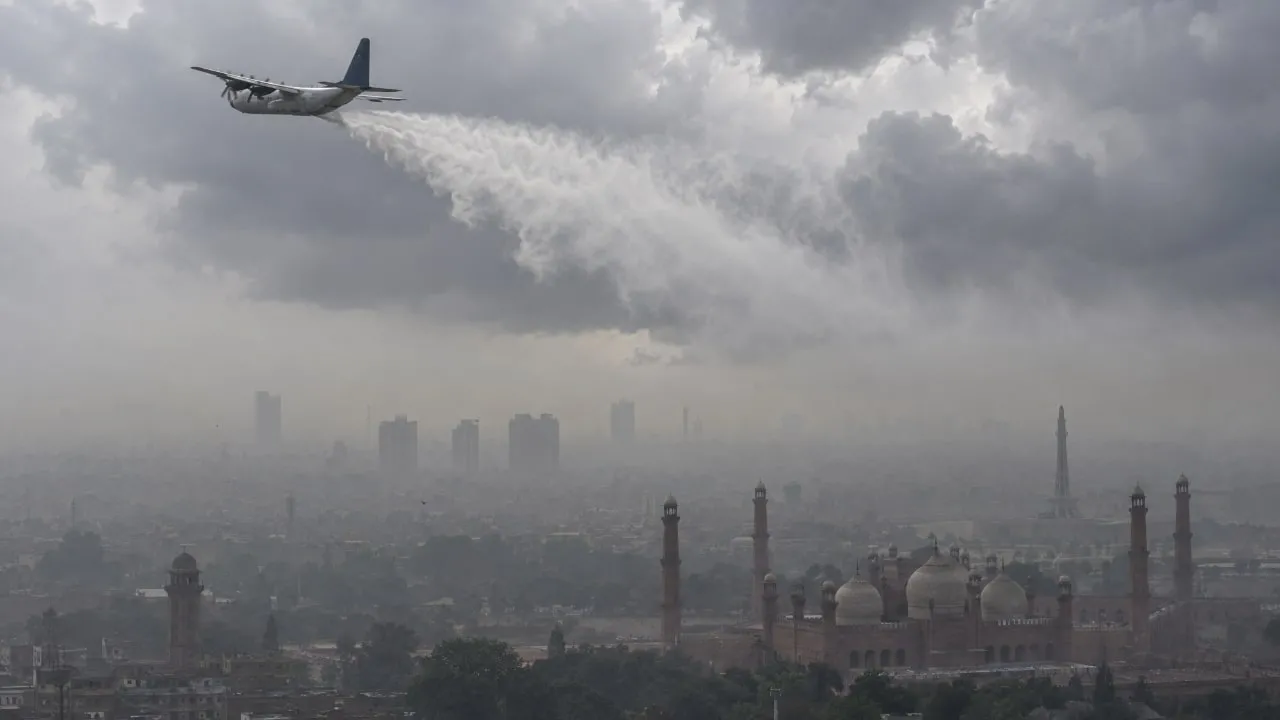
Provincial authorities are weighing a cloud-seeding operation for early Friday morning as a rain-bearing system moves toward Lahore and surrounding districts, aiming to secure short-term relief from the city's escalating smog.
According to sources, the experiment could be launched if atmospheric conditions stay favourable, particularly the presence of moisture in the clouds and temperatures below freezing in the rain-bearing layers. The final decision, the agencies that will take part, and the precise locations to be targeted have not been confirmed as of the evening.
What Is Cloud Seeding and How Does It Work?
Cloud seeding is a form of weather modification that involves dispersing substances such as silver iodide, potassium chloride or dry ice into clouds to encourage the formation of ice crystals. These crystals grow and eventually fall as precipitation. The technique has been used worldwide for decades, often to augment water supplies in arid regions or to improve snowfall in ski resorts.
In Pakistan, the practice dates back to the early 2000s when the national meteorological department partnered with research institutes to test the method in the Indus basin. Results were mixed, with some operations producing measurable rainfall and others yielding little effect. The variability is largely due to the need for very specific cloud conditions - sufficient super-cooled liquid water, appropriate temperature gradients, and adequate wind patterns to carry the seeding agents through the cloud mass.
Why Lahore Is Turning to Artificial Rain Now
Lahore has been grappling with severe winter smog for several years. The smog season typically peaks between November and February, when low wind speeds trap pollutants from vehicle exhaust, industrial emissions, and the burning of agricultural residue in nearby fields. In recent weeks, the Air Quality Index (AQI) in the city has hovered above 300, a level classified as hazardous by the World Health Organization.
Health officials have reported a surge in respiratory complaints, especially among children, the elderly and people with pre-existing conditions. Schools have intermittently closed, and outdoor activities have been curtailed. The economic impact is also noticeable, with reduced foot traffic in markets and a slowdown in construction work.
Given these pressures, the provincial government is exploring every available tool to break the smog cycle. Artificial rain offers a rapid, albeit temporary, method to wash particulate matter out of the lower atmosphere. When rain falls, it can capture fine particles and bring them to the ground, where they are removed from the air column.
Timeline and Conditions for the Proposed Operation
Officials have indicated that the cloud-seeding attempt could be carried out early Friday morning, provided that the following conditions are met:
- Moisture content in the target clouds must be sufficient to sustain seeding.
- Temperatures in the rain-bearing layers need to be below freezing, a requirement for ice-nucleating agents to work effectively.
- Wind direction should allow seeded clouds to move over the most polluted parts of Lahore and its adjoining regions.
The decision will be taken after a final review of real-time meteorological data from the Pakistan Meteorological Department (PMD) and the Punjab Climate Change Authority. If approved, aircraft equipped with seeding dispensers will fly at altitudes of 5,000 to 8,000 feet to release the agents.
Who Is Involved in the Initiative?
The article notes that representatives from all climate-change departments and experts were present at meetings that discussed the strategy for artificial rain. While the exact list of agencies has not been released, past operations have involved the following bodies:
- Punjab Climate Change Authority - oversees policy and coordination for climate-related interventions.
- Pakistan Meteorological Department - provides weather forecasts, cloud analysis and real-time monitoring.
- National Disaster Management Authority - ensures safety protocols for aerial operations.
- University of Engineering and Technology, Lahore - supplies scientific expertise and laboratory support for seeding material preparation.
These agencies typically collaborate to assess feasibility, secure necessary clearances, and monitor the outcomes of any seeding activity.
Technical Requirements and Past Experience
Temperature is a particularly important factor in cloud seeding. Earlier artificial rain operations in Lahore were conducted during daylight hours, but the current assessment emphasizes that the temperature of rain-bearing clouds must be below freezing for suitable conditions to develop. This is because the seeding agents act as ice nuclei, prompting the formation of ice crystals that later melt into raindrops as they descend.
In the 2022 season, Lahore attempted a cloud-seeding experiment that produced approximately 5 mm of rainfall over a limited area, reducing the AQI by roughly 30 points for a few hours. While the impact was short-lived, the operation demonstrated that the necessary technology - aircraft, seeding chemicals, and monitoring equipment - is available in the region.
Potential Benefits and Limitations
Should the operation succeed, the immediate benefit would be a measurable drop in particulate concentration, offering temporary respiratory relief for residents. A modest rain event can also dampen dust on roads and construction sites, further limiting secondary aerosol generation.
However, experts caution that artificial rain is not a substitute for long-term pollution control measures. The effect is typically limited to a few hours or a single day, after which smog can re-accumulate if emission sources remain unchanged. Moreover, the technique requires precise weather windows; a mis-judgment can result in wasted resources and no rainfall.
What Comes Next?
The provincial government has not set a public timeline for a final decision. Observers expect an announcement by late evening, once meteorologists confirm that the cloud mass meets the temperature and moisture thresholds. If approved, the seeding flight could take place before sunrise on Friday, with real-time monitoring to assess rainfall intensity and AQI changes.
Following the operation, authorities will likely release a brief report outlining the amount of precipitation achieved, the area covered, and any observable shift in air-quality metrics. This data will inform future decisions about the role of cloud seeding in Lahore's smog-mitigation strategy.
Practical Takeaways for Residents
While the possibility of artificial rain generates hope, residents should continue to follow standard health advisories:
- Limit outdoor activities during peak smog hours, typically early morning and late evening.
- Use N95 or equivalent masks when venturing outside.
- Keep windows closed and use air purifiers if available.
- Stay informed through official channels for any updates on the cloud-seeding operation and subsequent air-quality forecasts.
Even a brief rain can improve visibility and reduce the immediate health burden, but lasting improvement will depend on broader policies addressing vehicle emissions, industrial pollutants and agricultural burning.
Historical Context of Weather Modification in Pakistan
Weather modification projects in Pakistan date back to the 1970s, when the government launched the "Rain Enhancement Programme" under the Ministry of Water and Power. The early efforts focused on monsoon augmentation in the Punjab plains, using silver iodide released from aircraft. Results were mixed, and the programme was scaled back in the 1990s due to budget constraints.
In the 2000s, renewed interest emerged as climate change intensified extreme weather events. The Pakistan Meteorological Department partnered with international research institutions to conduct pilot studies in the Indus River basin. These studies highlighted the importance of accurate cloud microphysics data and led to the establishment of a dedicated cloud-seeding unit within the PMD.
Today, cloud seeding is part of a broader climate-adaptation toolkit that includes early-warning systems for floods, drought-resilience projects, and urban greening initiatives. Lahore's current consideration of artificial rain reflects this evolving approach, where short-term interventions are combined with long-term emission-reduction policies.
Conclusion
Provincial officials are poised to decide whether to launch a cloud-seeding operation early Friday, contingent on suitable atmospheric conditions. The experiment could provide a brief respite from hazardous smog levels in Lahore, but experts stress that it is a stop-gap measure. Sustainable improvement will require coordinated action across transportation, industry, and agricultural sectors, alongside continued investment in climate-resilient technologies.





