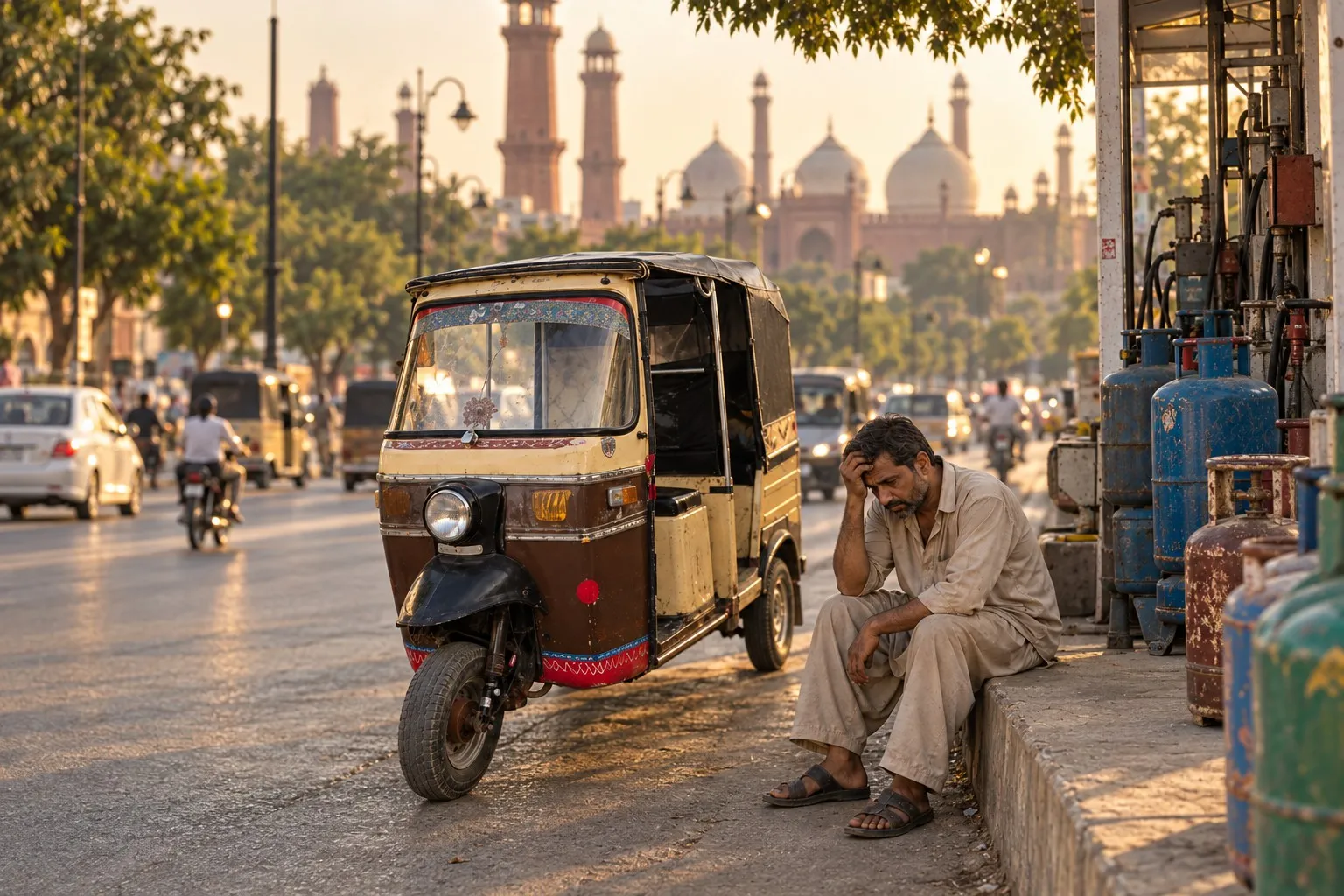
A sharp fifty-six percent increase in liquefied petroleum gas prices, triggered by the closure of two Iranian border crossings on October 17, has left thousands of motorized three-wheeler operators in Lahore struggling to survive as their daily earnings shrink dramatically. For thirty-three-year-old Rashid Ali, this sudden economic squeeze means his family now survives on just two meals a day, highlighting the severe personal toll of supply chain disruptions on urban transport workers.
Ali has spent thirteen years navigating the busy streets of Lahore behind the handlebars of a motorized three-wheeler. His working day routinely begins at six in the morning and stretches until midnight, but the roughly six dollars and fifty cents he previously earned daily has plummeted to about three dollars. This steep decline in disposable income forces workers to make impossible choices between fueling their vehicles and buying basic groceries for their dependents.
How Falling Incomes Affect Daily Survival in Lahore
The meager earnings Ali brings home must support two young children while covering essential household expenses. He pays eleven thousand rupees a month for housing, while renting the three-wheeler costs another six hundred rupees each day. These fixed overhead costs remain constant even as fuel expenses consume a much larger share of daily revenue, leaving little to nothing for food and medical needs.
Reflecting on the change in his financial situation, Ali explained the harsh reality of his trade. Previously, when liquefied petroleum gas was cheap, drivers could earn a decent income to support their households. Now, the high cost of energy eats up the profit margin before the working day is even half over, leaving families vulnerable to hunger and debt.
Border Closures Stop Fuel Imports and Push Up Prices
According to traders, the crossing closures stopped fuel imports entirely and pushed the open-market price of a twelve-kilogram cylinder to seven thousand rupees within days, equivalent to about five hundred eighty-three rupees per kilogram. The Pakistan LPG Association reported that Pakistan had been importing around seven thousand metric tons daily from Iran before the disruption occurred. This heavy reliance on cross-border supply left the domestic market exposed to sudden shortages.
Authorities have offered different explanations for the border closures. The Balochistan government pointed to security concerns and smuggling as the primary reasons for restricting movement. Meanwhile, Iran's foreign ministry attributed the disruption to technical problems at the frontier. Iran's ambassador subsequently stated that his country had placed no restrictions on exports, including liquefied petroleum gas, and instead attributed the problem to changes in Pakistani import documentation.
Impact on Three-Wheeler Transport and Household Fuel
Sold primarily in metal cylinders, liquefied petroleum gas serves both household cooking and heating needs while powering many passenger vehicles across urban centers. Awami Rickshaw Union chairman Majeed Ghauri said roughly seventy percent of the union members' forty-three thousand auto-rickshaws and almost eight thousand Qingqis use this fuel. Qingqis are popular motorcycle-based passenger three-wheelers operating along fixed neighborhood routes.
The widespread reliance on this fuel source means that supply disruptions affect not only commercial drivers but also households that depend on cylinders for domestic cooking. When import channels dry up, competition for remaining domestic supplies drives prices higher across the board, creating a ripple effect that touches millions of urban residents who have few alternative energy options.
Higher Operating Costs Meet Resistance Over Fares
Ali buys fuel four or five times during a single working day, spending three hundred to four hundred rupees on each refill. Yet he says passengers resist fare increases, sometimes offering only eighty, one hundred, or one hundred fifty rupees for journeys he values at two hundred to two hundred fifty rupees. Passengers also feel the pinch of a slowing economy and try to limit their own transport expenditures.
Passenger Mohammad Ramzan described offering two hundred fifty rupees when a driver requested five hundred rupees for a city trip. He walked away after the driver rejected the offer, illustrating the widening gap between what drivers need to cover their costs and what commuters are willing or able to pay for a standard urban ride.
Broader Economic Pressures and Inflation in Pakistan
The transport crisis unfolds against a backdrop of wider price increases across the national economy. Pakistan's inflation rate reached nine point six percent in October, and the central bank raised interest rates to twelve percent, pointing to surging energy and wheat costs. Petrol, which reached a record four hundred fifty-eight rupees per litre on April three, remains around forty percent above its pre-war price, keeping transportation overhead high.
Returning home at midday, Ali still had lunch to provide for his two boys after a morning of sparse earnings. He planned to resume driving until late into the night, hoping the additional hours would yield enough money to bring home food for the evening meal, continuing a grueling cycle born from international trade disruptions.