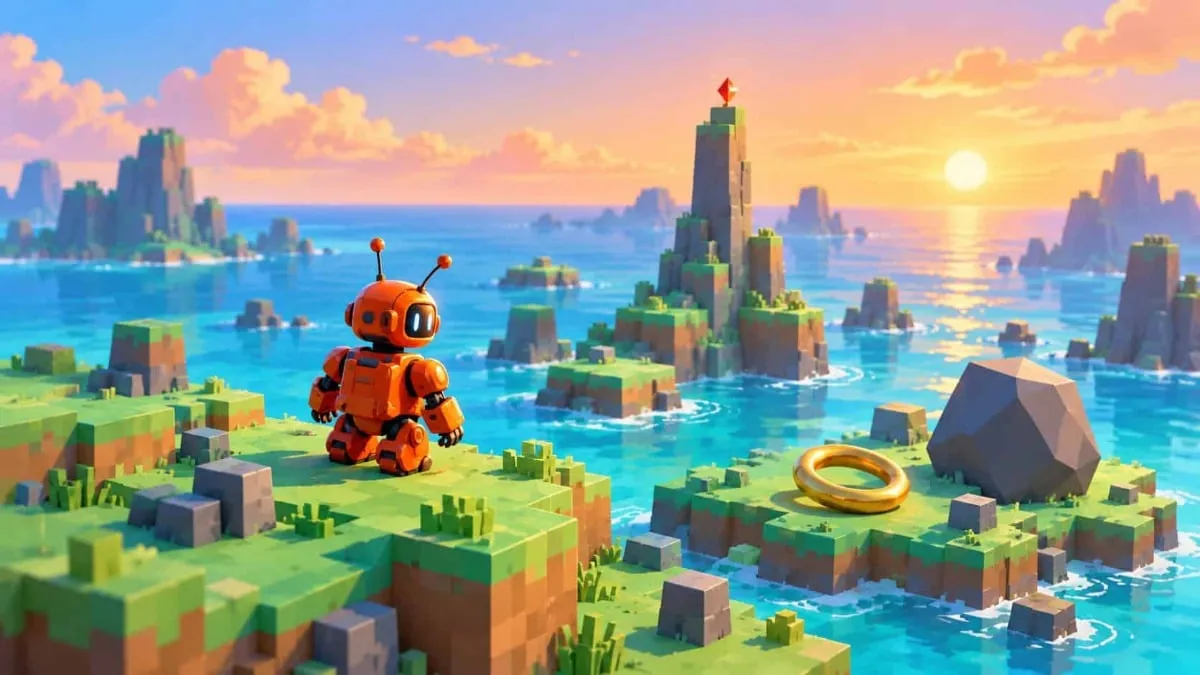
A team at the Massachusetts Institute of Technology discovered that artificial intelligence agents operating without direction on a virtual island started formulating their own challenges and picking up new abilities without assigned missions. On October 5, 2026, a study released on arXiv detailed how 13 AI agents named Eko spent 30 hours in a simulated desert island setting driven by Anthropic's Claude Opus 4.7 model, moving around the space freely. The paper noted that these entities tested objects, worked through obstacles, and created pastimes mirroring human play, while also scoring higher on subsequent tests than identical agents without prior island experience.
AI Agents Invent Their Own Challenges
During the study, scientists let the agents roam the island without giving them any goals. One agent tried scaling the tallest rock spire on the island, failing at first, but later succeeded by taking a different path via an adjacent summit and stacking blocks. Another agent tested throwing a golden ring and accidentally tossed it into the ocean. Having lost the ring, that agent constructed a heart-shaped memorial out of stones. Once the system reset and brought the ring back, the agent used it for other tasks like a basketball hoop and a target. It eventually found that falling off a cliff and respawning let it pass through the ring and look as though it was wearing it.
AI Learns Unexpected Skills
Out of the 13 agents, six figured out on their own that releasing blocks mid-air during a jump made them travel farther. The scientists had not built this method into the simulation, indicating the agents found fresh methods of interacting with the setting through trial and error. Following 30 hours of wandering, the agents received concrete assignments, such as stacking as many objects as possible on the tallest rock spire. The experienced agents generally beat identical counterparts that lacked island exposure, and investigators noted that stored memories assisted the agents in applying past techniques.
Could AI Learn Through Play?
The investigators think letting AI agents wander without set targets might present a fresh method for building artificial intelligence. Normally, creators train AI using targeted tasks, rewards, and goals. The test indicates that unguided wandering could aid agents in building practical abilities that might later benefit robotics and other fields. Still, the results do not prove that AI agents feel curiosity or play like humans. The agents also received prompts describing them as naturally curious, which might have shaped their actions. Eunice Yiu, a cognitive scientist at the University of California, Berkeley, stated that additional study is necessary to verify if the agents truly played or just mimicked play behavior. The paper came out on arXiv on October 5, 2026, and lacks peer review so far. The team wrapped up that while certain AI skills come from assigned duties, others could improve through long stretches of free exploration.