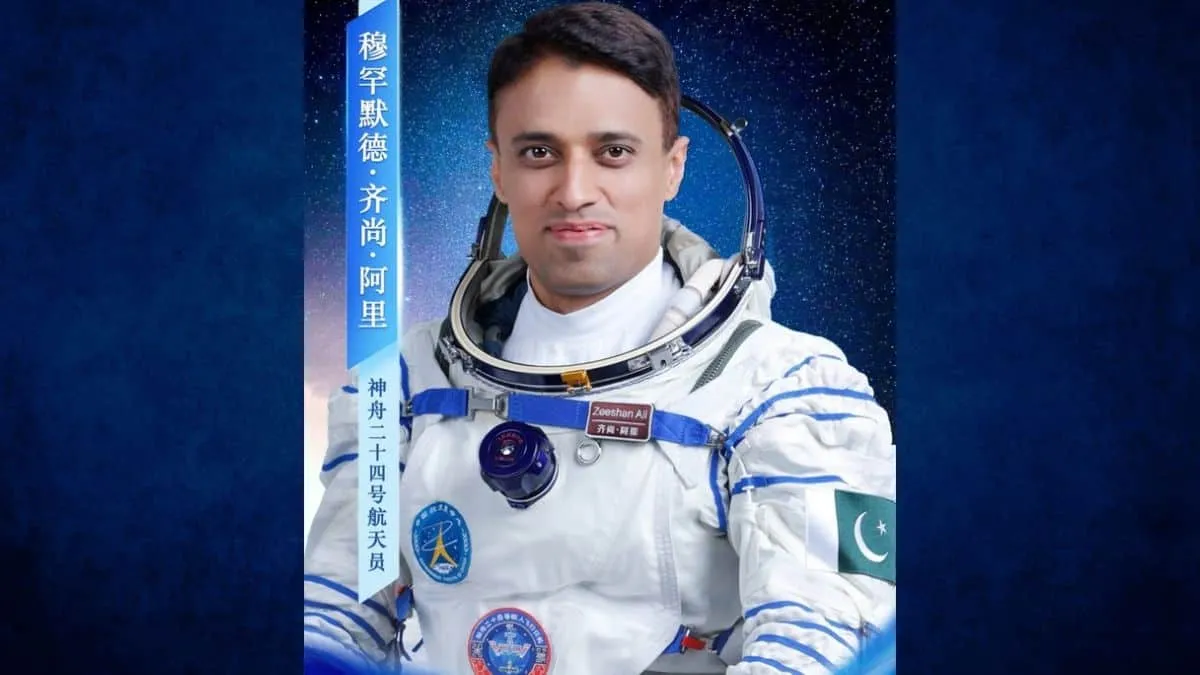
Pakistan's Muhammad Zeeshan Ali has been selected for China's Shenzhou-24 mission, becoming the first Pakistani astronaut to visit the Tiangong Space Station.
The China Manned Space Agency announced the three-member Shenzhou-24 crew on Tuesday. Ali will fly alongside Chinese astronauts Tang Hongbo and Wu Yi.
The mission will also make Ali the first foreign astronaut to visit China's Tiangong Space Station.
What the Shenzhou-24 Launch Means for Pakistan and China
China plans to launch the Shenzhou-24 spacecraft at 8:18 am Beijing time on Wednesday, November 25, from the Jiuquan Satellite Launch Center in northwest China. The launch window was chosen to match orbital alignment requirements for the Tiangong Space Station.
Tang Hongbo will command the mission. The crew includes Tang as spacecraft pilot, Wu Yi as flight engineer and Ali as payload specialist. Ali, a former pilot in Pakistan's armed forces, will spend around one week aboard the Tiangong Space Station. After completing his short-duration mission, he will return to Earth aboard the Shenzhou-23 spacecraft.
The flight will also mark the first joint space mission involving Chinese and foreign astronauts in the history of China's crewed space programme. It demonstrates the deepening technical partnership between the two countries and sets a precedent for future multinational crews on the Chinese platform.
How Pakistan Chose Its First Astronaut
Pakistan and China signed an agreement in February 2025 covering astronaut selection, training and participation in missions to the Chinese Space Station. The bilateral accord created a framework for sharing training facilities, scientific payload opportunities and flight slots.
Following a three-stage selection process, Muhammad Zeeshan Ali and Khurram Daud were chosen as Pakistani astronaut candidates. Both travelled to China for training and underwent assessments before authorities selected one astronaut for the mission and retained the other as backup. The training included spacecraft operations, extravehicular activity simulations, and scientific experiment protocols required for a crewed mission.
Ali's background as a former Pakistan Armed Forces pilot gave him the flight experience and discipline needed for the rigorous training regime. His selection reflects both personal merit and the strategic intent of Pakistan to develop a national space capability through partnership.
Why the Tiangong Space Station Is Central to the Mission
Tiangong, meaning "Heavenly Palace," is China's modular space station launched in phases beginning in 2021. It consists of the core module Tianhe and two laboratory modules, Wentian and Mengtian. The station orbits at roughly 393 km altitude and supports long-duration crewed missions, scientific research, and international collaboration.
Shenzhou-24 will dock with Tiangong's forward port, allowing the three crew members to conduct routine maintenance, scientific payload operations, and public outreach activities. Ali's role as payload specialist will involve managing experiments contributed by Pakistani research institutions, ranging from micro-gravity materials studies to Earth observation tasks.
The presence of a foreign astronaut on Tiangong signals China's willingness to open its orbital platform to partners beyond its traditional allies. It also offers Pakistan a direct avenue to participate in low-earth-orbit research without having to develop its own station.
Impact on Pakistan's Emerging Space Programme
Pakistan's space ambitions have been guided by the Space and Upper Atmosphere Research Commission (SUPARCO), which has focused on remote sensing, satellite communications and scientific payload development. Ali's flight provides a high-visibility milestone that can attract public interest, inspire a new generation of engineers, and justify increased budget allocations for human spaceflight research.
Scientific institutions in Pakistan are already preparing experiments that Ali will operate in orbit. These include a crystal growth study, a fluid dynamics test, and a small-scale Earth-imaging camera aimed at monitoring agricultural patterns in Punjab. Successful execution could lead to joint publications and technology transfer between Pakistani universities and Chinese research centres.
On the policy side, the mission may influence Pakistan's future agreements with other space-faring nations, showing that participation in an established platform is feasible without the high cost of building a domestic crewed vehicle.
What the Mission Means for China's Crewed Space Programme
Since the launch of Shenzhou-5 in 2003, China has steadily expanded its crewed capabilities. Shenzhou-24 is the first flight to carry a non-Chinese astronaut, marking a diplomatic milestone similar to the International Space Station's multinational crews.
The mission also tests operational procedures for integrating foreign payload specialists into the Chinese mission control workflow. This includes language coordination, data sharing protocols, and safety standards that meet both nations' regulations.
By demonstrating that a foreign astronaut can safely conduct experiments and return on a different spacecraft (Shenzhou-23), China validates its modular approach to crew rotation and mission flexibility.
What to Watch After Launch
After liftoff, the Shenzhou-24 spacecraft will perform a series of orbital maneuvers to rendezvous with Tiangong. The docking is expected within six hours of launch. Once docked, the crew will conduct a joint press conference, livestreamed to audiences in both China and Pakistan.
Key milestones to monitor include:
- Successful docking and hatch opening.
- Completion of the scheduled scientific payloads, especially those supplied by Pakistani researchers.
- Any unexpected technical issues that could affect the planned one-week stay.
- The return of Ali on Shenzhou-23, which will involve a separate re-entry and landing sequence in Inner Mongolia.
Both space agencies have pledged to release daily updates, and the mission will be closely followed by analysts assessing the long-term prospects of China-Pakistan space cooperation.
Practical Takeaways for Readers
For Pakistani citizens, the mission offers a source of national pride and a tangible example of how international partnerships can accelerate scientific progress. Students interested in aerospace can look for new scholarships and training programmes announced by SUPARCO and Chinese universities.
For businesses, the flight may open opportunities to supply experiment hardware, telemetry services, or data-analysis tools to the joint payload programme. Companies in the satellite imaging sector could benefit from the Earth-observation data generated during Ali's stay.
Finally, the mission underscores the importance of language and cultural preparation for any future joint crewed flights, as both crews will operate in a bilingual environment and share responsibilities aboard the station.