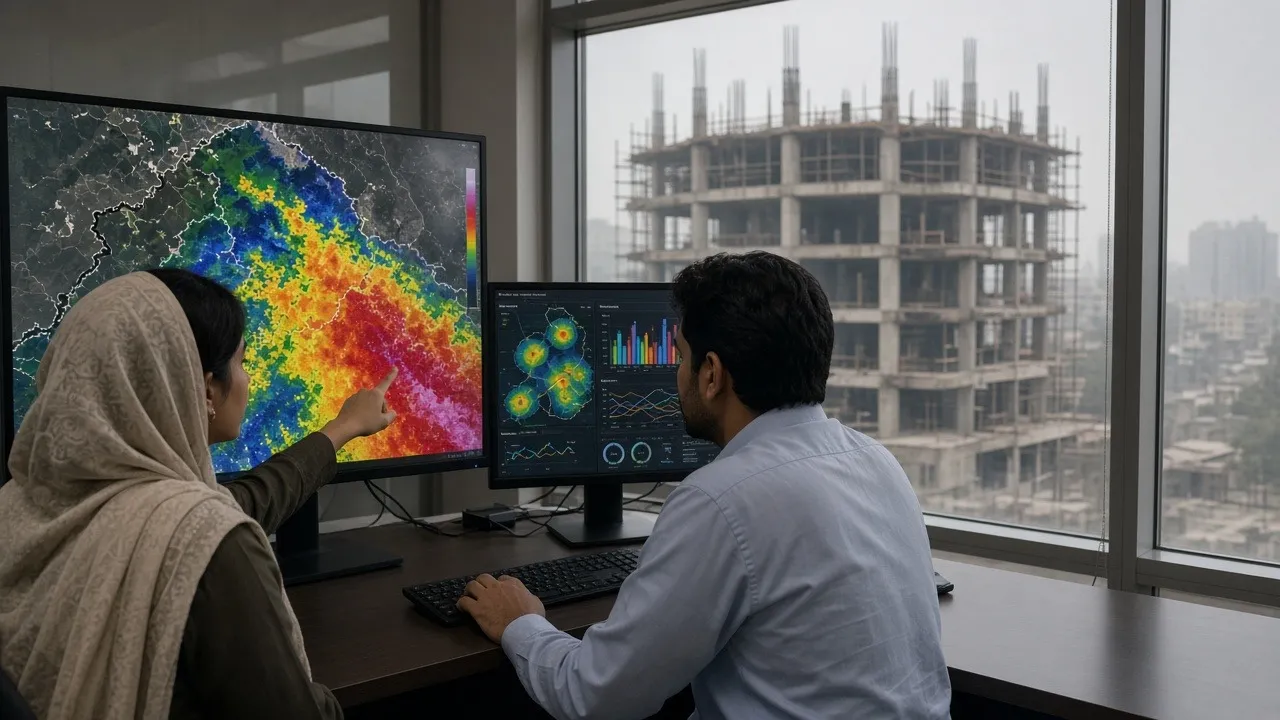
Pakistan Building Its First AI-Powered Climate Observatory
The Punjab government is building Pakistan's first artificial intelligence-powered climate observatory in Lahore, a facility meant to monitor environmental changes in real time and predict extreme weather and floods before they hit.
Punjab Chief Minister Maryam Nawaz Sharif shared a first look at the construction work on X on Sunday, calling the Punjab Climate Observatory the first facility of its kind in the country.
What the Observatory Will Do
According to the chief minister, the observatory will run an AI-based climate intelligence system that tracks air quality, water, soil and weather in real time. It will also handle advanced forecasting to strengthen early warning systems, flood forecasting and climate preparedness.
The facility will bring environmental data, research laboratories, learning spaces and international scientific partnerships under one roof. Its work is expected to cover disaster rehabilitation, water conservation, sustainable resource management, climate-resilient agriculture and forest conservation, along with evidence-based policymaking and public awareness.
Project Background and Timeline
The project was approved in May 2025 after a review of its feasibility plan, including its budget, equipment, and land. The University of Engineering and Technology (UET) Lahore also presented a technical report on the proposed facility. In June 2025, the chief minister directed the relevant departments to speed up construction.
Maryam Nawaz said the observatory is aimed at empowering the next generation of climate scientists and positioning Punjab as a regional leader and international partner in climate innovation. The province has also been named the lead agency for a $10 million youth climate grants project.
Understanding Climate Vulnerability in Punjab
Punjab is home to millions of residents and faces severe seasonal shifts, ranging from intense summer heatwaves to heavy monsoon rains that frequently trigger riverine and urban flooding. Agriculture forms the backbone of the regional economy, making crop yields highly sensitive to unpredictable precipitation patterns and shifting temperatures. Air pollution, particularly during the winter months in Lahore, poses persistent public health challenges that require continuous tracking and scientific analysis. Traditional meteorological methods often struggle to provide localized, real-time insights needed for rapid emergency response. Establishing a centralized facility addresses these gaps by merging modern computing power with environmental science.
How Artificial Intelligence Transforms Weather Forecasting
Artificial intelligence models process vast amounts of historical meteorological data at speeds far exceeding human capability or legacy computer programs. By recognizing complex patterns in atmospheric pressure, wind currents, and surface temperatures, machine learning algorithms generate reliable forecasts days in advance. In the context of flood forecasting, AI systems analyze upstream river levels and rainfall distribution to pinpoint exact areas at risk of inundation. This technological leap allows disaster management authorities to evacuate vulnerable populations and secure infrastructure before disaster strikes. Integrating these capabilities into the new Lahore observatory marks a major shift toward proactive disaster risk reduction in the region.
The Role of Academic and International Partnerships
The involvement of the University of Engineering and Technology Lahore highlights the integration of local academic expertise into public sector development. Technical reports and feasibility assessments provided by engineering specialists ensure that the physical infrastructure and digital architecture meet rigorous scientific standards. Furthermore, housing international scientific partnerships under the same roof encourages cross-border collaboration on global environmental challenges. Researchers from different countries will be able to share datasets, test new methodologies, and coordinate responses to shared ecological threats. This collaborative environment also supports educational programs for students specializing in environmental engineering, data science, and atmospheric research.
Broader Environmental Strategy and Economic Impact
Beyond immediate weather tracking, the facility supports long-term resource management through dedicated research laboratories and data platforms. Water conservation strategies benefit from precise soil moisture tracking and groundwater level assessments, which help agricultural planners optimize irrigation schedules. Sustainable resource management policies rely on the evidence gathered by the observatory to enact regulations protecting local ecosystems and forested areas. By championing climate-resilient agriculture, the provincial administration aims to safeguard farm incomes against erratic weather shocks. The inclusion of disaster rehabilitation studies ensures that post-disaster recovery efforts are guided by empirical data rather than short-term estimations.
Empowering Youth and Fostering Climate Innovation
Investing in advanced technological infrastructure creates pathways for young scientists, engineers, and data analysts to build careers within the country. The administration emphasizes youth empowerment as a core pillar of its broader environmental strategy, ensuring that local talent drives future policy formulation. Being designated as the lead agency for a $10 million youth climate grants project reinforces this commitment by providing financial resources for innovative grassroots initiatives. These grants enable young entrepreneurs and researchers to test green technologies, develop community-level adaptation strategies, and contribute directly to sustainability goals. Through these combined efforts, the province seeks to establish itself as a recognized hub for environmental technology development across South Asia.





