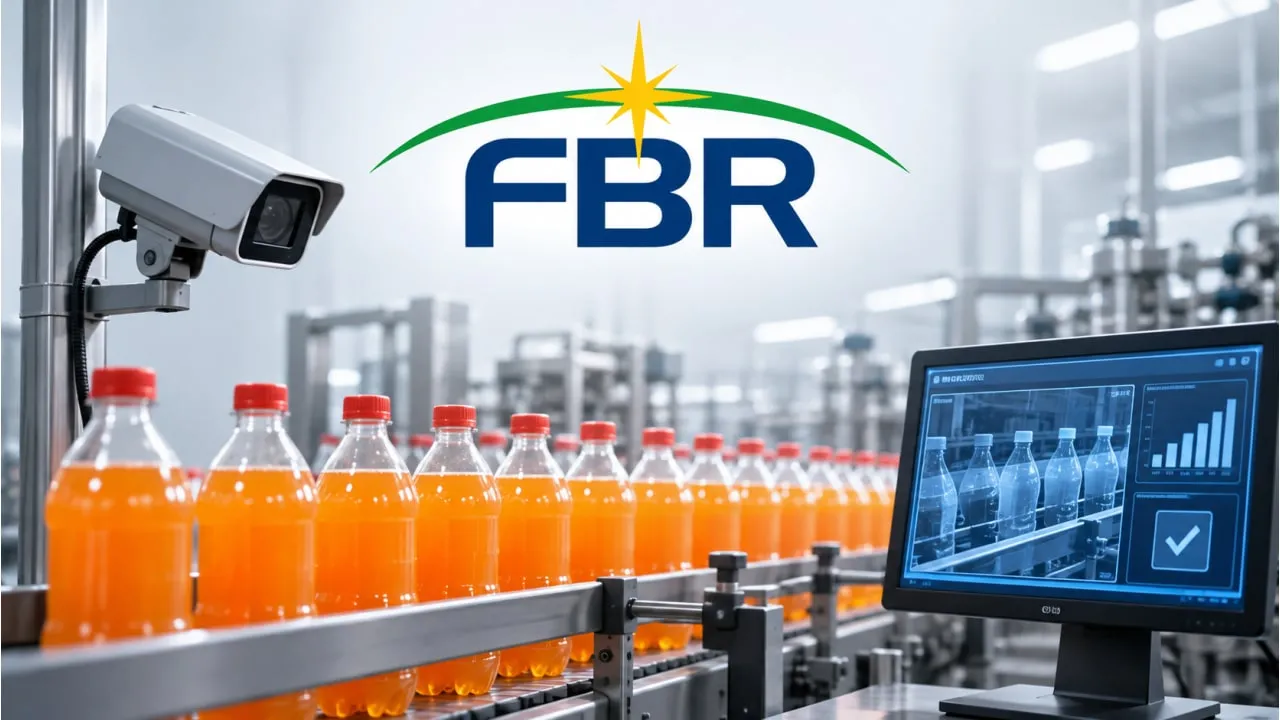
The Federal Board of Revenue (FBR) has identified 54 beverage companies required to install electronic production monitoring systems as part of its efforts to curb tax evasion and improve oversight of the sector.
The list covers manufacturers of bottled water, packaged juices, milk, and carbonated beverages.
The companies include Coca-Cola Pakistan, Lotte Akhtar Pepsi, Nestle Pakistan, Murree Brewery, Gourmet, Shezan, Fauji Foods, Haleeb Foods, Engro Foods' Olpers, Pakola Products, Qarshi Industries, and Shakarganj Food Products.
Why the FBR Is Introducing Mandatory Production Tracking
Electronic production monitoring is a digital solution that records every unit produced at a plant, timestamps the data and transmits it to the tax authority in real time. Under the Sales Tax Act, 1990, the FBR can require such systems where there is a high risk of under-declaration of output, which directly reduces taxable sales.
Pakistan's beverage sector accounts for a sizable share of the country's excise and sales-tax revenue. Historically, the sector has faced allegations of under-reporting volumes, especially for high-margin carbonated drinks and premium bottled water. By mandating electronic monitoring, the FBR aims to create an auditable trail that matches factory records with tax filings.
What the New Sales Tax General Order (STGO) No. 37 of 2026 Stipulates
Issued on Tuesday by the Inland Revenue Operations Wing, STGO No. 37 expands the list of approved vendors and clarifies compliance requirements. The order references Section 40C(2) of the Sales Tax Act, 1990 and Rules 150ZQR and 150ZQT of Chapter XIV-BA of the Sales Tax Rules, 2006, which together define the technical standards for data capture, encryption, and reporting.
Key points of the order include:
- All 54 named manufacturers must have a compliant system installed within 90 days of the order's publication.
- Vendors must certify that their hardware and software meet the specifications in Rule 150ZQT.
- Businesses may choose any of the now-seven authorized vendors for installation, maintenance, and support.
Seven New Vendors Authorized to Supply Monitoring Systems
The FBR has authorized seven additional vendors to install, supply, and maintain electronic production monitoring systems across the beverage sector, expanding the pool of approved service providers under its digital monitoring framework.
According to the order, the new vendors are National Radio and Telecommunication Corporation (NRTC), Obsidian Technologies, Excellence Delivered (ExD) (Pvt.) Ltd., ISSM Labelling Solutions (Pvt.) Ltd., Tollink Pakistan (Private) Limited, AJCL (Pvt.) Ltd., and Authentik.
These companies were evaluated on criteria such as prior experience with industrial IoT solutions, cybersecurity certifications, and capacity to service large-scale production lines. Their inclusion is intended to foster competition, reduce implementation costs, and ensure that smaller manufacturers can access affordable technology.
Compliance Requirements for Vendors and Manufacturers
The latest order follows STGOs No. 3, 4, 6, and 7 of 2026, issued between May 15 and June 2, 2026, under Section 40C(2) of the Sales Tax Act, 1990, read with Rules 150ZQR and 150ZQT of Chapter XIV-BA of the Sales Tax Rules, 2006.
Vendors must ensure their systems can:
- Capture production count at each bottling or packaging line automatically.
- Encrypt data using FBR-approved algorithms before transmission.
- Provide a web-based dashboard for both the manufacturer and the FBR audit team.
- Generate audit logs that retain at least 12 months of historical data.
The FBR has directed all authorized vendors to ensure their production monitoring systems comply with the requirements prescribed under Rule 150ZQT of the Sales Tax Rules, 2006, and paragraph 6 of the relevant Sales Tax General Orders.
Registered businesses covered by earlier orders may now hire any of the seven newly approved companies, giving them flexibility to select a provider that matches their technical and financial needs.
Other Beverage Companies Subject to Monitoring
In addition to the 54 named firms, a broader list of manufacturers is expected to fall under the monitoring regime once the systems are operational. The following companies have been identified in the FBR's internal briefing as likely candidates for future inclusion:
| Al-Hidaya Food Stuff (Sufi Water) | Al-Hilal Industries | Achha Foods | Aiman Foods & Beverages |
| Al-Badar Manufacturing | Aiman Foods & Beverages | Ajmair Foods | ANC Foods |
| ARD Foods | At-Tahur | Benz Juice Industries | Beverage Plus, |
| Cider Foods (Makka Cola) | CitroPak | CN Pak | Evolve Foods |
| Five Star | Fluid Technologies (Vey Waters) | Gul Bottlers | Haidri Beverages |
| Hajvery Beverages (OG Cola) | Ismail Global Pakistan | Juice Pack Industries | King Beverages |
| Malmo Foods | Mashmoom | Master Beverages Gujranwala | Meezan Beverages |
| Mehran Bottlers | Naubahar Bottlers | Nishat Sutas Dairy | Northern Bottling |
| Pakistan Beverages | Popular Juice | Punjab Beverages | Pure Foods |
| Pure Pack (Aab-e-Dubai) | Quice Industries | Rifson Foods | Sapphire Dairies |
| Sharif Milk Products (Anhaar) | Six B Industries | Sukkur Beverages |
These firms operate across the same subsectors, bottled water, packaged juices, packaged milk, and aerated beverages, meaning they will eventually need to integrate the same electronic monitoring technology.
Impact on the Beverage Industry and Consumers
For large multinational players such as Coca-Cola Pakistan and Nestle Pakistan, the requirement is largely procedural because they already use advanced ERP and production reporting tools. However, the FBR's order may necessitate additional hardware upgrades and integration work, incurring short-term capital expenditure.
Smaller domestic producers could face higher relative costs, especially if they must contract a new vendor. The inclusion of seven approved vendors is intended to mitigate this by fostering price competition.
From a consumer standpoint, the initiative is unlikely to affect product prices directly. The FBR expects that improved tax compliance will broaden the tax base, potentially stabilising revenue streams that fund public services.
What Comes Next: Implementation Timeline and Oversight
The FBR has set a 90-day deadline for the 54 listed manufacturers to have compliant systems fully operational. After installation, each system will undergo a certification audit by an FBR technical team. Only after certification will the manufacturers be considered fully compliant.
Failure to meet the deadline could trigger penalties under Section 40C(2) of the Sales Tax Act, including fines up to 10 % of the assessed tax liability and possible suspension of sales-tax registration.
Monitoring will be an ongoing process. The FBR plans quarterly data reviews and random on-site inspections to verify the integrity of the transmitted information. The agency also announced that it will publish an annual compliance report, detailing the number of firms that have met the requirements and any discrepancies detected.
Practical Takeaways for Beverage Producers
Manufacturers should immediately:
- Contact one of the seven authorized vendors to obtain a project proposal and timeline.
- Review Rule 150ZQT to ensure internal IT teams understand the encryption and data-retention standards.
- Allocate budget for hardware, software licensing, and possible training for plant staff.
- Prepare documentation for the FBR certification audit, including system architecture diagrams and data flow charts.
By acting promptly, firms can avoid penalties and demonstrate compliance, which may also improve their standing with banks and investors who view robust tax practices as a risk-mitigation factor.
The FBR's move reflects a broader shift toward digital tax administration in Pakistan, echoing similar initiatives in customs, property registration and e-invoicing. As the government continues to modernise its revenue collection, other sectors such as pharmaceuticals and textiles may soon face comparable electronic monitoring mandates.





