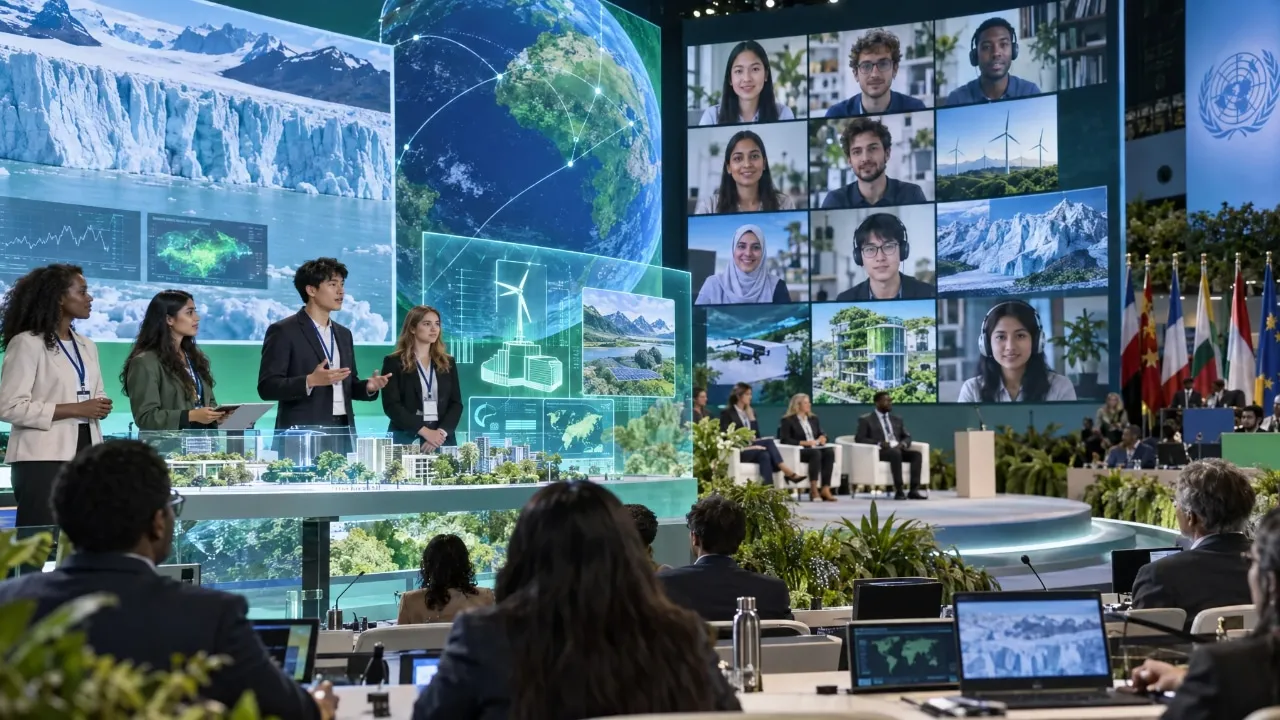
Pakistan has proposed the creation of a virtual green university through worldwide academic cooperation, alongside a special fund to assist youth-led climate innovations, during international discussions on environmental resilience.
Federal Minister of Environmental Coordination and Climate Change Dr Musadik Malik announced these initiatives at a session titled From Learning Campuses to Climate Solutions: Advancing Climate Resilience Through Education, Innovation and Partnerships. The event took place on the fringes of the UN Climate Change Conference, known as COP31, held in Antalya, Turkey, and was arranged in association with the Islamabad Electric Supply Company, also referred to as IESCO.
Pakistan Proposes Virtual Green University at COP31
The core objective of the virtual green university proposal is to transform theoretical climate knowledge and research into practical, real-world solutions. Dr Malik emphasised the necessity of moving beyond standard conference resolutions to achieve tangible results, stating that Pakistan aims to build an international platform where researchers, academic institutions, and students can cooperate on climate issues.
Under this proposed framework, international academic institutions are invited to participate in joint research programmes, virtual research centres, and faculty and student exchanges. The initiative is designed to bring together graduate students, experienced researchers, and scholars, with a particular focus on developing countries, to generate localized knowledge for pressing environmental challenges.
Offering Glacier Research Facilities and Data
As part of the academic outreach, Dr Malik offered Pakistan's research facilities, glacier-related data, and primary research support to international scientists. This offer targets researchers interested in studying mountain ecosystems and the changing cryosphere.
The minister noted that mountain regions are often among the first geographic areas to experience the severe impacts of cryosphere changes. He warned that shifts in these elevated regions carry serious consequences for downstream plains in the coming years, making collaborative study an urgent priority.
To facilitate this, the country is prepared to make relevant data and academic resources accessible while supporting foreign researchers who wish to work alongside local institutions.
Establishing the Greenfield Fund for Young Innovators
The second major proposal introduced by Dr Malik is the Greenfield fund, which is intended to provide direct financial support to climate-related ventures and innovative ideas developed by young people.
A fund has already been announced, and a board has been established featuring a proposed five-member team. This team includes investment and private-sector expertise to evaluate promising concepts and help finance their development.
Access to risk capital was highlighted as a primary requirement for encouraging young inventors, as many viable ideas fail to reach commercialisation due to a lack of financial backing.
Urging institutional commitment, Dr Malik stated, Place your bets on your children, not on conferences and resolutions, while calling on leaders to provide the resources needed to turn innovative thoughts into operational solutions.
Expanding Innovation Beyond Science and Technology
During the session, the minister argued that innovation should not be strictly limited to science and technology fields. Instead, he suggested that valuable ideas can originate from arts, music, literature, history, drama, and modern business models.
The convergence of these diverse disciplines can generate creative answers that carry both economic and social value for society. Drawing on international examples, he pointed to the experiences of China and Finland to illustrate how public demand and environmental pressures create market opportunities.
China's development of advanced solar technology and Finland's thriving environmental technology sector were cited as practical examples of successful innovation pathways.
Connecting Research, Education, and Entrepreneurship
Dr Malik also stressed the importance of linking every stage of the innovation pipeline, moving from initial idea generation and incubation to acceleration and commercialisation.
He noted that structured collaboration among academic institutions, government bodies, and private businesses is essential for this entire process to function smoothly. If properly implemented through operational funding structures and institutional partnerships, these proposals could establish a durable framework connecting climate education with practical entrepreneurship.





