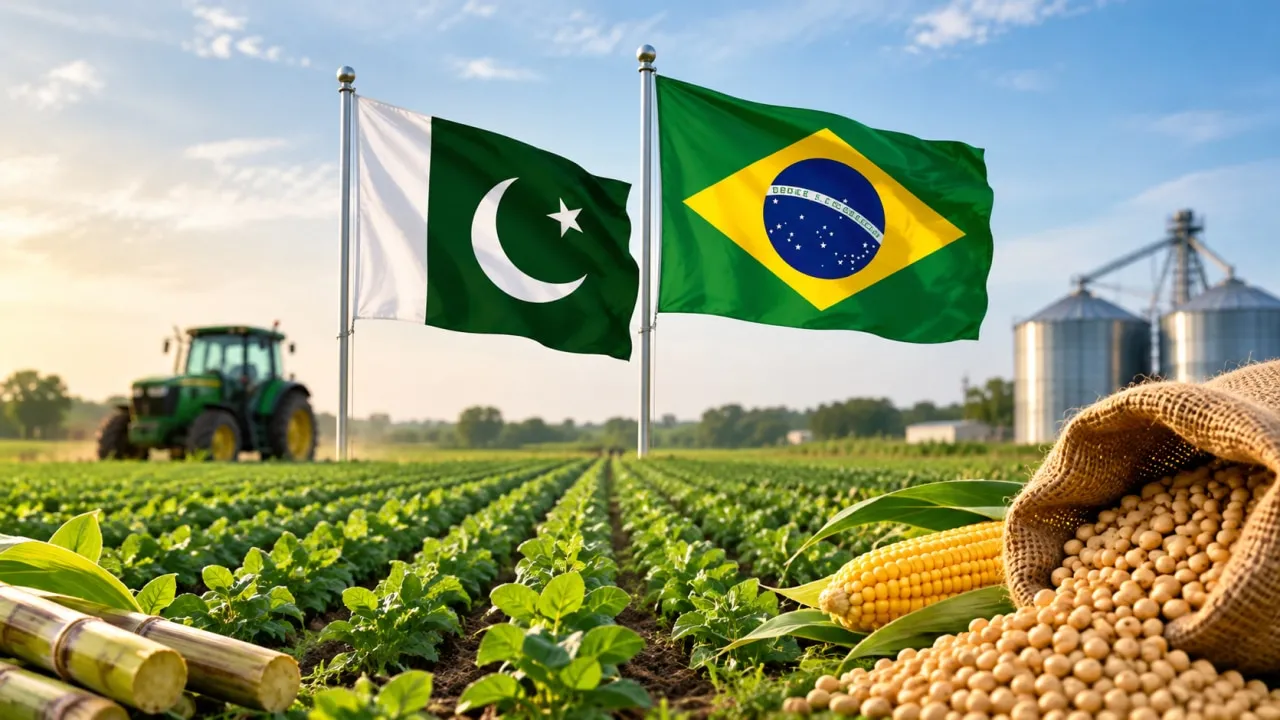
Pakistan will send a senior delegation to Brazil in January 2027 to examine the South American nation's agricultural model, a step approved by Prime Minister Shehbaz Sharif after a meeting between National Food Security and Research Minister Rana Tanveer Hussain and Brazilian Ambassador Olyntho Vieira in Islamabad on Wednesday.
The visit aims to identify technologies and practices that can be adapted to Pakistan's diverse agro-ecological zones, with a focus on research institutions, modern crop production methods and livestock development models.
Why Pakistan Is Turning to Brazil for Agricultural Guidance
Pakistan's agriculture sector contributes about 19.5% of its GDP and employs roughly 42% of the labour force. Yet the sector faces chronic challenges: water scarcity, low yields for staple crops such as wheat and rice, and limited access to modern inputs. Over the past decade, the government has launched several initiatives - from the Agriculture Emergency Programme to the establishment of the Pakistan Agricultural Research Council (PARC) - to boost productivity, but progress has been uneven.
Brazil, by contrast, transformed its agribusiness landscape in the last three decades, becoming one of the world's top exporters of soy, beef and coffee. The country's success rests on a combination of public-private research, large-scale mechanisation, and a strong emphasis on sustainable intensification. By studying Brazil's approach, Pakistani officials hope to replicate elements that suit local conditions, particularly in the Punjab and Sindh provinces where most of the country's arable land lies.
What the Delegation Will Examine in Brazil
The itinerary, still being finalised, will centre on three pillars: agricultural research institutions, modern farming techniques, and livestock development models.
Research Institutions - Embrapa and PARC Collaboration
Embrapa, Brazil's state-run agricultural research corporation, is a cornerstone of the country's agronomic advances. Founded in 1973, Embrapa operates more than 80 research centres covering crops, livestock, soils and climate adaptation. Its work on tropical soybeans, biofuels and disease-resistant cattle has set global benchmarks.
During the Islamabad meeting, both sides agreed to strengthen institutional cooperation between Embrapa and PARC. The partnership is expected to involve joint research projects, staff exchanges and co-development of crop varieties suited to Pakistan's semi-arid zones.
Modern Farming Techniques - Precision Agriculture and Mechanisation
Brazil's farms increasingly rely on precision agriculture tools - satellite-based soil mapping, variable-rate fertiliser application and real-time pest monitoring. These technologies have helped raise average yields for soybeans from 1.5 tonnes per hectare in the 1990s to over 3.5 tonnes per hectare today.
Pakistani officials will tour model farms in the states of Mato Grosso and Paraná, where large-scale mechanisation and integrated pest management are standard practice. The delegation will assess the feasibility of introducing similar equipment, such as combine harvesters and GPS-guided tractors, into Pakistan's smallholder-dominant landscape.
Livestock Development - Beef, Dairy and Disease Control
Brazil's cattle herd now exceeds 215 million head, making it the world's largest beef exporter. The country's success is linked to systematic breeding programmes, improved feed formulations and rigorous disease-control protocols, especially for foot-and-mouth disease (FMD).
Pakistan, with a livestock population of around 180 million, faces recurring FMD outbreaks that threaten trade and domestic consumption. The delegation will discuss Brazil's vaccination schedules, quarantine procedures and meat-processing standards, aiming to reduce disease incidence and open new export markets for Pakistani meat products.
Historical Context of Pakistan-Brazil Agricultural Ties
Diplomatic relations between Pakistan and Brazil date back to the 1950s, but agricultural cooperation has only gained momentum in the last fifteen years. In 2015, Brazil's Ministry of Agriculture signed a memorandum of understanding (MoU) with Pakistan's Ministry of National Food Security and Research to exchange information on tropical crop management. Subsequent visits by Pakistani scientists to Embrapa's headquarters resulted in joint publications on drought-tolerant wheat varieties.
Despite these steps, trade in agricultural goods remains modest. Brazil exports primarily soybeans, coffee and beef to Pakistan, while Pakistan's exports to Brazil are limited to rice and textiles. Strengthening research links could create a pipeline for technology transfer, potentially expanding bilateral trade volumes.
Potential Impact on Pakistani Farmers and the Economy
If successful, the knowledge transfer could raise crop yields by 10-15% on farms that adopt Brazilian-style practices, according to a preliminary estimate from the Ministry of National Food Security. Higher productivity would improve food security, reduce reliance on wheat imports, and stabilise domestic grain prices.
In the livestock sector, improved disease control could lower mortality rates by up to 5% annually, translating into an estimated Rs. 1.6 billion increase in meat production value. Moreover, better compliance with international sanitary standards could enable Pakistani exporters to access new markets in the Middle East and Europe.
Next Steps and Timeline
The delegation's travel is slated for January 2027. Upon return, the team will present a detailed report to the Prime Minister's Office and the Ministry of National Food Security. The report is expected to include specific recommendations on technology adoption, capacity-building programmes and budgetary requirements.
Following the report, the government plans to draft a bilateral implementation framework with Brazil, outlining joint research projects, funding mechanisms and timelines. No formal agreement has been signed yet, but officials indicated that a draft MoU could be ready by mid-2027.
Practical Takeaways for Stakeholders
- Farmers should monitor upcoming extension workshops that may introduce Brazilian-inspired seed varieties and fertiliser regimes.
- Livestock producers are advised to review current FMD vaccination schedules and prepare for possible upgrades in quarantine infrastructure.
- Agri-business investors may explore opportunities in importing precision-agriculture equipment, as demand is likely to rise after the delegation's findings are disseminated.
While the visit is still in the planning stage, the clear political backing from Prime Minister Shehbaz Sharif signals a long-term commitment to modernising Pakistan's agriculture through international cooperation.





