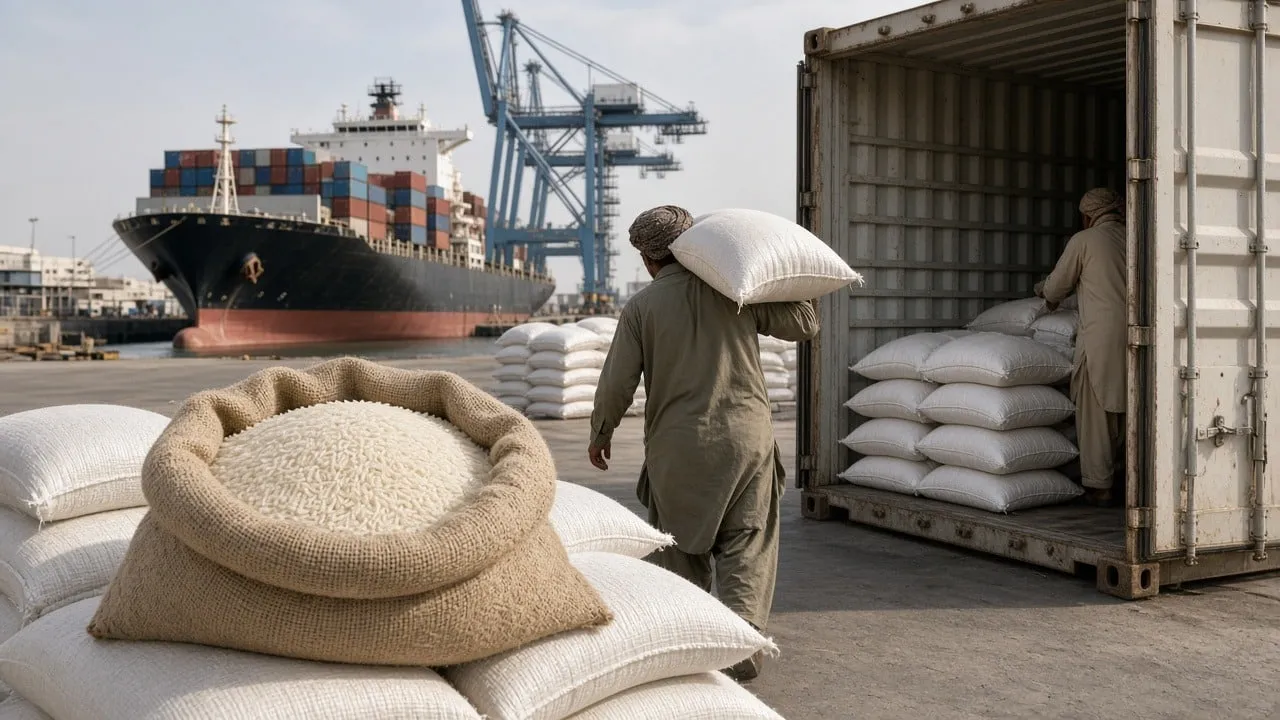
Pakistan's Basmati rice exports surged 62% in the first four months of the current fiscal year, reaching 301,000 tonnes between July and October 2026, even as shipping disruptions in the Red Sea, the Strait of Hormuz and the wider Middle East raised freight costs.
The jump came alongside a rise of 140,000 tonnes in non-Basmati shipments, taking total rice exports to 1.351 million tonnes for the period. The growth occurred despite heightened ocean freight charges, higher marine-insurance premiums and stiff competition from subsidised Indian rice.
What Drove the 62% Basmati Export Increase?
Analysts point to several converging factors. First, Pakistan enjoyed an unusually large Basmati harvest in 2026, with higher per-acre yields recorded across the Punjab and Sindh provinces. The Ministry of National Food Security reported that average yields rose from 4.2 tonnes per hectare in 2025 to 5.0 tonnes per hectare in 2026, a gain attributed to improved seed varieties and timely irrigation.
Second, the government extended the Drawback of Local Taxes and Levies (DLTL) scheme through September 2026. The DLTL refunds exporters for taxes paid on inputs such as fertilizers, pesticides and diesel, effectively lowering production costs. By keeping the scheme active longer than originally planned, the authorities gave exporters a cash-flow boost that translated into larger shipment volumes.
Third, large carry-over stocks from the previous year allowed traders to meet rising overseas demand without waiting for new crops to mature. In addition, a bigger cultivated area, estimated at an extra 150,000 hectares of Basmati fields, provided the physical basis for higher output.
Finally, favourable weather throughout the growing season, with average rainfall close to historic norms and limited pest outbreaks, helped secure the bumper harvest. Together, these elements created a supply environment that could absorb the higher freight rates caused by the Middle East crisis.
How Shipping Disruptions Affected the Trade
The Red Sea and the Strait of Hormuz have been flashpoints since early 2026, when regional tensions forced many container ships to divert around the Cape of Good Hope. The longer routes added 7-10 days to transit times and lifted ocean freight charges by roughly 15% on average, according to the International Chamber of Shipping.
Marine-insurance premiums also climbed, with underwriters raising rates by up to 30% for vessels passing through the high-risk corridor. Exporters absorbed part of the cost by negotiating lower freight contracts and by using larger vessels to achieve economies of scale.
Despite the added expense, Pakistani exporters remained competitive because the Basmati brand commands a premium in key markets such as the Middle East and the European Union. The premium offset the higher logistics bill, allowing Pakistan to retain market share even as Indian rice flooded the market at lower prices.
Non-Basmati Growth Amid Price Competition
Non-Basmati shipments rose by 140,000 tonnes year-on-year to 1.049 million tonnes. This segment faces intense price pressure from Indian rice, which benefits from government subsidies that keep export prices low.
In addition, Thailand, Vietnam, Cambodia and Myanmar have launched aggressive marketing campaigns and offered discounts to win contracts in Africa and the Gulf. Pakistani traders responded by focusing on quality, timely delivery and flexible payment terms, which helped preserve buyer confidence.
February 2026 saw a 35% drop in overall Pakistani rice exports after a surge of cheap Indian rice entered the market. The rebound observed in July-October demonstrates the resilience of Pakistani exporters when they combine policy support with a strong harvest.
Top Buyers in October 2026
October 2026 data show the Philippines as the single largest importer of Pakistani rice, taking 87,478 tonnes. The country's demand reflects its long-standing preference for Basmati aroma and grain length.
- Tanzania: 43,747 tonnes
- Kenya: 33,078 tonnes
- UAE: 25,305 tonnes
- European Union: 21,200 tonnes
- Central Asia: 16,400 tonnes
- China: 11,949 tonnes
- Saudi Arabia: 7,655 tonnes
These destinations illustrate the geographic breadth of Pakistan's rice market, spanning Africa, the Middle East, Europe and Asia. The diversification reduces reliance on any single region and buffers exporters against localized shocks.
Background: Pakistan's Rice Industry and the DLTL Scheme
Rice is Pakistan's second-largest agricultural export after textiles, generating roughly $3.5 billion in foreign exchange annually. Basmati, a long-grain aromatic variety, accounts for about 30% of total rice exports and commands the highest price per tonne.
The Drawback of Local Taxes and Levies (DLTL) scheme was introduced in 2018 to stimulate agricultural exports. Under the scheme, exporters receive a refund of taxes paid on inputs used in the production of exported goods, calculated as a percentage of the export value. The refund is paid after customs clearance, improving cash flow for farmers and traders.
Extension of the DLTL scheme through September 2026 was announced by the Ministry of Commerce in June 2026. The decision came after lobbying by the Pakistan Rice Exporters Association, which argued that the scheme's expiry would raise production costs at a time when global freight rates were already climbing.
Impact on Farmers, Traders and the Economy
Higher export volumes translate into better farmgate prices for rice growers. The Pakistan Bureau of Statistics reported an average farmgate price increase of 8% for Basmati in 2026 compared with 2025, partially due to the DLTL refunds and partially to the strong overseas demand.
Traders benefit from larger shipment sizes, which lower per-tonne shipping costs and improve profitability. Export-related services, freight forwarders, customs brokers and insurance firms, also see increased activity, supporting jobs in port cities such as Karachi and Port Qasim.
At the macro level, the rise in rice exports adds to the country's foreign-exchange earnings, helping to narrow the current-account deficit. The State Bank of Pakistan has highlighted agricultural exports as a key pillar of its 2026-27 economic stabilization plan.
What Comes Next: Monitoring Freight Costs and Market Shifts
Stakeholders are watching several variables that could influence the next reporting period. First, the security situation in the Red Sea and the Strait of Hormuz remains fluid; any escalation could further raise freight rates or force additional diversions.
Second, the Indian government is expected to announce a new subsidy package for rice exporters in early 2027, which could intensify price competition.
Third, climate forecasts for the 2027 cropping season suggest a potential shortfall in monsoon rainfall for parts of Punjab. A weaker harvest could reduce the supply cushion that helped sustain exports this year.
Exporters are therefore preparing contingency plans, including securing longer-term freight contracts, diversifying into alternative markets such as South America, and investing in post-harvest processing to improve grain quality.
Regulators have indicated that the DLTL scheme may be reviewed after September 2026, with a possibility of extension if export performance remains strong. Traders are advised to stay in close contact with the Ministry of Commerce for updates.
Practical Takeaways for Stakeholders
- Farmers should continue to adopt high-yield Basmati seed varieties and adhere to recommended fertilizer schedules to maintain the yield gains seen in 2026.
- Exporters need to factor higher freight and insurance costs into pricing models and consider bulk shipping to mitigate per-tonne expenses.
- Buyers in importing countries should monitor price trends, as the premium on Pakistani Basmati may tighten if freight costs rise further.
- Policy makers must assess the impact of extending the DLTL scheme beyond September 2026 to sustain the export momentum.