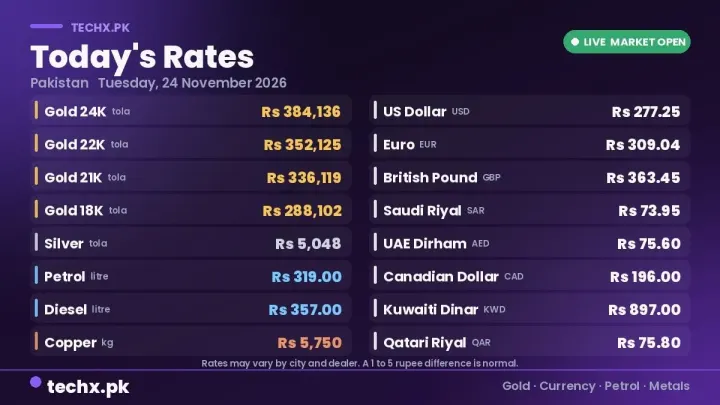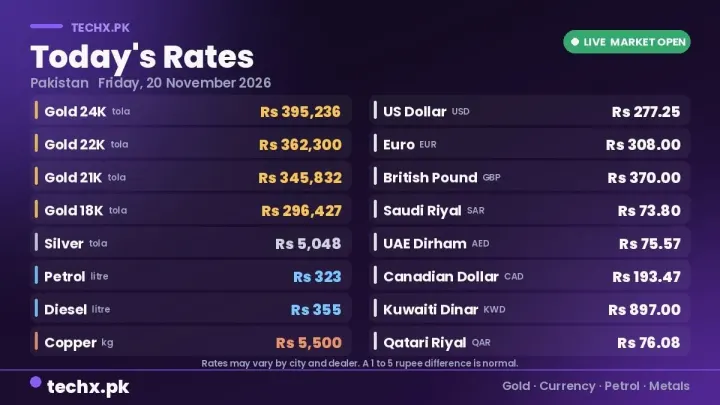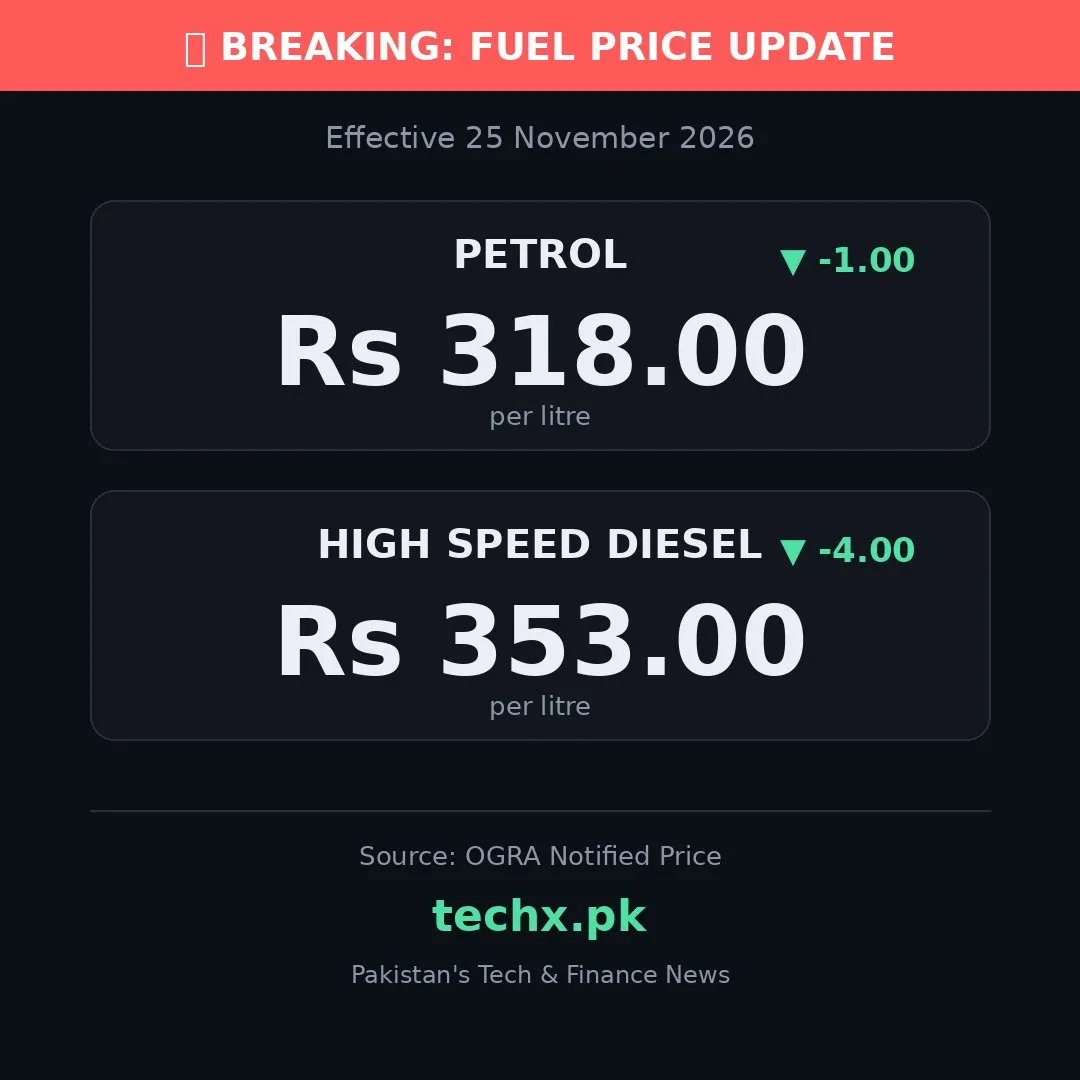
Pakistan's oil and gas regulator, the Oil and Gas Regulatory Authority (OGRA), announced a new set of fuel prices effective 25 November 2026, reducing the price of petrol (Super) by Rs 1.00 per litre to Rs 318.00 and lowering the price of High Speed Diesel by Rs 4.00 per litre to Rs 353.00.
The fortnightly revision comes as global crude oil markets softened and the Pakistani rupee showed relative stability against the US dollar, allowing the regulator to pass modest savings on to consumers.
What Are the New Fuel Prices?
OGRA published the following rates for 25 November 2026:
| Fuel | New Price | Change |
|---|---|---|
| Petrol (Super) | Rs 318.00 per litre | -Rs 1.00 |
| High Speed Diesel | Rs 353.00 per litre | -Rs 4.00 |
Both prices apply nationwide from the date of the announcement.
Why Did OGRA Adjust Fuel Prices Now?
OGRA reviews fuel tariffs every two weeks. The agency links its calculations to two main variables: the price of crude oil on international exchanges and the exchange rate of the Pakistani rupee. When crude oil prices decline, or when the rupee does not depreciate sharply, the regulator can reduce domestic fuel rates.
During the most recent review period, the price of Brent crude fell by roughly 2.5 percent, while the Pakistani rupee traded within a narrow band against the dollar. These market signals created a margin for OGRA to cut prices without jeopardising the financial health of fuel importers and distributors.
The larger cut in diesel reflects a sharper easing in the global diesel and furnace-oil markets. Diesel margins are typically tighter than those for gasoline, so a modest swing in international pricing can translate into a more pronounced domestic adjustment.
How Does the Price Cut Affect Different Segments?
Commuters and private car owners will see a Rs 1.00 reduction per litre at the pump. While the absolute saving per kilometre is modest, the cumulative effect over a month of regular driving can amount to several hundred rupees, easing household cash flow.
Transport operators - including truck owners, bus services, rickshaw drivers and operators of agricultural machinery - stand to benefit more significantly. Diesel powers the majority of commercial vehicles in Pakistan, and a Rs 4.00 per litre reduction translates into a noticeable decrease in operating costs. For a long-haul truck that consumes 30 litres per 100 km, the saving is roughly Rs 120 per 100 km, which can reduce freight rates and, indirectly, the price of food and other goods.
Industrial users that rely on diesel for generators or process heating also experience lower input costs, potentially improving profit margins for small-scale manufacturers and agro-based enterprises.
Historical Context of Fuel Pricing in Pakistan
Pakistan has a long history of fortnightly fuel price revisions dating back to the early 2000s. The practice was introduced to keep domestic fuel prices aligned with volatile global oil markets and to protect consumers from sudden spikes. Over the past decade, average annual adjustments have ranged from 3 percent to 8 percent, with occasional periods of double-digit hikes during global oil shocks.
Since 2018, the rupee's depreciation has been a major driver of price increases, as import costs rise. However, periods of relative currency stability, such as the first half of 2026, have allowed OGRA to implement reductions, as seen in the current announcement.
What Is OGRA's Mandate and How Does It Set Prices?
OGRA is an autonomous statutory body established under the Oil and Gas Regulatory Authority Act, 2002. Its core responsibilities include licensing, regulating tariffs, ensuring fair competition, and protecting consumer interests. When setting fuel tariffs, OGRA follows a formula that incorporates:
- International crude oil price (based on a weighted basket of Brent, WTI and Dubai grades)
- Exchange rate of the Pakistani rupee against the US dollar
- Logistics and handling costs incurred by importers
- Taxes and duties levied by the federal government
- A modest margin for oil marketing companies
The agency publishes its calculations in a detailed circular, which is then implemented by fuel retailers across the country.
What Should Consumers Do Now?
Consumers should verify the new rates at their nearest fuel station. Retailers are required to display the updated price per litre on signage at the pump. It is advisable to keep receipts for a short period in case of billing errors.
For those budgeting household expenses, the modest drop in petrol may allow a slight reallocation of funds toward other necessities. Transport businesses can use the diesel reduction to renegotiate freight contracts or to invest in maintenance, which may improve vehicle efficiency over the longer term.
What Comes Next for Fuel Prices?
OGRA's next scheduled review will occur on 9 December 2026, following the fortnightly cycle. Market watchers will monitor crude oil trends, the rupee's exchange rate, and any changes in government tax policy that could affect the next tariff set.
In the meantime, analysts caution that the global oil market remains susceptible to geopolitical events, which could reverse the current downward trend. Stakeholders are advised to stay informed through official OGRA releases and reputable financial news sources.
Overall, the 25 November 2026 price revision provides immediate, though limited, relief to Pakistani consumers and businesses, illustrating the regulator's role in translating global market movements into domestic price adjustments.