Punjab Approves Rs. 23.85 Billion Khushhal Dehat Program
The Punjab government has approved Rs. 23.85 billion for the Khushhal Dehat Program, an ambitious regional infrastructure initiative aimed at improving basic amenities in rural settlements across the province, with Rs. 50 million earmarked for development work in each village. This large financial commitment targets long-standing issues in the agricultural heartland, focusing heavily on modernizing civic amenities that have historically lagged behind urban centers.
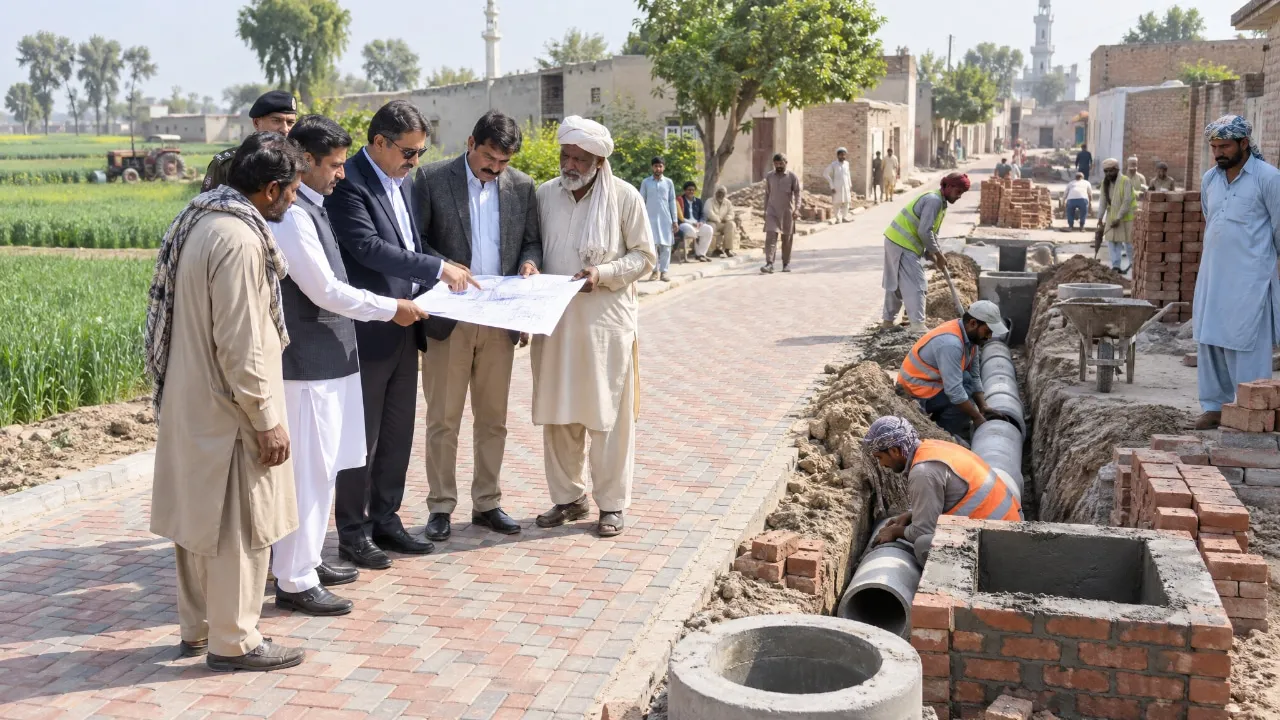
Chief Minister Punjab Maryam Nawaz Sharif said the first phase of the program would cover 475 villages, where paved streets and a proper sewerage system would be developed. She directed the authorities to release the first instalment of funds to village development committees by November, setting a strict timeline for local administration to disburse resources and initiate ground-level engineering work.
Understanding the Khushhal Dehat Program and Rural Infrastructure
Rural communities in Punjab have traditionally faced systemic challenges regarding sanitation, drainage, and internal transportation networks. The Khushhal Dehat Program seeks to address these disparities by injecting capital directly into grassroots development projects. By allocating Rs. 50 million per village in the opening stage, the provincial administration intends to fund tangible upgrades that transform daily life for millions of residents.
Paved streets reduce mud accumulation during monsoon seasons, improve pedestrian safety, and allow better access for emergency vehicles. Meanwhile, proper sewerage systems prevent stagnant wastewater from pooling in residential zones, significantly reducing waterborne illnesses and improving public health standards across agrarian districts. These foundational improvements form the core of the government development strategy.
Phase One Rollout and Village Selection
The initial phase of the Khushhal Dehat Program focuses on 475 villages distributed across the province. Selecting these settlements involves evaluating existing infrastructure deficits and prioritizing communities with the most urgent needs. Local councils and district administrations coordinate closely with provincial authorities to ensure that funds are directed where they will generate the greatest positive impact for residents.
Chief Minister Maryam Nawaz Sharif instructed relevant departments to maintain transparency and efficiency as the rollout begins. By establishing a clear deadline of November for the release of the first instalment of funds to village development committees, the administration aims to prevent bureaucratic delays that frequently stall public sector projects.
Oversight Committees for Project Transparency
To ensure proper utilization of the Rs. 23.85 billion allocation, the government has established strict monitoring mechanisms. Under the programme, a committee comprising five government and four private members will oversee development projects, balancing bureaucratic accountability with local community representation.
The administrative structure of these monitoring bodies is clearly defined to avoid conflicts of interest and inefficiency. The relevant additional Deputy Commissioner (social services) will head the committee, which will also include the union council chairman and the concerned sub-engineer. This multi-tier oversight ensures that engineering standards are met and public funds are spent strictly according to financial regulations.
Second Phase in the Works and Future Expansion
Even as the initial rollout begins, planning for subsequent stages is already underway. The Chief Minister has also sought a development plan for another 2,000 villages in the second phase of the initiative, signaling a long-term commitment to rural renewal across the entire province.
This planned expansion demonstrates the provincial government scaling up its administrative machinery to reach a much larger segment of the rural population. Officials are currently mapping out infrastructure gaps in these prospective locations to prepare project proposals and cost estimates for future budget cycles.
Non-Discriminatory Development Across Punjab
A central tenet of the policy is equitable distribution of state resources without regard to political affiliations or electoral outcomes. Provincial leadership has emphasized that infrastructure funding must serve the public interest universally rather than favoring specific constituencies.
She said the provision of paved streets and an organised sewerage system in every village across Punjab was a priority, adding that development would be carried out across both urban and rural areas without discrimination on political grounds. Expanding on this inclusive governance model, she stated, \u201cDevelopment programs and resolution of public issues are the right of every area of Punjab,\u201d adding that political affiliations would not be allowed to hinder the province\u2019s development process.





