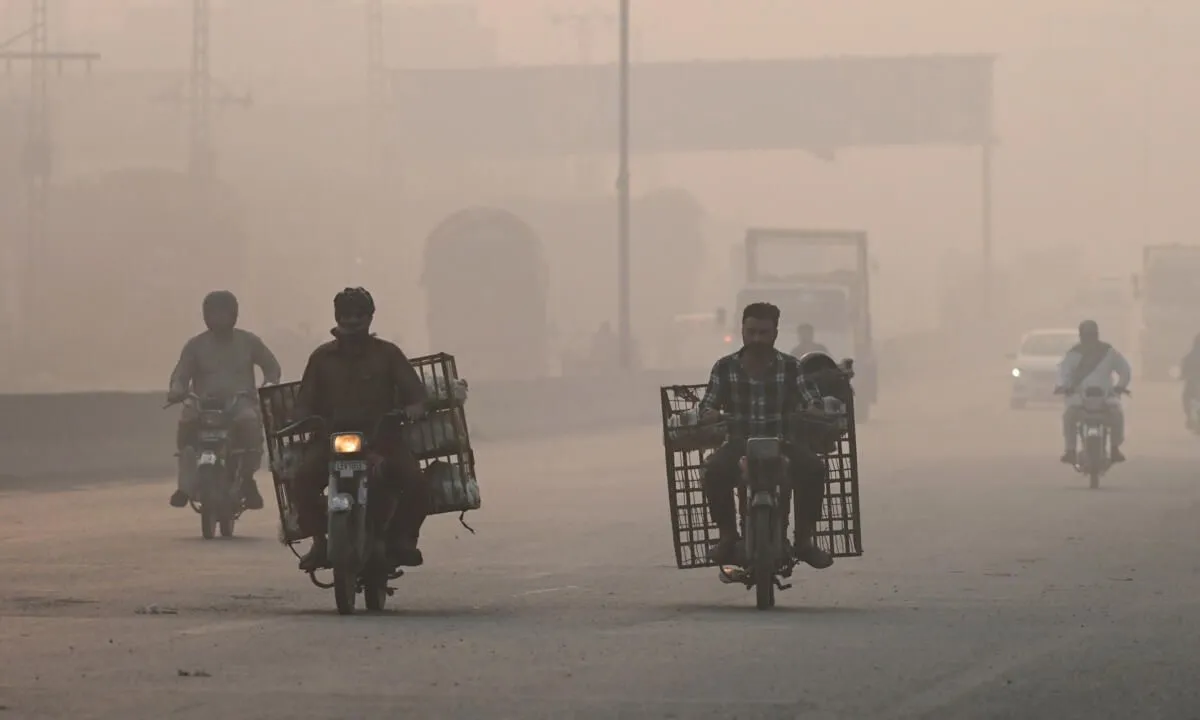
Environmental experts, researchers and residents have urged the Punjab government to publish true air pollution readings after its official dashboard was found to display a maximum Air Quality Index (AQI) of 500, even when actual levels go higher. The government says the cap does not mean any data is being hidden.
Why the AQI Cap Matters
The Punjab Environmental Protection Agency (EPA) runs a real-time AQI dashboard that measures air quality on a scale of zero to 500, divided into seven categories ranging from "Good" to "Hazardous." When pollutant concentrations push the index above 500, the screen continues to show the maximum value, preventing the public from seeing whether the air quality is at 600, 700 or worse.
Senior Provincial Minister Maryam Aurangzeb defended the practice, noting that several countries, including the United States, set 500 as the upper limit of the index. She said the government has no intention of concealing data and that any reading above 500 is regarded as hazardous.
How the AQI System Works
The AQI is a composite metric that translates concentrations of key pollutants, primarily particulate matter (PM2.5 and PM10), ozone, nitrogen dioxide, sulfur dioxide and carbon monoxide, into a single number. In the United States, the Environmental Protection Agency (EPA) defines 500 as the top of the standard scale, but the agency also acknowledges that extreme events can produce values beyond that ceiling. For such cases, the U.S. EPA recommends a "Beyond the AQI" reporting method that records the actual pollutant concentration while still flagging the situation as hazardous.
Maryam Shah, an expert with the Pakistan Air Quality Initiative (PAQI), explained that a capped reading does not by itself indicate concealment, because 500 already signals extremely dangerous air in which people should avoid all outdoor activity. However, she added that countries calculate AQI differently depending on the dominant pollutant, and that in Pakistan and the broader South Asian region the actual PM2.5 concentration is a more effective measure of severity. She urged that PM2.5 readings be displayed alongside the AQI on official portals.
Legal and Scientific Perspectives
Environmental lawyer Altamash Saeed praised the public release of real-time data from the government's monitoring network as a positive step, but warned that a single index cannot convey the full state of the air. He argued that citizens should also have access to the actual concentrations of individual pollutants and to spatial variations across districts.
The cap also limits research. Noshin Fatima, a Punjab University student, said a figure fixed at 500 prevents any meaningful comparison of pollution levels across different areas, hindering academic studies and policy analysis.
Public Concerns and Accusations
Some residents doubt the government's reasons for the limit. Abdul Rehman of Gulberg said the cap could make air quality appear better than it is, and alleged that real readings are not being shown in order to highlight the government's efforts to reduce pollution.
WWF-Pakistan Director General Hammad Naqvi emphasized that every citizen has a basic right to accurate air-quality information to protect their health and that of their families. He called for an end to any practice that censors data at the 500 mark.
Regional Context: Delhi, Lahore and Punjab
Yesterday, Delhi overtook Lahore as the most polluted major city in the world, with an AQI of 334, classified as hazardous by IQAir. The Delhi pollution board recorded an even higher reading of 403. By 11 am PKT, Delhi's AQI had improved to 208, while Lahore ranked seventh globally at 155.
A Pakistan Air Quality Initiative report found that the average PM2.5 concentration in Lahore was 126 µg m⁻³, eight times the World Health Organization (WHO) guideline of 15 µg m⁻³. Pollution exceeded national standards on all 40 days with valid data during the monitoring period.
Satellite monitoring detected 18 825 fires across Punjab, Pakistan, with 89 percent linked to likely crop-residue burning, a known driver of seasonal spikes in particulate matter.
What the Cap Means for Citizens
When the dashboard stops at 500, residents cannot gauge whether the air is merely hazardous or entering a "extremely hazardous" range that would demand emergency measures such as school closures, suspension of outdoor work, or distribution of masks. Health advisories currently rely on the generic "hazardous" label, which may not trigger the strongest protective actions.
Medical professionals in Punjab have warned that prolonged exposure to PM2.5 levels above 300 µg m⁻³ can exacerbate asthma, cardiovascular disease and premature mortality. Without precise data, vulnerable groups, including children, the elderly and people with pre-existing conditions, cannot make fully informed decisions.
Next Steps and What to Watch For
The Punjab EPA has indicated that the cap is a technical limitation rather than a policy choice. Officials have not announced a timeline for upgrading the dashboard to display values beyond 500 or to add separate PM2.5 figures.
Stakeholders are calling for three concrete actions:
- Publish real-time PM2.5 concentrations alongside the AQI.
- Adopt the "Beyond the AQI" reporting format used by the U.S. EPA for extreme events.
- Provide downloadable datasets that researchers and NGOs can analyze for spatial and temporal trends.
Watch for any official press releases from the Punjab EPA in the coming weeks, as well as statements from the federal Ministry of Climate Change, which oversees provincial environmental agencies. Civil-society groups have pledged to file a public-interest litigation if the cap remains unchanged.
In the meantime, residents can use independent air-quality apps that pull data from satellite-derived estimates and ground-based sensors operated by NGOs. These platforms often display PM2.5 levels without the 500 ceiling, offering a more granular view of local conditions.
Practical Takeaways for Readers
Until the official dashboard is updated, citizens should:
- Check multiple sources, including independent apps and local news, for real-time PM2.5 readings.
- Limit outdoor activities when AQI is reported as 500 or higher, especially for children and those with respiratory issues.
- Advocate for transparent data by contacting local representatives and supporting NGOs that monitor air quality.
Accurate, uncapped data is essential for public health, research, and policy-making. The current limitation hampers all three, and pressure is building for the Punjab government to align its reporting with international best practices.





