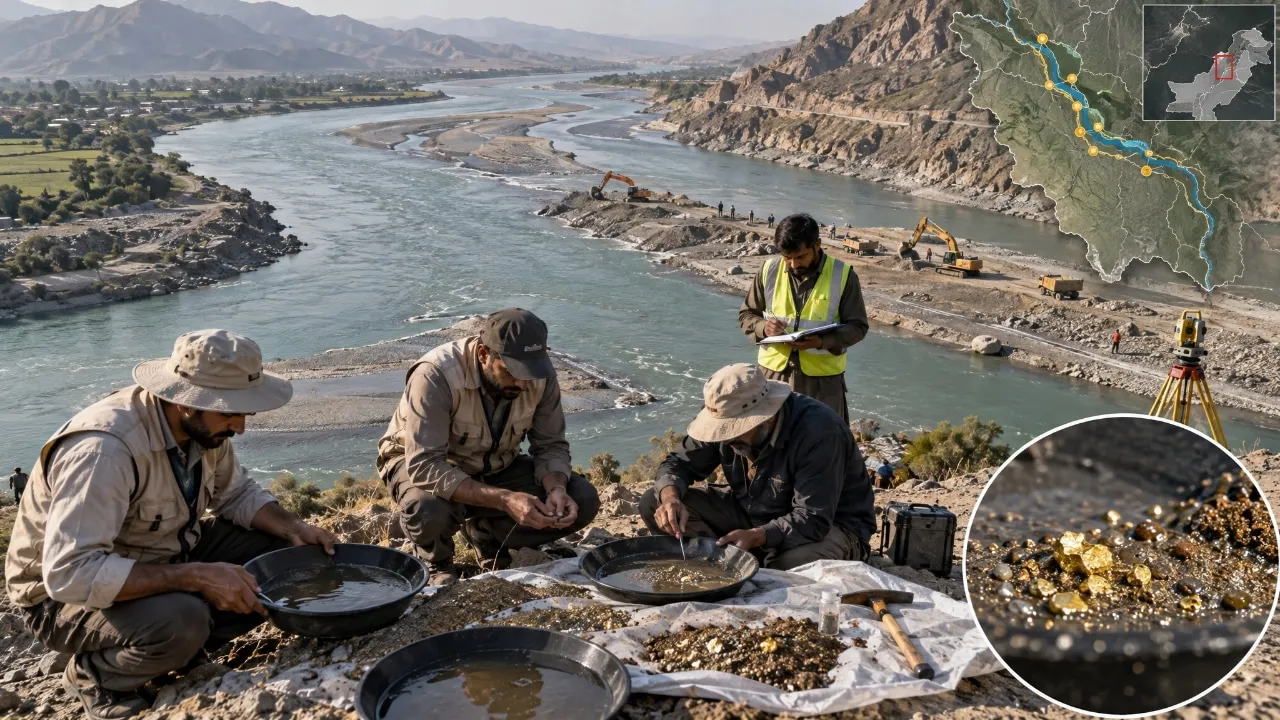
Location of 75,000 Tolas of Gold Confirmed in Rivers of Punjab
Significant progress has been made in the search for gold reserves in Punjab's rivers, with a preliminary NESPAK report revealing the presence of 75,000 tolas of gold in a single block. Provincial authorities and mineral departments have focused heavily on alluvial mining potentials across specific water channels in the region, marking a major turning point for local resource exploration.
Provincial Minister for Minerals Sardar Sher Ali Gorchani confirmed the presence of gold reserves in Punjab's rivers, saying the deposits in Attock, Mianwali and the Sutlej river areas have been divided into nine blocks. This division aims to streamline future exploration efforts and attract specialized mining firms to distinct zones with proven mineral wealth.
Value and Investment of Punjab Gold Reserves
According to the provincial minister, the initially discovered 75,000 tolas of gold are worth more than Rs30 billion, while approximately Rs20 billion in investment will be required to extract the gold. This capital requirement covers the specialized machinery, heavy engineering equipment, and operational manpower needed to dredge and process riverbed sediments effectively.
He said the total value of the gold reserves could reach hundreds of billions of rupees. The Geological Department's report also revealed the presence of 480,000 tolas of gold in two blocks, pointing to a much larger economic footprint than initially anticipated by regional planners.
Understanding Alluvial Gold Mining in River Basins
Alluvial gold deposits form over thousands of years as natural weathering breaks down auriferous rocks in upstream mountain ranges. Rivers and streams then transport these heavy gold particles downstream, where they settle in specific gravel bars, river bends, and floodplains. The geographical makeup of Punjab, featuring major rivers flowing from northern mountain ranges, creates ideal natural traps for heavy mineral accumulation.
Extracting this gold requires careful environmental management to protect local aquatic ecosystems while recovering microscopic or placer gold flakes from river sand and gravel. Modern suction dredging, gravity separation tables, and washing plants are typically employed in such riverine environments to separate dense gold from lighter river sediments without causing excessive downstream silting.
The Role of NESPAK and Geological Surveys
The National Engineering Services Pakistan, commonly known as NESPAK, plays a central technical role in evaluating public infrastructure and resource projects across the country. In this initiative, NESPAK engineers and geologists conduct rigorous topographical mapping, core sampling, and sediment analysis to measure exact mineral concentrations. Their preliminary findings provide the empirical data required by the provincial administration to establish viable mining leases.
Working alongside the Geological Department, NESPAK surveyors systematically test different sections of riverbeds to map out commercial viability. Their detailed technical assessments reduce the exploratory risk for future commercial operators by providing verified volumetric estimates of gold-bearing sediment within each designated mining block.
Geographical Breakdown of Attock, Mianwali and Sutlej Regions
The newly identified mineral blocks span several distinct hydrological zones within Punjab, each presenting unique operational characteristics. The Attock region, situated near major confluence points of historic rivers, features rocky riverbeds and swift currents that historically trap heavy minerals. Mianwali brings its own riverine topography, shaped by major water flows running through western parts of the province.
Meanwhile, the Sutlej river areas extend across vast agricultural plains where ancient river channels have shifted over centuries. Dividing these diverse geographic zones into nine distinct blocks allows mining authorities to manage environmental oversight and auction procedures more efficiently, tailoring requirements to the specific physical conditions of each site.
The Way Forward and International Auction Plans
According to the government, NESPAK has begun surveys to determine the amount of gold in the remaining blocks. Once final reports for all blocks are compiled, an international auction process will be initiated for the exploration and extraction of the gold reserves. This competitive bidding framework is designed to draw experienced global mining conglomerates with the financial capacity and technical expertise required for large-scale riverbed operations.
State regulators intend to establish transparent contractual guidelines during the upcoming auction phase to ensure a fair return for the provincial exchequer. Observers and industry stakeholders are closely watching these developments as the government moves from preliminary geological surveys toward commercial exploitation of the river gold.





