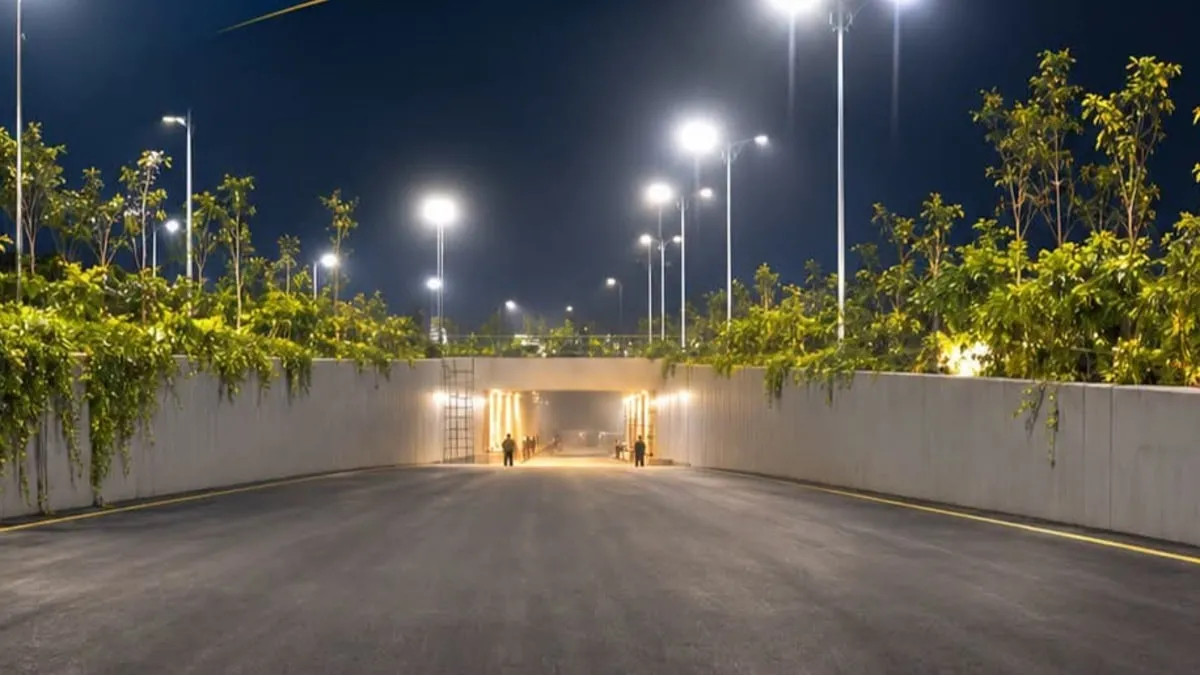
Prime Minister Shehbaz Sharif inaugurated the Kashmir Chowk Underpass in Islamabad on Thursday, a Rs. 1.45 billion project aimed at reducing traffic congestion in the capital.
The 500-metre underpass was completed in just 27 days through round-the-clock construction work, according to the prime minister.
Speaking at the inauguration ceremony, Shehbaz congratulated Interior Minister Mohsin Naqvi, the Capital Development Authority (CDA), project officials and contractors on completing the project.
He said the development also includes a four-kilometre road network, two monuments and thousands of newly planted trees. The prime minister said the underpass would improve traffic flow in the area, particularly as Islamabad prepares to host the Shanghai Cooperation Organization (SCO) conference next year.
He also said the project was completed transparently and in accordance with government procurement rules at a cost 2.5 percent below the estimated amount.
Why the Kashmir Chowk Underpass Matters for Islamabad
Traffic congestion has long been a chronic issue in Islamabad, especially along the main arteries that connect the diplomatic enclave, commercial districts and residential zones. Prior to the underpass, the intersection at Kashmir Chowk experienced peak-hour delays of up to 20 minutes, according to a 2022 traffic study by the CDA. By diverting through-traffic beneath the surface, the new underpass is expected to cut travel time by at least 40 percent during rush hour.
The underpass also aligns with the capital's broader master plan, which envisions a network of grade-separated crossings to accommodate growing vehicle numbers. The four-kilometre road network mentioned by the prime minister links the underpass to the newly widened Margalla Road and the Islamabad-Rawalpindi Expressway, creating a more resilient circulation system.
How the Project Was Delivered in Record Time
Completing a Rs. 1.45 billion infrastructure work in 27 days required a coordinated approach that combined several mechanisms:
- Round-the-clock shifts: Construction crews operated in three eight-hour shifts, allowing continuous progress.
- Pre-fabricated components: Key structural elements such as girders and concrete panels were manufactured off-site and installed quickly.
- Streamlined procurement: The prime minister emphasized that the work adhered to government procurement rules, which helped avoid delays often caused by tender disputes.
According to CDA officials, the project's cost came in 2.5 percent below the original estimate, reflecting efficient resource use and the avoidance of cost overruns that have plagued other public works.
Environmental and Aesthetic Features
Beyond traffic relief, the underpass incorporates several green and cultural elements. Thousands of newly planted trees were part of the surrounding landscape design, contributing to Islamabad's reputation as a 'city of trees.' The two monuments, whose designs were selected through a public competition, are intended to celebrate local heritage and provide visual landmarks for commuters.
Environmental impact assessments, conducted by the Ministry of Climate Change in early 2023, cleared the project after confirming that the tree-planting plan would offset the carbon footprint of construction. The underpass also includes LED lighting and a ventilation system that meets national safety standards.
Implications for the Upcoming Shanghai Cooperation Organization Summit
Islamabad is due to host the Shanghai Cooperation Organization (SCO) conference next year, an event that will draw delegations from China, Russia, India, Pakistan and several Central Asian nations. The prime minister highlighted that the underpass will improve traffic flow in the area, ensuring smoother movement for delegates, security personnel and media crews.
Security agencies have praised the underpass for providing an additional route that can be used for rapid deployment of emergency services, a factor that often influences venue selection for high-profile international meetings.
What the Project Means for Future Infrastructure Initiatives
The success of the Kashmir Chowk Underpass may set a precedent for future fast-track projects in the capital. Analysts note that the combination of transparent procurement, round-the-clock construction and pre-fabricated components could be replicated for other grade-separated crossings, flyovers and pedestrian bridges.
However, experts also caution that replicating the 27-day timeline requires careful risk management. Factors such as weather conditions, supply-chain stability and labor availability can affect schedule adherence. The CDA has announced a review of the project's lessons learned, with a report expected by early 2025.
Practical Takeaways for Commuters
Commuters using the Kashmir Chowk corridor can expect the following immediate changes:
- Reduced waiting time at the former at-grade intersection.
- Improved safety due to the separation of through-traffic from local pedestrians.
- Better air quality in the immediate vicinity, thanks to the new tree planting.
The CDA has installed real-time traffic monitoring sensors at the underpass entrances, and data will be published on the authority's website to help drivers plan routes.
What to Watch for Next
The next steps involve monitoring traffic patterns once the underpass is fully operational. The CDA will conduct a six-month post-implementation study to measure travel-time reductions, accident rates and environmental impact. Results will be presented to the National Assembly's Standing Committee on Transport.
In addition, the Ministry of Interior will coordinate with the SCO secretariat to integrate the underpass into the official logistics plan for the 2025 conference. Stakeholders are also awaiting the final design specifications of the two monuments, which are expected to be unveiled later this year.