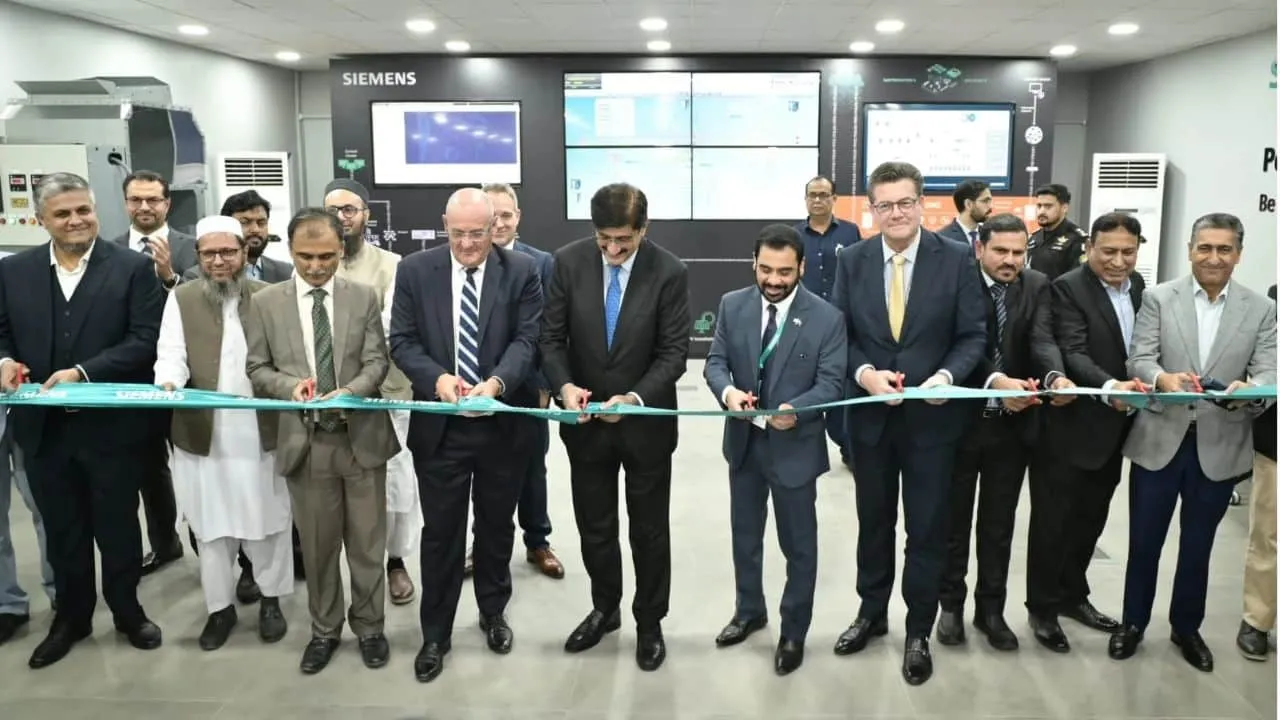
Siemens inaugurated the Siemens Power Academy at NED University of Engineering and Technology in Karachi on Thursday, creating the first Power Academy globally to be housed inside an engineering university. The ceremony was attended by Sindh Chief Minister Syed Murad Ali Shah, German Consul General Thomas E. Schultze, senior Siemens executives and university leaders.
The new Academy will deliver specialised technical training and certification in medium-voltage systems, electrical protection, power quality, substation automation, digital substations, grid planning, operations and cybersecurity. It will also cover AI-enabled technologies, digital twins and connected systems through classroom, virtual, digital and blended formats.
Why the Power Academy Matters for Pakistan's Energy Sector
Pakistan's power grid faces growing demand, aging infrastructure and a need for digital transformation. By embedding Siemens' training model within NED University, the Academy aims to equip both current professionals and future engineers with the skills required to modernise the grid, improve reliability and integrate renewable energy sources.
Chief Minister Syed Murad Ali Shah highlighted the strategic importance, saying, "Empowering our youth with the right skills and opportunities is a priority for the Government of Sindh. Partnerships like this can help prepare young engineers to play an active role in Pakistan's future development."
History of the Siemens Power Academy Model
The Siemens Power Academy concept began in 1998/99 when specialist power-technology training started in Germany. Frankfurt became the first dedicated location in 2000, followed by Berlin in 2003. Austria scaled the model internationally around 2005, and the network now operates in more than 60 countries across 20+ nations.
In recent years the Middle East expanded the model with Power Academies in the United Arab Emirates and Egypt. Pakistan's Academy represents a new direction: for the first time a Siemens Power Academy is co-located within an engineering university, merging professional training and academic education under one roof.
How the Academy Operates Within NED University
Siemens will provide equipment, software licences and certified trainers, while NED University contributes campus facilities, faculty and academic oversight. Students and faculty will gain hands-on access to Siemens hardware such as medium-voltage switchgear, protection relays and digital substation platforms, as well as software tools for grid modelling and AI-driven analytics.
Training programmes will be delivered through several pathways:
- Standard classroom courses led by Siemens-certified instructors.
- Virtual instructor-led sessions for remote learners.
- Digital modules that can be accessed on-demand via Siemens' learning portal.
- Blended learning that combines on-site labs with online theory.
Each pathway culminates in a Siemens-issued certification, recognised by utilities and industrial customers worldwide.
Voices from the Inauguration
Paul Fairweather, Managing Director of the Electrification and Automation Business Unit at Siemens Middle East, told the media, "What makes Pakistan unique is that we are taking a global Siemens training model into a university for the first time. This creates an opportunity to invest in people at every stage, from the professionals driving today's infrastructure to the engineers who will shape its future."
Prof. Dr. Muhammad Tufail, Vice Chancellor of NED University, added, "Bringing practical, industry-relevant knowledge into the curriculum strengthens the foundations of engineering education and helps students connect theory with real-world application, making them better prepared and more employable when they graduate."
Impact on Students, Industry and the Wider Economy
Students enrolled in electrical, mechanical and computer engineering programmes will now be able to supplement their degree coursework with industry-grade labs and certification. This dual exposure is expected to improve graduate employability, reduce the skills gap for utilities, and attract foreign investment in Pakistan's power sector.
For utilities and private power developers, the Academy offers a pipeline of certified technicians and engineers who understand Siemens' digital substation architecture, AI-based grid optimisation and cybersecurity standards. This alignment can shorten project commissioning times and lower operational risk.
On a macro level, the partnership supports Pakistan's Vision 2025 goals of expanding electricity access, modernising transmission networks and integrating renewable energy. By fostering a skilled workforce, the Academy contributes to the country's broader industrial development agenda.
What the Training Curriculum Covers
The curriculum is divided into core modules and elective specialisations:
- Medium-Voltage Systems - design, installation and maintenance of MV equipment.
- Electrical Protection - relay settings, fault analysis and coordination studies.
- Power Quality - harmonics, voltage sag mitigation and quality monitoring.
- Substation Automation - SCADA integration, IEC 61850 communications and remote operation.
- Digital Substations & Digital Twins - virtual modelling of physical assets for predictive maintenance.
- Grid Planning & Operations - load flow analysis, contingency planning and real-time monitoring.
- Cybersecurity - protecting critical infrastructure from digital threats.
- AI-Enabled Technologies - machine-learning applications for fault detection and asset optimisation.
Each module includes theory, hands-on lab work, case studies from real projects and a final assessment that leads to a Siemens certification.
Future Steps and Expansion Plans
While the Karachi Academy is the first of its kind, Siemens has indicated that the model could be replicated at other Pakistani universities, subject to demand and institutional readiness. The next formal review of the Academy's impact is scheduled for six months after opening, when Siemens and NED will assess enrollment numbers, certification pass rates and industry feedback.
Stakeholders are advised to watch for announcements from the Sindh government and Siemens regarding potential scholarship programmes, expanded lab facilities, and collaborative research projects focused on smart grid technologies.
About Siemens and Its Global Training Network
Siemens AG is a leading technology company operating in industry, infrastructure, mobility and healthcare. Its purpose is to create technology that transforms everyday life for everyone. By combining the real and digital worlds, Siemens helps customers accelerate digital and sustainability transformations, making factories more efficient, cities more livable and transportation more sustainable.
Siemens is a recognized leader in industrial AI, applying deep domain expertise to real-world applications across sectors. The company also holds a majority stake in Siemens Healthineers, a publicly listed medical-technology firm pioneering breakthroughs in healthcare.