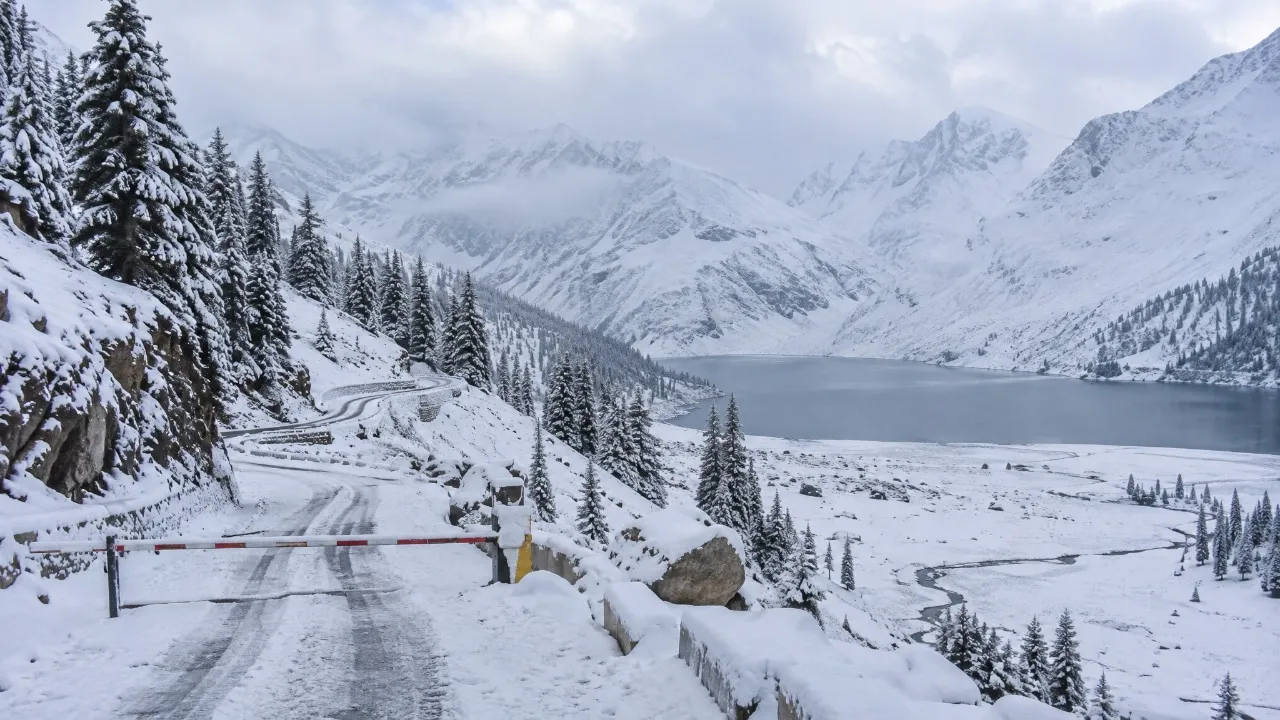
Continuous snowfall in Naran Valley and other upper areas has brought a sharp drop in temperature, while rain in Balakot and nearby areas has made the weather very cold.
What Is Happening in Naran Valley and Saif-ul-Malook?
The region has been under snow for the past five hours, covering Lulusar Lake, Gitti Das Meadows and Babusar Top with a thick white blanket. Authorities have temporarily closed Babusar Top to all traffic for safety reasons because of the bad weather and heavy snowfall.
Why Have Authorities Closed Babusar Top?
Babusar Top, at an altitude of about 4,173 metres, is a key mountain pass that links the Kaghan Valley with Chilas in Gilgit-Baltistan. The pass is popular with tourists, motorcyclists and local transporters during the summer months. When heavy snow accumulates, the risk of avalanches, landslides and sudden white-out conditions rises sharply. The provincial disaster management department, together with the police, issued a traffic ban to prevent accidents and to allow snow-clearing crews to work safely.
How Is the Snowfall Affecting Local Businesses?
The arrival of winter has also hit business activities in the upper areas. Shops and other businesses in Barawai and Batakundi are closed for the next five months. Hotels, shops and petrol pumps in Batakundi have also shut down until the next tourist season as snowfall and cold weather set in.
These closures represent a significant loss of income for families that depend on the summer tourism rush. In a typical year, Batakundi and Barawai host hundreds of tourists who spend on accommodation, food and fuel. With the road to Babusar Top closed, the flow of visitors is expected to drop by more than 80 percent until the snow melts.
What Is the Historical Context of Winter in the Kaghan Valley?
The Kaghan Valley, which includes Naran, Barawai and Batakundi, is a major summer destination in Pakistan's Khyber Pakhtunkhwa province. The valley lies between 2,000 and 4,000 metres above sea level, and its climate is classified as humid continental. Historically, the valley receives snow from late November to early March, but the intensity and duration vary each year.
In 2010, an exceptionally early snowfall forced the closure of the Babusar Pass for three weeks, costing the local tourism sector an estimated Rs. 250 million in lost revenue. Since then, the provincial government has invested in early-warning systems and snow-clearing equipment, but extreme weather events still disrupt the seasonal economy.
How Does Snowfall Impact the Environment and Safety?
Snowfall around Saif-ul-Malook Lake adds to the area's beauty while making the weather even colder. The lake, situated at 3,605 metres, is fed by melting glaciers and is a key freshwater source for downstream communities. Heavy snow can delay the meltwater flow, affecting irrigation schedules in the lower Kaghan Valley.
From a safety perspective, the accumulation of snow on steep slopes increases the likelihood of avalanches. Local rescue teams have reported a rise in avalanche alerts during periods of rapid snowfall. The closure of Babusar Top is therefore a preventative measure aimed at reducing the chance of a large-scale incident.
What Are the Immediate Steps for Residents and Travelers?
Travelers are advised to avoid the Babusar Pass until official notices lift the ban. The Khyber Pakhtunkhwa police have set up temporary checkpoints at the base of the pass to inform drivers of the situation and to direct them to alternative routes via Mansehra.
Residents of Barawai, Batakundi and surrounding villages are receiving emergency supplies from the district administration. The local health department has also dispatched mobile clinics to ensure that cold-related illnesses such as hypothermia and respiratory infections are treated promptly.
What Is Expected When the Snow Melts?
Weather forecasts from the Pakistan Meteorological Department predict that the snowfall will gradually subside over the next ten days, with daytime temperatures rising to just above freezing. Once the snow pack stabilises, the provincial road authority will begin clearing the Babusar Top road. Historically, the pass reopens in early May, aligning with the start of the tourist season.
Business owners are preparing for a phased reopening. Hotels have stocked firewood and heating fuel, while shops are ordering winter-ready merchandise to meet the demand of the first wave of tourists. Petrol pumps are coordinating with fuel distributors to ensure a steady supply once traffic resumes.
What Can Visitors Do to Prepare for Future Trips?
Potential visitors should monitor official weather updates and road-status bulletins before planning a trip to Naran Valley or Saif-ul-Malook. Wearing layered clothing, carrying waterproof boots and having a reliable means of communication are essential in the high-altitude environment.
Travel agencies are now offering flexible booking policies, allowing tourists to reschedule without penalty if the pass remains closed. This practice reflects a growing awareness of the unpredictable nature of mountain weather.
In summary, the current snowfall has triggered a cascade of safety measures, economic impacts and logistical challenges across the upper Kaghan Valley. While the immediate priority is public safety, the longer-term focus will be on restoring tourism and supporting the livelihoods that depend on it.





