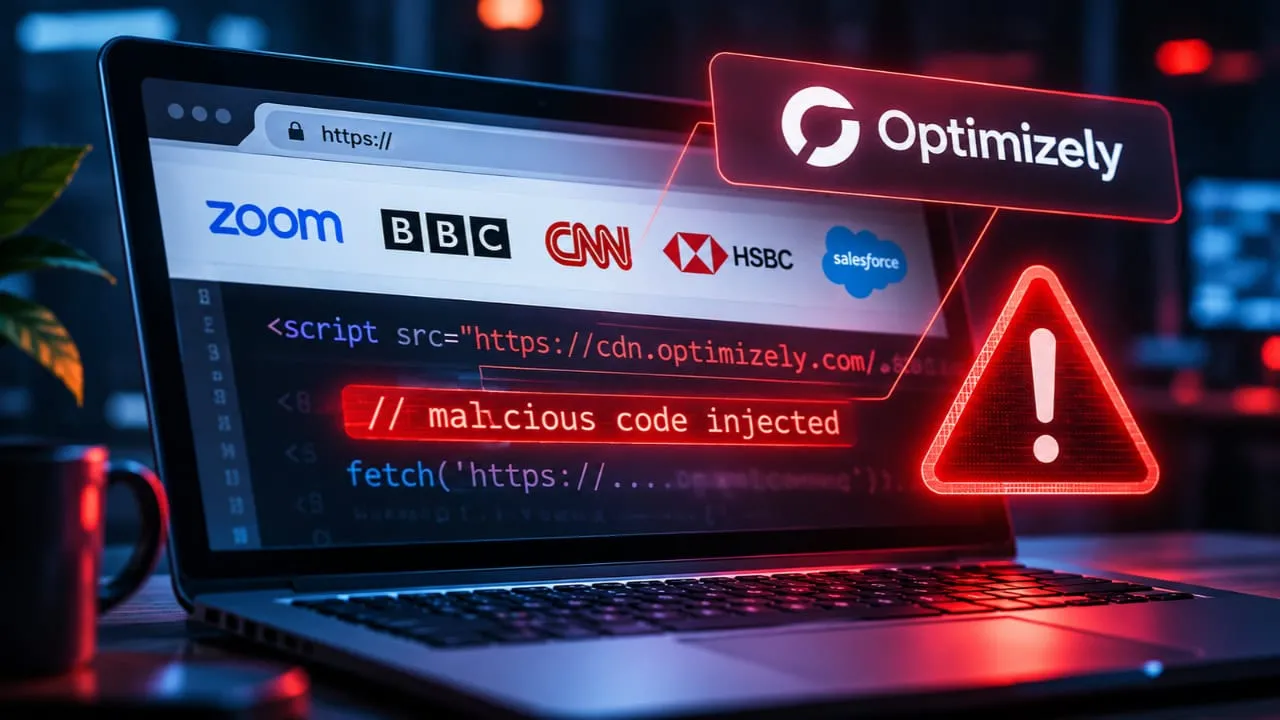
Reports have surfaced that attackers injected malware into 178 organizations through the Optimizely Web experimentation platform on Saturday, November 16.
The list of victims includes Zoom, BBC, CNN, Salesforce, GitLab, IKEA, HSBC, Equifax, Air France-KLM, Ledger, and Peacock. As a result, visitors to some of the most trafficked websites in the world received malicious code without anyone noticing for hours.
Security researcher Scott Helme of Report URI discovered and documented the attack.
Scott Helme of Report URI just exposed a supply chain attack that put malware on 178 major organisations’ websites today. Here’s what you need to know. Helme first posted that his team was tracking a breach of a 3rd-party JS host hitting hundreds of high value websites, and called it staggering. That post passed 2.3M views. The host is Optimizely, a website testing and A/B platform. Report URI found malicious JavaScript served through Optimizely Web to visitors of some of the world’s largest sites. The campaign is being called OPTIMJACK. One write-up says the attacker wrote the code into the Optimizely Web projects of these organisations on 16 November 2026. Another report says three smaller vendors also served the code. Affected names include Zoom, BBC, CNN, HSBC, Salesforce, GitLab, KLM, Air France-KLM, IKEA, Equifax, Ledger, Peacock, Fox News, Bitly, IG Group, American Eagle and Hootsuite. The malware looks aimed at crypto users. It works as a clipper. It swaps a crypto address you copied for the attacker’s address, and it rewrites addresses in the page’s outgoing requests. Researchers say it cannot take private keys. It also includes a card skimmer, and some reports mention iOS exploits. Report URI’s blog notes crypto theft, card skimming and iOS exploits among the payloads. One analyst noted the attacker addresses in the article show a low hit rate. Helme said the clean up is done, and Report URI then published its full write-up with the list of affected sites. Troy Hunt, who worked on it with Helme, said most sites would have no idea their customers were being served malware, and asked where disclosure even begins. Key numbers: – 178 organisations affected per Report URI’s write-up – 188 infected Optimizely scripts found – 186 sites confirmed infected in Helme’s earlier count – 16 November 2026, when the code was reportedly injected – 2.3M views on Helme’s original post Anyone who visited an affected site while it was live and copied a crypto address should check their recent transfers.
— AGTP (@AGTPinsights) November 17, 2026
How the Optimizely Platform Works and Why It Became a Target
Optimizely provides a Web experimentation service that lets customers run A/B tests, personalization and feature rollouts. The core of the service is a JavaScript snippet that each client site loads from Optimizely's content-delivery network (CDN). The snippet pulls a JSON payload that contains the client's active experiments and, optionally, a field called "Project JavaScript" where developers can place custom code that runs on every page view.
Because the snippet is served from a domain that browsers already trust, the code is executed without prompting the user or triggering security warnings. This trust model is essential for performance, but it also creates a single point of failure: if an attacker can write to the Project JavaScript field, the malicious script will be delivered to every visitor of the affected site.
What the Malicious Payload Did
The injected script performed four distinct functions simultaneously:
- It replaced cryptocurrency wallet addresses displayed on the page with attacker-controlled addresses for BTC, ETH, Solana, TRON, Litecoin, Dogecoin and other chains. The script also hijacked clipboard copy events, silently swapping any copied address with the attacker's address.
- It skimmed credit-card numbers from form submissions by validating them with the Luhn algorithm and then exfiltrated the data to an external server.
- It stole browser cookies and captured screenshots of the compromised pages, giving the attacker session tokens and visual context.
- On iPhones and iPads running iOS 18.6 or earlier, it loaded hidden iframes that delivered the Coruna and DarkSword exploit kits, which can achieve remote code execution on vulnerable devices.
Financial Impact and Timeline of the Attack
By 7:25 PM UTC the attackers had already transferred approximately $7,040 in cryptocurrency to wallets they controlled. Verified transactions hit Bitcoin, Litecoin, TRON and Ethereum addresses. Between 1:03 PM and 1:05 PM UTC the funds were moved to exchanges, including HitBTC. The TRON wallet showed activity dating back to March 2026, indicating that the threat group had been operating long before the November 16 campaign.
The attack unfolded over the course of the day:
- 4:21 AM UTC - First malicious snippet observed on the BBC site.
- 11:20 AM UTC - Zoom's snippet modified.
- 1:43 PM UTC - Card-skimming code added to the payload.
- Late afternoon - iOS exploit kits injected via hidden iframes.
- Throughout the day - Payload rebuilt 26 times, each version adding new wallet addresses or features.
- 8:40 PM UTC - Cleanup began, with Optimizely (or its customers) removing the malicious code.
- 9:52 PM UTC - Only one snippet remained infected; the breach was effectively contained.
Scope of the Breach Across Industries
The compromised snippets spanned a wide range of sectors, demonstrating the breadth of Optimizely's customer base:
- 32 banking and finance organisations
- 23 technology firms
- 20 retailers
- 12 streaming platforms
- 10 news outlets
- 9 airlines
- Dozens of entities in healthcare, telecommunications, insurance and nonprofit sectors
- Optimizely's own corporate websites were also affected
How the Attack Was Discovered
Scott Helme, a well-known security researcher, noticed anomalous JavaScript behaviour while monitoring a client site. He traced the code back to Optimizely's CDN and identified the Project JavaScript field as the injection point. Helme documented the findings in a public report, which prompted further investigation by security analysts and the broader community.
Response from Optimizely and Ongoing Investigation
Report URI, the organization behind Helme's research, contacted Optimizely through multiple communication channels but did not receive a response before publishing the report. Optimizely has not issued a public statement as of the time of writing, and the exact method the attackers used to gain write access to 178 unrelated customer projects remains unknown.
Law enforcement agencies in several jurisdictions have been notified, and forensic teams are analysing server logs to determine whether the breach resulted from compromised credentials, a supply-chain vulnerability in Optimizely's build pipeline, or an insider threat.
What Users Should Do Now
For anyone who visited an affected website on November 16, the following steps are recommended:
- If you use an iPhone or iPad, update to iOS 18.7.3 or later to patch the Coruna and DarkSword exploits.
- If you transferred cryptocurrency after visiting a compromised site, verify the destination address on the blockchain and consider moving the funds to a fresh wallet.
- If you entered credit-card details on any of the listed sites, monitor your bank statements closely and report any unauthorized charges to your issuer.
- Clear browser cookies and cached data to remove any potentially stolen session tokens.
- Consider using a password manager with built-in breach alerts to detect if any of your credentials were exposed.
Broader Lessons for the Industry
This incident highlights the risks inherent in third-party JavaScript delivery. Organizations that rely on SaaS platforms for front-end functionality must implement strict subresource integrity (SRI) checks, employ content-security-policy (CSP) headers that limit script sources, and regularly audit any custom code fields for unauthorized changes.
Supply-chain security remains a top priority for regulators worldwide. The European Union's Digital Services Act and the U.S. Executive Order on Improving the Nation's Cybersecurity both call for greater transparency and accountability from providers of software components that appear on public websites.
As investigations continue, the security community will be watching for any indication of how the attackers bypassed Optimizely's authentication mechanisms. The outcome will likely influence best-practice guidance for all firms that embed third-party scripts in their user-facing pages.