Understanding the New Trinity Airways Business Class Experience
Business class has long stood as a symbol of elite aviation luxury. Passengers with deep pockets typically expect to sip champagne, recline fully into lie-flat beds, and watch the latest films on large personal screens at 35,000 feet. However, a major shift in premium cabin design is challenging these long-held industry standards.
South Korean budget carrier Trinity Airways has introduced a radical alternative that strips away many traditional amenities to lower ticket prices. The airline has rebranded its cabins on new Airbus A330-900neo jets to feature a minimalist product known as SoFab. While the seat has existed conceptually since 2023, Trinity Airways has recently adopted the design and currently stands as the only airline to install it onboard its aircraft.
The core concept behind this offering revolves around removing costly and heavy components like entertainment monitors and mechanical reclining joints. By eliminating these features, the aircraft becomes lighter and cheaper to fly, which translates directly into reduced fares for travelers seeking extra space without paying top-tier prices. Although Trinity Airways does not operate direct routes from the UK, a one-way journey from Rome to Seoul in December costs around £1,296.21 for this business class option. For comparison, a similar one-way business class trip on the same route with Korean Air runs around £1,816.96.
How the SoFab Business Class Seat Works
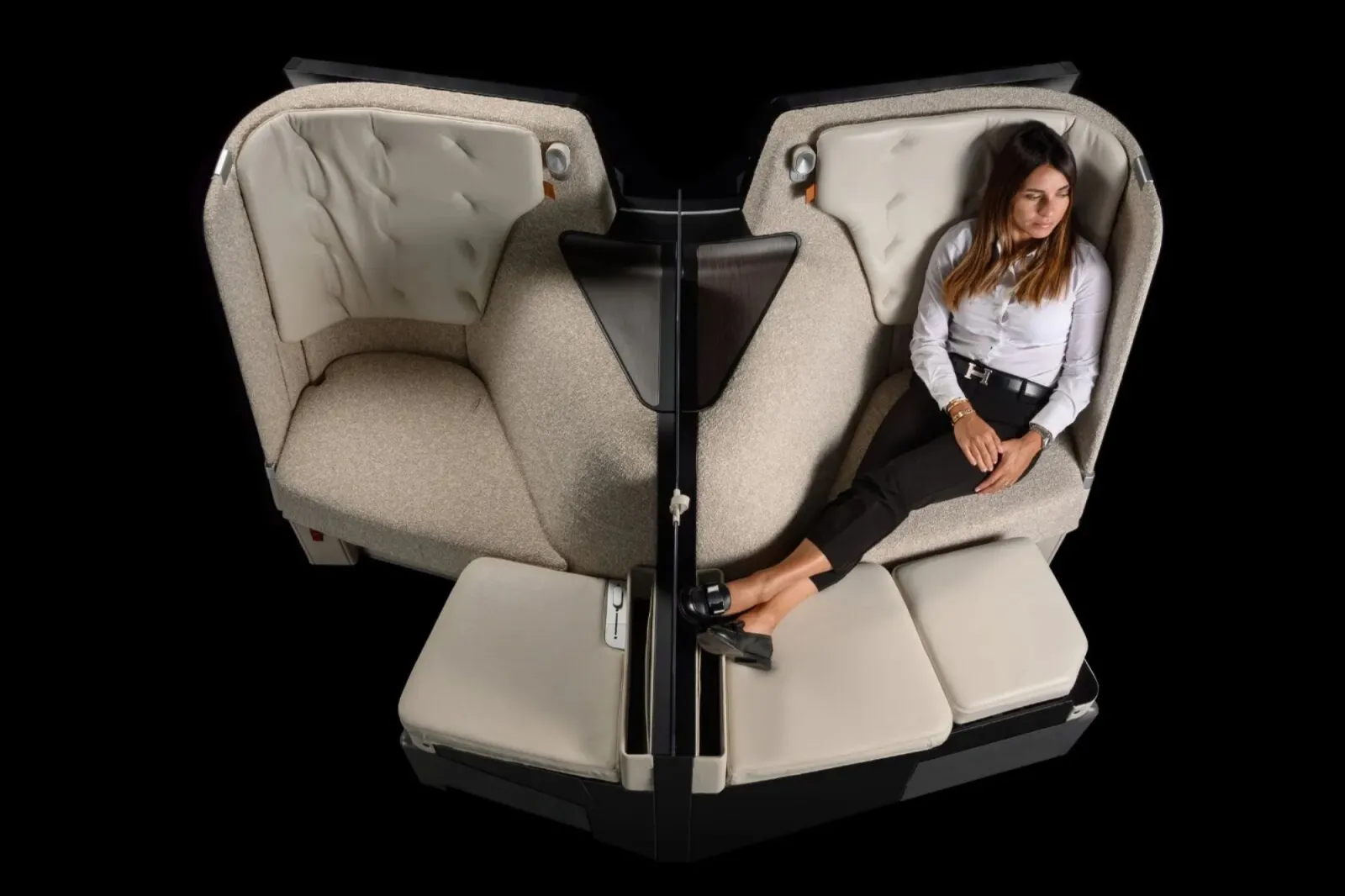
The SoFab design takes a back-to-basics approach by replacing standard reclining chairs with a fixed, sofa-like seat and a wraparound privacy screen. Traditional business class seats rely on complex motorized mechanisms to shift between upright, lounging, and fully flat positions. In contrast, the SoFab chair remains in a fixed position while offering alternative ways to achieve comfort.
When passengers want to sleep or stretch out, they must pull a tab located near the seat. This action causes a cushioned ottoman to slide outward, bridging the gap between the main chair and the footwell to form an extended flat bed surface. Travelers can either sit upright with their legs fully stretched straight ahead or slouch down into the chair, positioning themselves across the combined area of the seat and the ottoman.
Reports indicate that the resulting sleeping space is approximately 25 per cent larger than standard business class beds found on many competing airlines. The total dimensions stretch 198cm long, providing enough room for someone who is 6'5 to lie completely flat, and measure 102cm wide.
Cabin Layout and Privacy Features
Airlines typically rely on sliding doors to create private suites in premium cabins, but Trinity Airways takes a different route to maintain passenger seclusion. Across the aircraft cabin, these seats are arranged in a 1-2-1 layout, ensuring that every single passenger enjoys direct aisle access without needing to step over a neighbor.
Instead of featuring individual doors that enclose the suite, a curved shell wraps around each passenger to act as a privacy screen. For travelers seated in the two middle positions of the plane, a privacy divider sits between the chairs to separate companions or strangers. Essential modern utilities remain integrated into the suite, including standard air conditioning outlets and a USB socket for charging personal electronics.
Dining arrangements also feature a practical design modification. The tray table doubles as a side table, meaning passengers do not need to fully collapse or stow the table just to stand up and visit the lavatory during flight service.
Entertainment and Technology Changes
The most noticeable omission in the Trinity Airways business class cabin is the complete absence of embedded television screens. Traditional premium cabins feature large LED monitors built into the seat ahead or deployed from the armrest, requiring complex wiring and heavy hardware.
By removing these screens, the airline reduces the overall weight of the cabin installation. Passengers who wish to watch movies or catch up on television shows must rely on their own devices. The aircraft is equipped with onboard WiFi, allowing travelers to stream content directly onto their personal laptops, tablets, or smartphones.
Market Impact and Cost Comparisons
The introduction of stripped-down luxury cabins addresses a growing market segment of travelers who want premium space and comfort without paying exorbitant legacy carrier prices. Traditional business class tickets often carry steep markups due to the cost of heavy seating hardware, extensive catering options, and dedicated entertainment systems.
By streamlining the cabin architecture, budget carriers can pass operational savings down to the consumer. While luxury purists might miss the automated recline functions and widescreen displays, the promise of substantially cheaper fares makes premium space accessible to a broader demographic of flyers on long-haul routes.