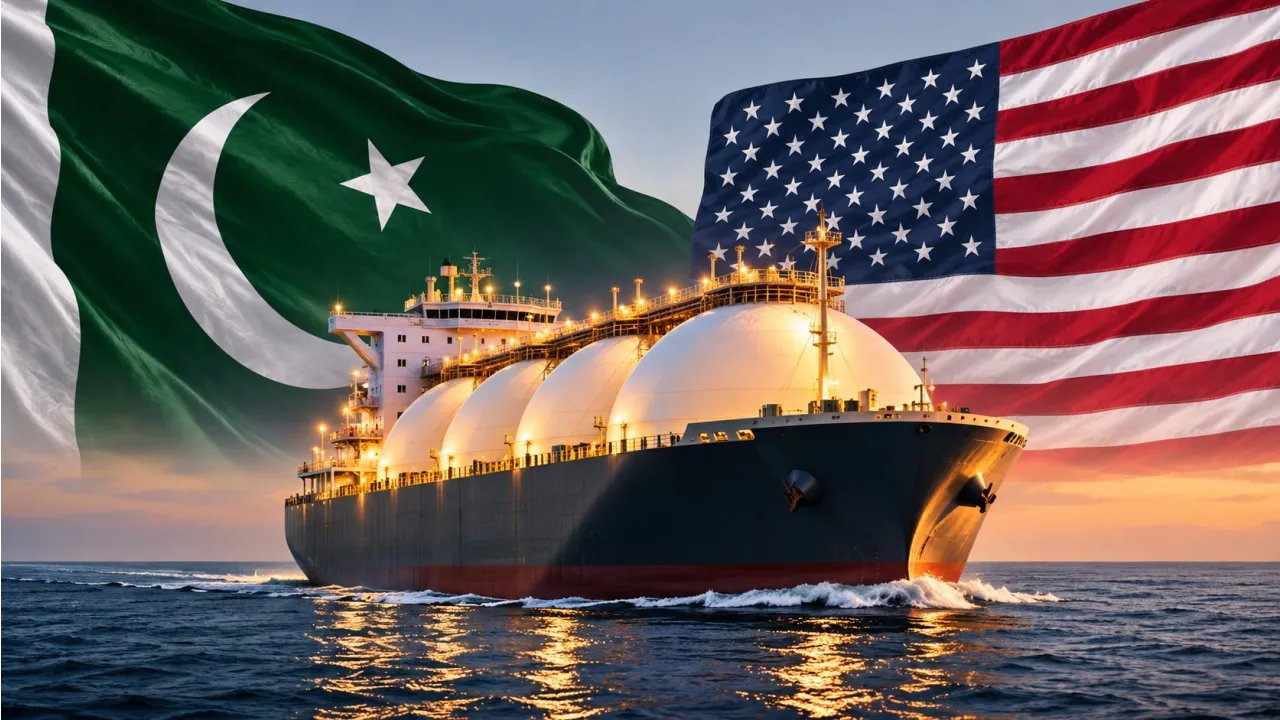
A US-linked consortium has put forward a plan to invest as much as $4.4 billion in an integrated liquefied natural gas project in Pakistan, covering import, storage, regasification, transmission and sales to large users. The proposal, supported by the Trump administration, follows the withdrawal of Energas - a partnership of the Lucky Group and QatarEnergy - which cited policy and fiscal uncertainties.
The group consists of Global Vision Energy Partners (GVEP) and Khanjee Holdings, together with strategic co-investors from abroad and Luxembourg-based General Mediterranean Holding. They have reportedly secured consent from the Port Qasim Authority for the site and filed an application with the Oil and Gas Regulatory Authority for a provisional licence.
Project to Include LNG Terminal and 1,100km Pipeline
Two phases are outlined. Phase one calls for an LNG terminal and storage complex at Port Qasim with four tanks holding a total of 560,000 cubic metres. The facility would process roughly 35 billion cubic feet (BCF) of LNG each year and is priced at $1.7 billion.
Phase two envisions a 1,100 km pipeline, 42-48 inches in diameter, moving gas to inland markets at about 1.2 billion cubic feet per day (BCFD). Adding this brings the overall cost to $4.4 billion.
The terminal's annual handling capacity is projected at 35.6 BCF, based on three inventory turnover cycles per year, each cycle moving about 11.9 BCF.
Project Could Establish Regional LNG Trading Hub
Sponsors aim to build the venture as a merchant infrastructure platform that meets Pakistan's regasification needs while creating a physical LNG storage and trading hub for US and Middle-East suppliers.
Pakistan currently lacks any LNG storage, making its regasified supplies wholly dependent on imports and external pricing.
The proposal highlights Port Qasim's existing port facilities and marine access for LNG carriers, and notes the site's location outside the Strait of Hormuz, a key global shipping chokepoint.
Development, ownership and operation would be handled by a special purpose vehicle designed to isolate assets, liabilities and financial risk, without relying on a single government-backed offtake contract.
US Financing Support and Local Investment
The project is under consideration by the US Trade and Development Agency's project preparation programme and may receive partial funding from the US Development Finance Corporation, backed by export-credit guarantees from the US Export-Import Bank for technology, equipment and services.
The consortium seeks up to 10 percent equity from Pakistani investors, with a minimum commitment of $50 million per investor, and hopes to attract strategic co-investors such as Grey Rock Investment Partners, Kohlberg Kravis Roberts & Co, Blackstone, Saudi Arabia's Public Investment Fund and the Kuwait Investment Authority.
These investors' participation remains conditional on due diligence, investment approvals and definitive agreements; no binding equity commitments have been confirmed.
Financing is expected to follow a 70:30 debt-to-equity split. GVEP would hold 26 percent, General Mediterranean Holding 24 percent, and Khanjee Holdings and strategic co-investors 20 percent each. Local investors would own the remaining 10 percent in phase one, which is estimated to cost $1.32 billion based on the proposed ratio.
Proposed LNG Tariffs and Commercial Structure
The consortium intends to combine long-term tolling and storage contracts, transshipment arrangements and take-or-pay commitments where appropriate, while keeping residual capacity for merchant use.
It proposes a terminal and storage tariff of $4.93 per million British thermal units (mmBtu) and a transmission tariff of $1.91 per mmBtu for the first ten years.
Rates are expected to fall to $2.20 per mmBtu for terminal and storage and $0.92 per mmBtu for transmission thereafter. Regasification tariffs for the domestic market will be submitted to Ogra for approval, and other services such as storage, tolling and transshipment will be priced on market terms.
The final project cost will be set after engineering, procurement and construction contracts and other supply agreements are signed.
Government facilitation has reportedly been conveyed through the Ministry of Maritime Affairs and the Petroleum Division of the Ministry of Energy.