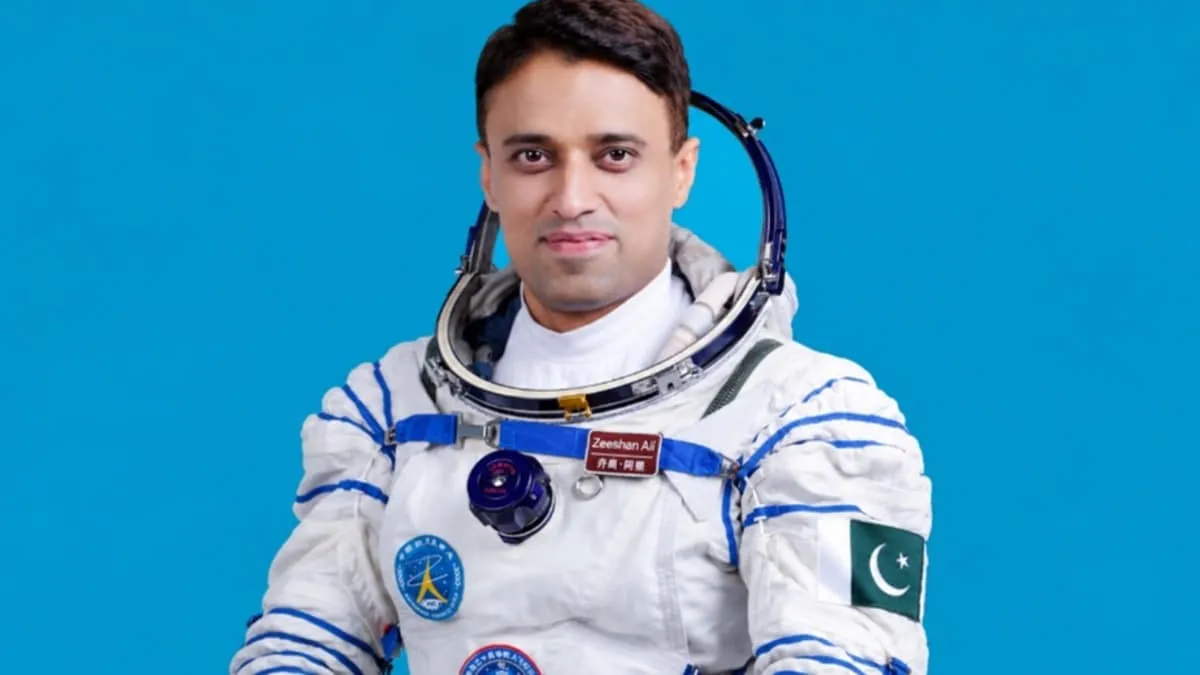
Pakistan has made history in space exploration as Muhammad Zeeshan Ali became the country's first astronaut to travel into orbit and reach China's Tiangong space station.
The 40-year-old Pakistani Air Force pilot reached the station aboard China's Shenzhou-24 spacecraft on November 25, 2026, marking a major milestone in Pakistan's space program and its cooperation with China.
Ali also became the first foreign astronaut to join China's crewed space program and board its independently operated space station.
Who Is Muhammad Zeeshan Ali?
Muhammad Zeeshan Ali is a Pakistani Air Force pilot selected to become the country's first astronaut to participate in an orbital space mission.
He was chosen for China's Shenzhou-24 mission as part of a space cooperation agreement between Pakistan's Space and Upper Atmosphere Research Commission, known as SUPARCO, and the China Manned Space Agency.
Ali traveled to China in April 2026 to begin astronaut training at the Astronaut Center of China, where he prepared for his role as a payload specialist. He is part of a three-member Shenzhou-24 crew alongside Chinese astronauts Tang Hongbo and Wu Yi.
How Was Zeeshan Ali Selected as Pakistan's First Astronaut?
Pakistan and China signed a cooperation agreement in February 2025 to train Pakistani candidates for a mission aboard China's Tiangong space station.
Under the arrangement, two Pakistani candidates, Muhammad Zeeshan Ali and Khurram Daud, were selected to undergo astronaut training in China. Both candidates traveled to the Astronaut Center of China in April 2026 to prepare for the mission.
Following the training and selection process, Ali was chosen as the Pakistani astronaut for Shenzhou-24, while Daud served as the backup candidate. The mission represents Pakistan's first participation in a crewed orbital spaceflight.
Where Did Zeeshan Ali Receive His Astronaut Training?
Ali completed his astronaut training at the Astronaut Center of China in Beijing. His preparation included seven months of training, covering spacecraft systems, mission procedures and the responsibilities of working aboard a space station.
He also received intensive Chinese-language instruction to communicate with his fellow astronauts and work effectively during the mission. According to reports, his training also involved learning Chinese songs, reading poetry, practicing calligraphy and playing table tennis.
What Is the Shenzhou-24 Mission?
Shenzhou-24 is a Chinese crewed space mission that carried three astronauts to the Tiangong space station. The spacecraft launched from the Jiuquan Satellite Launch Center in northwest China aboard a Long March-2F rocket on November 25, 2026.
It lifted off at 8:18 a.m. Beijing time, or 5:18 a.m. Pakistan time, carrying Ali and Chinese astronauts Tang Hongbo and Wu Yi. The spacecraft entered its designated orbit approximately 10 minutes after launch and successfully docked with the Tiangong space station three hours and 38 minutes later.
The mission marked the first time a Pakistani astronaut entered orbit and the first time an international astronaut joined China's crewed space program.
What Will Zeeshan Ali Do at the Tiangong Space Station?
Ali is serving as a payload specialist, meaning his responsibilities include working with scientific experiments and research equipment aboard the space station.
He is expected to spend approximately one week in space before returning to Earth with the departing Shenzhou-23 crew. The mission includes scientific research involving materials science, plant biology and sustainable life-support systems. According to SUPARCO, Pakistani research projects associated with the mission include:
- Hybrid Composite Shield: The experiment explores lightweight graphene-based hybrid composite materials that could help protect spacecraft from radiation while maintaining structural strength and reducing weight.
- Self-Healing in Space: This research examines carbon fiber composites capable of repairing small cracks, potentially improving the durability and structural integrity of spacecraft.
- Quinoa Beyond Earth: The experiment studies how microgravity and cosmic radiation affect quinoa seeds, including their longevity, genetic characteristics and nutritional quality. The research could help assess the crop's potential as a food source during future space missions.
- Green Life Beyond Earth: This project explores the cultivation of microalgae and cyanobacteria in space. These organisms could support future life-support systems by producing oxygen, removing carbon dioxide and potentially providing food.
These experiments are part of Pakistan's contribution to scientific research aboard the Chinese space station.
How Long Will Zeeshan Ali Stay in Space?
Unlike Chinese astronauts who typically spend around six months aboard the Tiangong space station, Ali's mission is much shorter.
SUPARCO has said he will spend approximately one week in space. He is expected to return to Earth aboard the Shenzhou-23 spacecraft alongside members of the previous Chinese crew.
His short stay is part of a crew rotation and scientific research mission rather than a full six-month station assignment.
Why Is Zeeshan Ali's Space Mission Important for Pakistan?
Ali's journey marks Pakistan's entry into human spaceflight and creates new opportunities for cooperation with China in scientific research and advanced technology.
The mission gives Pakistani researchers an opportunity to conduct experiments in the microgravity environment of an operational space station. It also provides valuable experience in astronaut training, space research and international human spaceflight operations.
The development could help strengthen Pakistan's future space research capabilities and encourage more young people to pursue careers in science, engineering and technology. Ali has also expressed hope that cooperation between Pakistan and China will expand to additional joint missions, including future journeys to the Moon and Mars.