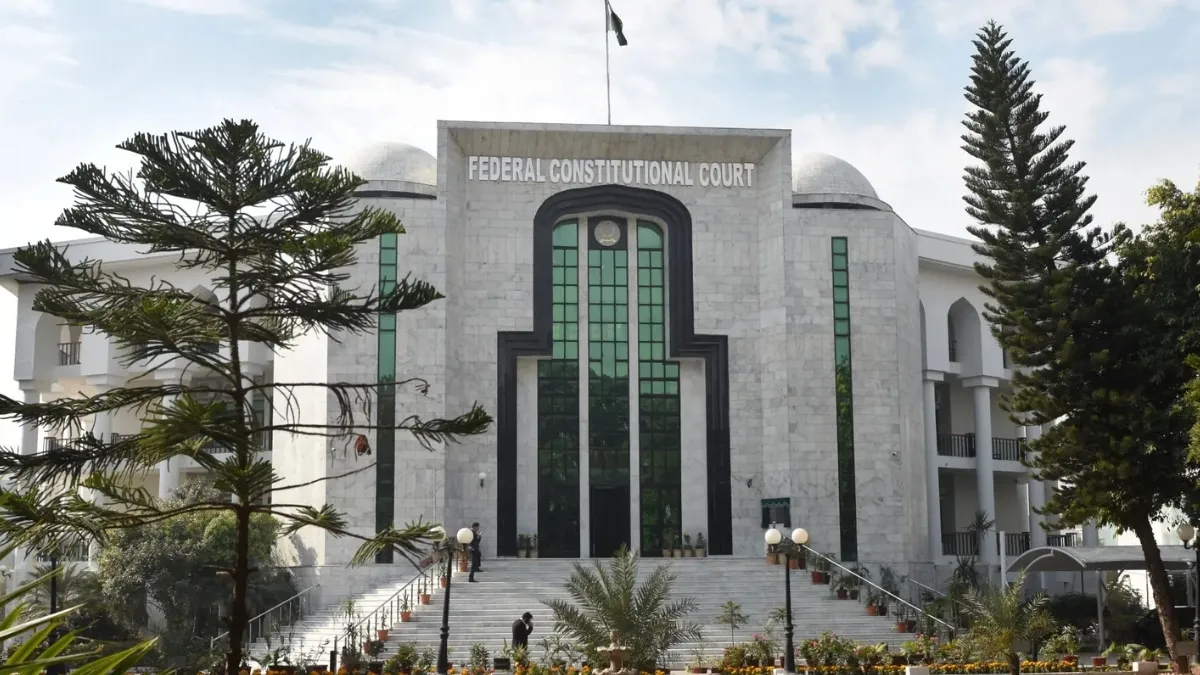
Federal Constitutional Court Issues Major Ruling on Inheritance Rights
The Federal Constitutional Court has ruled that inheritance records cannot deprive anyone of their rightful share under Islamic law, clarifying that cousins may be entitled to the remaining property under certain conditions. This landmark decision reinforces the supremacy of religious jurisprudence over administrative documentation in property disputes.
In an 11-page judgment authored by Chief Justice Aminuddin Khan, the court upheld the Lahore High Court's decision and dismissed appeals filed in a property inheritance dispute. The ruling provides definitive guidance on how estates must be distributed when multiple categories of relatives lay claim to the assets of a deceased person.
How Islamic Inheritance Law Governs Property Distribution
The court observed that inheritance rights cannot be determined solely on the basis of family ties or blood relationships. Instead, property must be distributed according to Islamic inheritance law and its established legal categories. Administrative convenience or long-standing informal family agreements hold no legal weight against the codified rules of succession.
It ruled that after the prescribed shares are distributed among the widow and sisters, the remaining property belongs to eligible residuary heirs, known as Asabah. These residuary heirs step in to receive portions of the estate that are left over after fixed Quranic shares are allocated to primary beneficiaries.
The Legal Principle of Radd and Residuary Heirs
The court further clarified that the principle of Radd, which allows the redistribution of remaining property among eligible heirs, cannot be applied when a legally entitled residuary heir exists. Radd, or the return of surplus estate shares, only comes into play under specific conditions where certain primary sharers take back the remainder in proportion to their fixed quotas in the absence of other qualified claimants.
By establishing that the presence of an Asabah blocks the application of Radd, the judiciary has reinforced traditional jurisprudence regarding distant kindred and collateral relatives. Legal practitioners handling estate matters must carefully verify the existence of all potential residuary claimants before settling estate divisions through local administrative bodies.
Details of the Muhammad Asghar Estate Case
In the case concerning the estate of Muhammad Asghar, the court upheld the inheritance claim of his paternal cousin, ruling that he was entitled to the remaining share of the property. The two-member bench, comprising Chief Justice Aminuddin Khan and Justice Ali Baqar Najafi, upheld the Lahore High Court's November 6, 2024, decision while dismissing appeals filed by Kaneez Haider.
According to the ruling, Asghar's widow is entitled to one-fourth of his estate, while his two full sisters are collectively entitled to two-thirds. The remaining one-twelfth share will go to an eligible residuary heir, validating the cousin's legal standing in the matter.
Why Revenue Records Cannot Override Legal Inheritance
The judgment also emphasized that revenue records and procedural formalities cannot change an individual's inheritance rights or validate an unlawful distribution of property. Land revenue departments often record mutations based on possession or verbal family settlements, but these entries do not constitute legal title if they conflict with statutory inheritance shares.
Citizens frequently rely on updated land registries as proof of absolute ownership, yet courts retain the power to correct historical errors in mutation registers. The judiciary made it clear that clerical entries in government registers lack the authority to extinguish legitimate statutory claims.
Jurisprudential Differences Between Sunni and Shia Schools
The court also noted that inheritance laws differ between Sunni and Shia schools of thought, emphasizing that property must be distributed according to the Muslim personal law applicable to the deceased. Jurisprudential interpretations vary regarding how collateral relatives and residuary heirs inherit across different legal traditions within Islam.
The bench concluded that the appellant had failed to establish any legal error that would justify interference with the Lahore High Court's decision. This leaves the established framework intact and signals to lower courts and administrative tribunals that adherence to strict doctrinal rules is mandatory in property litigation.





