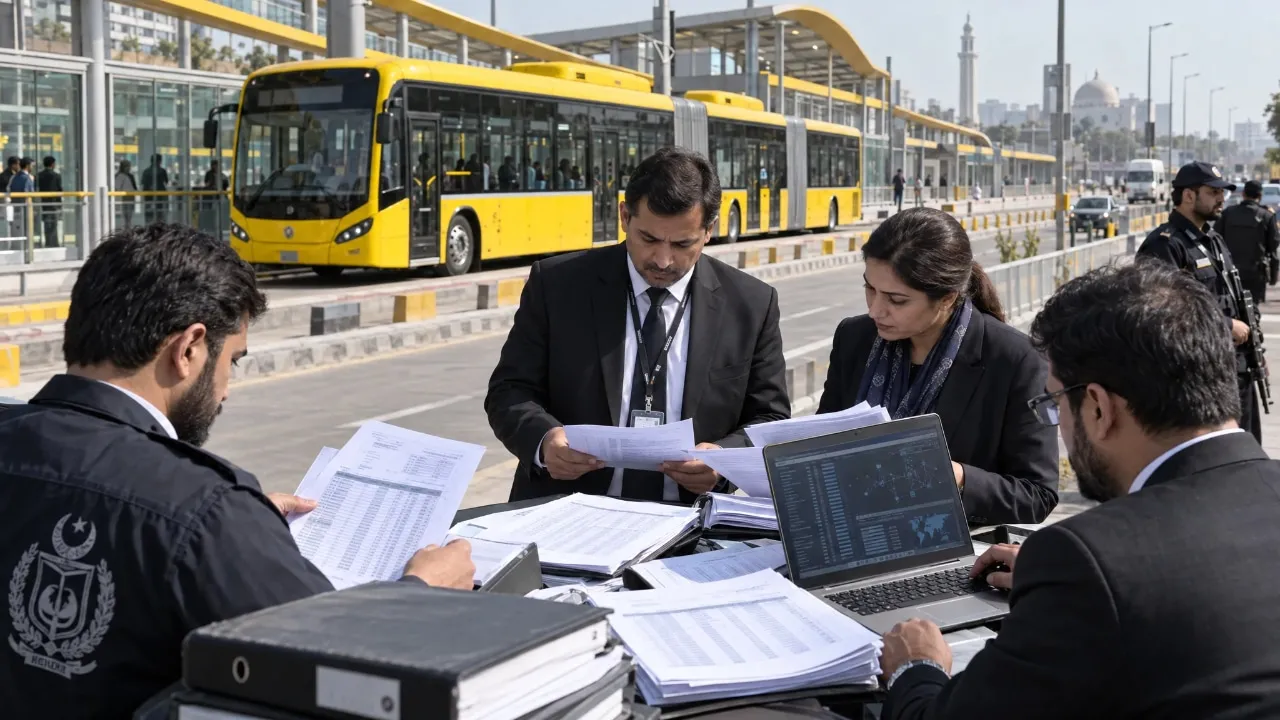
The Federal Investigation Agency's Commercial Banking Circle has filed a charge sheet against former Yellow Line Project Director Zameer Abbasi in the District and Sessions Court (South), alleging illegal transfers of large sums of money abroad through hawala networks.
The charge sheet, submitted on the day of the hearing, details alleged benami bank accounts, foreign travel without proper currency purchase records, and insurance premiums totalling more than Rs35 million.
What the Charge Sheet Accuses Zameer Abbasi of Doing
According to the FIA document, Abbasi, who served in various government departments at grades 17 to 19, accumulated substantial wealth through illegal means while in public service. The agency says he transferred large sums of money abroad via the hundi and hawala systems, informal channels that bypass official banking regulations.
Investigators identified three bank accounts in Abbasi's name that together show debit and credit transactions exceeding Rs110 million. The charge sheet claims these movements were not linked to any declared source of income.
Family Accounts Also Under Investigation
The FIA's probe extended to accounts held by Abbasi's immediate family. Three accounts in the name of his wife, Khansa Zameer, recorded transactions exceeding Rs160 million. In addition, accounts linked to his father, Muhammad Panah Abbasi, reportedly recorded transactions worth billions of rupees, though the exact figure is not disclosed in the charge sheet.
Authorities also allege that several properties across Pakistan were registered in the names of Abbasi and his family members, suggesting an effort to conceal ownership.
Insurance Policies and Travel Patterns
The charge sheet notes that Abbasi obtained seven insurance policies in his and his wife's names, paying more than Rs35 million in premiums. While the policies themselves are not illegal, the large sums raise questions about the source of the funds used to purchase them.
FIA investigators found that Abbasi travelled abroad 24 times during his tenure. However, he failed to produce records of foreign-currency purchases from authorised exchange companies for those trips, a breach of Pakistan's foreign exchange regulations.
These travel details are significant because Pakistani law requires proof of lawful currency acquisition for any overseas expenditure exceeding the annual personal allowance.
Background on the Yellow Line BRT Project
The Yellow Line Bus Rapid Transit (BRT) project, launched in 2015, was intended to provide a high-capacity, rapid-transit corridor linking key commercial districts. Funded through a mix of federal allocations, provincial contributions, and private-sector loans, the project has been touted as a model for urban mobility.
During the period when Abbasi held senior positions, the project faced cost overruns and delays, prompting scrutiny from oversight bodies. Allegations of financial irregularities have surfaced before, but this is the first time a former project director has been formally charged with moving money abroad through illegal channels.
How Hawala and Hundi Work in Pakistan
Hundi and hawala are informal value-transfer systems that rely on a network of trusted dealers. Money is handed to a dealer in one city, who then instructs a counterpart in another city or country to deliver the equivalent amount, often in a different currency. Because the transactions leave no paper trail, they are frequently used to evade taxes, launder money, or bypass foreign-exchange controls.
Pakistan's State Bank regulates foreign-exchange transactions, requiring all outward remittances to be processed through authorised dealers. The FIA's allegation that Abbasi used hawala suggests a deliberate circumvention of these regulations.
Legal Framework and Potential Penalties
Under the Prevention of Money Laundering Act (PMLA) 2002, individuals found guilty of transferring funds through unlicensed channels can face imprisonment of up to ten years and fines up to ten times the amount involved. The FIA also cites the Foreign Exchange Regulation Act, which penalises unauthorised foreign-currency transactions.
If the court upholds the charge sheet, Abbasi could face combined penalties, including confiscation of the alleged proceeds, forfeiture of property, and disqualification from holding public office.
Impact on Public Trust and Future BRT Projects
The case arrives at a time when Pakistan is seeking to expand its urban transit infrastructure. Public confidence in large-scale projects depends heavily on transparency and accountability. Allegations of high-level corruption can delay funding, deter private investors, and prompt tighter oversight from ministries of finance and planning.
For citizens, the immediate impact is a heightened awareness of how public officials might misuse authority for personal gain. For the transport sector, the case may lead to stricter procurement and financial monitoring mechanisms for future BRT initiatives.
What Happens Next?
The charge sheet will be examined by the District and Sessions Judge (South). The court will decide whether to frame charges and set a trial date. Abbasi is expected to file a response, and the FIA has indicated that further investigations into related accounts and properties are ongoing.
Watch for court filings that detail the exact amounts in the father's accounts, the list of properties identified, and any asset-seizure orders that may follow. The outcome will also influence how the FIA prioritises future investigations of public-sector officials suspected of using hawala networks.
Practical Takeaways for Readers
- If you hold a government position, ensure all foreign-exchange transactions are processed through authorised dealers and documented.
- Businesses dealing with large cash flows should maintain transparent records to avoid being implicated in benami or hawala investigations.
- Citizens can request information on public-sector projects under the Right to Information Act to monitor financial integrity.





