Understanding Why Gold Price and Silver Prices Are Rising Today
Precious metal markets are experiencing intense volatility driven directly by stalled diplomatic negotiations between the United States and Iran. President Trump recently demanded historical conflict compensation from Tehran, a demand that effectively freezes ongoing peace talks. This sudden deadlock crushes any immediate hope of reopening the Strait of Hormuz, a critical global shipping lane for petroleum. Consequently, spiking global oil prices fuel fresh inflation fears across international markets. Anxious investors aggressively buy gold and silver as safe-haven assets to protect their capital against currency devaluation and economic instability. In Pakistan, these international shocks push local prices of these assets sharply higher as traders react to global shifts. Local Sarafa markets constantly adjust prices to absorb these macroeconomic hits throughout the trading day.
Current Gold Rates in Pakistan For Local Markets
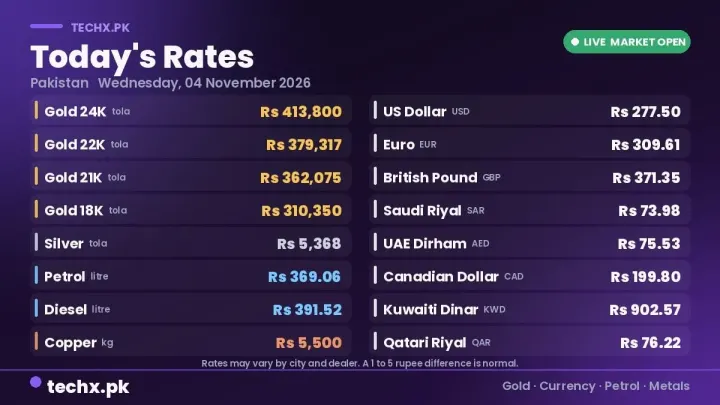
The domestic market in Pakistan reflects the immediate impact of international geopolitical tensions on physical bullion. Jewelers and bullion dealers across the country rely on these benchmark figures to conduct daily business transactions. Buyers and sellers monitor these official rates closely as market conditions fluctuate rapidly. For 24-karat gold, the current domestic rates established by market monitors are structured across standard traditional and metric measurements:
- Per Tola: Rs. 409,851
- 10 Grams: Rs. 351,387.30
- 1 Gram: Rs. 35,138.73
These figures demonstrate the substantial financial commitment required for retail and wholesale gold purchases within local Sarafa markets. Investors continue to allocate funds toward physical gold bullion despite the elevated price environment.
Current Silver Rates in Pakistan For Local Markets
Silver follows a trajectory similar to gold, moving upward in response to broad macroeconomic pressures and safe-haven buying trends. Industrial demand combined with retail investment interest keeps silver valuations elevated alongside its more expensive counterpart. The domestic rates for 24-karat silver across standard weight categories in Pakistan are detailed below:
- Per Tola: Rs. 5,172.31
- 10 Grams: Rs. 4,434.49
- 1 Gram: Rs. 443.45
Market participants watch these silver rates carefully to gauge retail sentiment and smaller-scale precious metal acquisition trends. Both retail buyers and industrial users must navigate these adjusted price points during their daily operations.
International Spot Prices For Gold and Silver
Global bullion exchanges dictate the baseline costs that eventually filter down to regional markets like Pakistan. Spot prices reflect real-time transactions executed on international commodity exchanges where institutional investors trade large volumes of precious metals. The international rates recorded for today stand at distinct levels:
- Spot Gold: $3,956.40 per troy ounce
- Spot Silver: $49.925 per troy ounce
These global valuations move dynamically as currency markets, geopolitical announcements, and energy prices shift throughout the trading week. Traders analyze these per troy ounce figures to anticipate upcoming adjustments in local retail markets.
The Geopolitical Factors Driving Precious Metal Volatility
The core catalyst behind the current price surge originates in the Middle East and diplomatic friction involving Washington and Tehran. Stalled diplomatic channels mean that economic uncertainty will likely persist for the foreseeable future. Energy markets react violently to political deadlocks, particularly when vital transit corridors face prolonged closures or heightened threat levels. Higher petroleum costs translate directly into broader inflationary pressures, prompting institutional funds to rotate out of riskier assets and into safe havens. Precious metals historically serve as a reliable hedge during periods of heightened international friction and economic unpredictability.
How Local Sarafa Markets Absorb Global Shocks
Domestic jewelers and bullion merchants in Pakistan operate within a framework heavily influenced by foreign exchange rates and international bullion benchmarks. When global spot prices jump overnight, local Sarafa associations recalculate domestic rates to maintain alignment with international parity. This continuous adjustment protects domestic dealers from arbitrage losses while passing the true cost of global instability onto the local consumer base. Retail buyers engaging with local markets must contend with these rapid pricing revisions as geopolitical headlines break around the clock.