Pakistan Air Force Conducts Maiden Test of Fa'az Air-to-Air Missile
The Pakistan Air Force successfully executed the initial flight test of the first indigenously developed Fa'az air-to-air missile. The Directorate General of Public Relations shared details of this breakthrough through a public statement on the social media platform X. This initial test represents a major milestone for domestic aerospace manufacturing and military defense capabilities. The new weapon will provide greater operational flexibility for the Pakistan Air Force while strengthening the overall defense posture of the country.
Military leaders, distinguished scientists, and specialized engineers gathered to observe the launch event in person. Following the successful test, national leadership offered formal praise to the technical teams responsible for the project. The President, the Prime Minister, the Chief of Army Staff, the Chief of Defence Forces, and various services chiefs congratulated the personnel involved. Additionally, Interior Minister Mohsin Naqvi issued statements commending the scientific community for reaching this historic objective.
Technical Specifications and Development Background of the Fa'az Missile
Engineers at NESCOM's Air Weapons Complex designed and built the Fa'az missile system entirely within the country. This same specialized complex previously developed other prominent domestic munitions, including the Ra'ad and Taimur air-launched cruise missiles. Global Industrial and Defence Solutions first introduced the Fa'az platform to the public during a defense exhibition in 2023. Domestic defense planners view the weapon as a demonstration of the technical maturity, innovative capacity, and self-reliance of the national military industry.
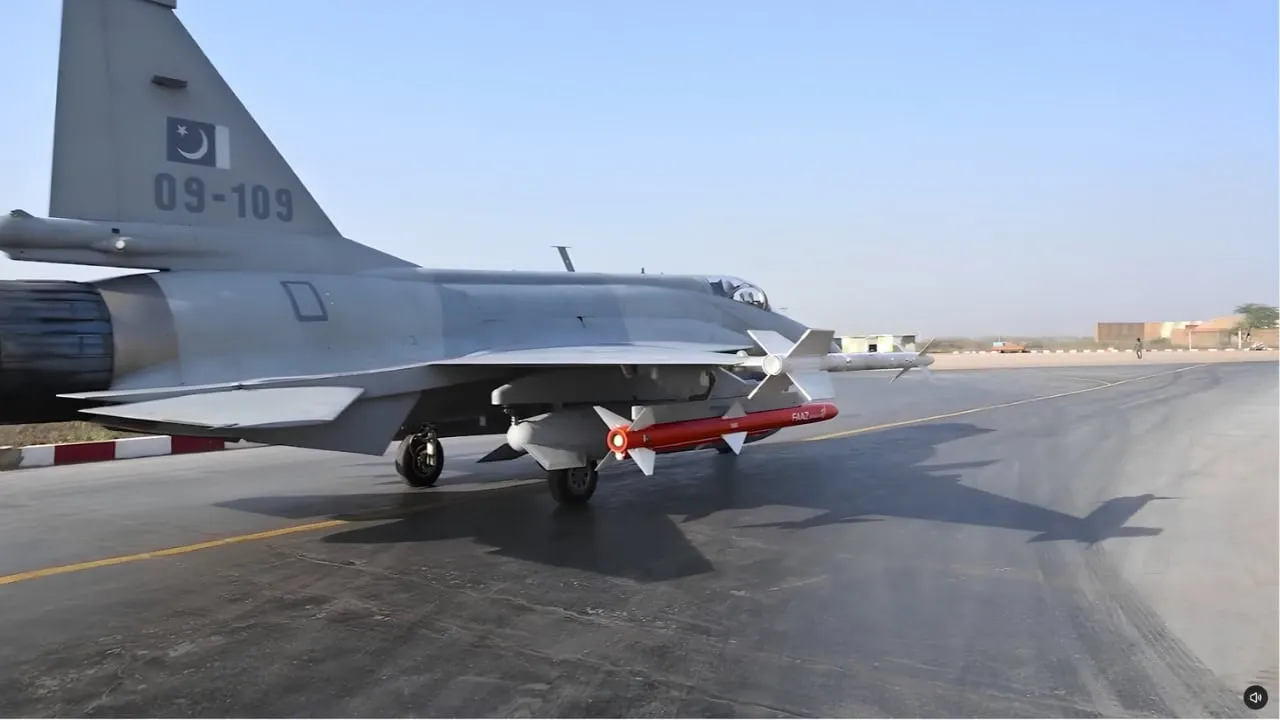
During the recent evaluation, a JF-17 Thunder Block-1 fighter jet deployed the Fa'az missile from an underwing weapons pylon. This particular aircraft had previously undergone a comprehensive overhaul at the Pakistan Aeronautical Complex starting in 2019. Defense analysts note that integrating new domestic munitions onto existing fighter platforms requires extensive engineering coordination between research laboratories and maintenance depots. The successful separation and launch from the JF-17 validate the compatibility of the weapon with frontline tactical aircraft.
Guidance Systems and Operational Capabilities
The tested version of the Fa'az missile incorporates a modern terminal guidance system designed to track hostile aircraft. Specifically, the munition uses an imaging infrared seeker capable of detecting targets at distances between 40 and 45 kilometers. Alternatively, the military can equip the weapon with an active radar-homing seeker configuration that offers a detection range of 25 kilometers. These options allow the air force to engage enemy aerial targets at much longer ranges than older short-range defense systems.
Longer engagement ranges provide pilots with a tactical advantage during aerial combat scenarios. By striking targets from a distance, aircraft reduce their exposure to enemy retaliatory fire. The dual seeker options also give military planners flexibility depending on weather conditions, electronic warfare environments, and the specific signature of the target aircraft. These technological features contribute directly to the enhanced operational flexibility noted by military public relations officers.
Broader Military Modernization and Indigenous Defense Programs
The introduction of the Fa'az missile occurs alongside a wider push by the military to modernize its arsenal through domestic production. Earlier in the month, the Pakistan Army conducted a successful test of an extended-range version of the Fatah-2 hypersonic ballistic missile. That weapon employs advanced navigation technology and a specialized flight trajectory designed to bypass hostile missile defense systems. Weeks prior to that test, forces also evaluated an extended version of the Fatah-4 ground-launched cruise missile, following a previous training launch of the original Fatah-4 at a 750-kilometer range in September 2025.
These consecutive weapon evaluations allow military engineers to gather telemetry data on critical navigational subsystems. Continuous testing helps verify the reliability of guidance components and structural frames under high-stress conditions. By relying on domestic design bureaus rather than foreign suppliers, the state aims to insulate its military supply chains from external geopolitical pressures and sanctions.
Regional Security Context and Strategic Implications
This latest defense milestone takes place against a backdrop of evolving security challenges in the region. Over a year ago, Pakistan and India engaged in a brief period of intense military hostilities marked by artillery duels and missile exchanges. During those clashes, both nations used fighter jets and combat drones extensively. Official reports from the conflict noted that Pakistani air defense forces shot down multiple opposing aircraft, including an advanced French-made Rafale fighter jet. While foreign governments and neighboring capitals disputed certain tallies, regional observers acknowledged significant aerial engagements.
The experience from past conflicts heavily influences current defense procurement and domestic manufacturing priorities. Maintaining a credible deterrent requires continuous upgrades to airborne interception systems and electronic countermeasures. As regional rivals invest in advanced stealth aircraft and modern avionics, domestic programs like the Fa'az missile provide the air force with the tools necessary to protect national airspace without depending on foreign military aid.