Gold Price And Silver Prices Sharply Rise As Market Opens Today
Stalled United States and Iran negotiations are currently driving significant volatility in precious metals across global and domestic markets. President Trump recently demanded historical conflict compensation from Tehran, which effectively freezes ongoing peace talks. This sudden deadlock crushes any immediate hope of reopening the Strait of Hormuz, a critical maritime chokepoint for international crude oil shipments. Consequently, spiking global oil prices fuel fresh inflation fears worldwide, causing anxiety among market participants. Anxious investors aggressively buy gold and silver as safe-haven assets to protect their capital from currency devaluation and economic instability. In Pakistan, these international shocks push local prices of these assets sharply higher as local Sarafa markets constantly adjust prices to absorb these macroeconomic hits.
Understanding Current Gold And Silver Rates In Pakistan
The domestic bullion market in Pakistan reacts immediately to shifts in international commodity benchmarks and currency exchange rates. Local Sarafa markets constantly monitor global spot prices to determine daily domestic tariffs for precious metals. Buyers and sellers across major cities must reference these updated figures before conducting transactions. The market adjustments reflect the immediate pressure from foreign trade dynamics and domestic economic conditions. Here is a breakdown of the gold and silver rates in Pakistan today for 24-karat purity levels across different traditional units of measurement.
Current Domestic Metal Valuations
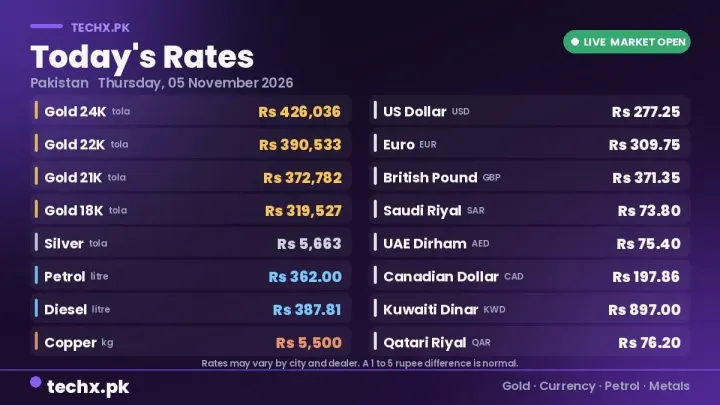
For gold 24K, the rate stands at Rs. 428,910 per tola. For 10 grams of 24K gold, the price is Rs. 367,727.50. For a single gram of 24K gold, local buyers must pay Rs. 36,772.75. Meanwhile, silver rates follow a similar upward trajectory due to parallel industrial and safe-haven demand. For silver 24K, the rate is Rs. 5,492.50 per tola. For 10 grams of silver, the cost reaches Rs. 4,709.01. Finally, one gram of silver is priced at Rs. 470.901 in the domestic market today.
International Market Drivers And Global Spot Prices
Precious metal valuations do not exist in a vacuum and rely heavily on international commodity exchanges. Spot prices dictate the baseline cost of raw bullion before import duties, taxes, and local fabrication charges apply. The recent geopolitical friction in the Middle East directly influences these global benchmarks. As diplomatic channels close between Washington and Tehran, commodities traders reallocate portfolios toward secure physical assets. Here is a breakdown of the international rates for today based on standard troy ounce measurements used in global trade.
Global Spot Valuations For Bullion
On the international commodities exchange, spot gold is currently trading at $4,134.54 per troy ounce. This high valuation reflects intense institutional buying and central bank reserve diversification amid rising geopolitical tensions. Similarly, spot silver registers strong upward movement alongside its yellow counterpart. Spot silver is currently priced at $52.953 per troy ounce on global markets. These international figures serve as the foundational pricing mechanism that local jewelers and bullion dealers use to compute domestic rates in Pakistan.
How Geopolitical Tensions Impact Inflation And Precious Metals
Geopolitical conflicts often create immediate supply chain disruptions that ripple through international energy and financial systems. The confrontation between the United States and Iran centers heavily on security demands and economic sanctions. When President Trump demanded historical conflict compensation from Tehran, diplomatic efforts stalled completely. This stalemate prevents the safe passage of commercial vessels through the Strait of Hormuz, through which a large portion of the world petroleum supply travels daily. The resulting restriction in oil supplies causes immediate spikes in global energy costs. Higher energy expenses drive up the cost of manufacturing, transportation, and goods production worldwide, fueling consumer price inflation. Investors traditional response to high inflation involves moving capital away from paper currency and into physical commodities like gold and silver, which historically retain their purchasing power during periods of monetary uncertainty.
The Role Of Sarafa Markets In Pakistan
Local Sarafa markets function as the traditional nerve center for precious metal trade across Pakistan. Jewelers, bullion traders, and retail investors rely on these markets for daily pricing updates and physical exchanges. Because Pakistan imports a significant portion of its raw gold and silver requirements, domestic rates remain closely tethered to foreign exchange rates and international bullion trends. When foreign currency fluctuations combine with global commodity spikes, Sarafa associations meet to revise local tariffs. This ensures that domestic prices accurately reflect the replacement cost of importing new bullion from international suppliers. Consumers tracking these markets must pay close attention to daily announcements from official Sarafa bodies to understand how external shocks affect their local purchasing power.