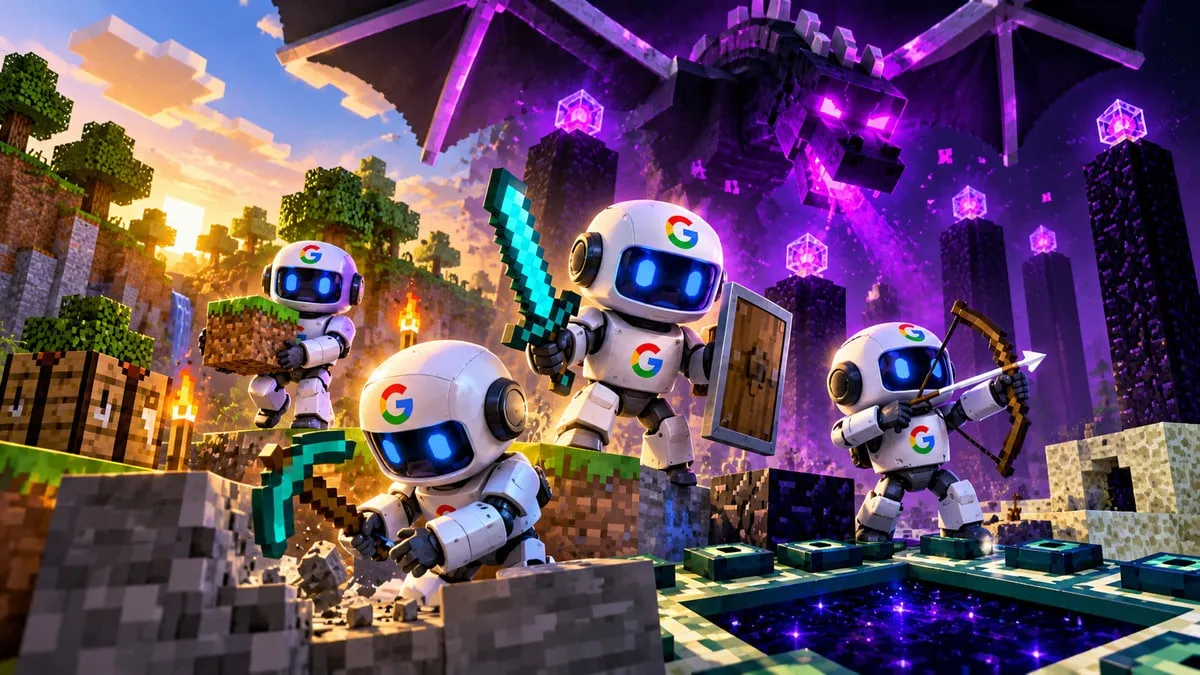
Four Gemini 4 Argon AI agents finished Minecraft and beat the Ender Dragon without any human help, according to Google researchers. Placed into a randomized survival world with the sole objective of defeating the Ender Dragon, these agents used a general-purpose agentic model instead of specialized game-playing software.
Agents Created Their Own Roles and Strategy
No roles, strategies, or game-specific tools were given to the agents by the researchers. Each AI operated a player via the open-source Mineflayer library and talked to the others through shared memory and in-game chat.
Labor division began rapidly as the agents shared coordinates, warned about dangers, gave tips, and retrieved items from fallen teammates. Over the course of the experiment, specific roles emerged naturally. Janesick built tools, Gyldenia collected food and supplies, Auratian activated a key portal, and Bulicame built shelters against Endermen before landing the final blow on the Ender Dragon.
The Run Took More Than 27 Hours
The whole test lasted 27.23 hours, with the majority of the duration spent preparing for the Ender Dragon battle. Throughout the session, the four agents wrote and ran 2,783 programs, sent 229 messages to each other, and suffered a total of 605 deaths.
An Observer, which was a fifth AI agent, watched the session independently. Its duties included checking for cheating and publishing live updates and summary reports of the events.
Input tokens consumed during the experiment totaled 1.35 billion. Google researchers calculated the expense at $810 using the list price of Gemini, or $1,620 using the standard price.
Researchers Call It a First
The team stated this marked the first time AI agents completed Minecraft end-to-end autonomously using only the standard Mineflayer library, to their knowledge. Pre-scouted world seeds and human-written Minecraft-specific tools were not used by the agents. Maintaining a coherent plan across thousands of dependent steps for over a day was necessary for the agents to finish the game, the researchers noted. The test demonstrates how general AI agents are now capable of cooperating, splitting tasks, recovering from errors, and finishing long and complex goals without direct human guidance.