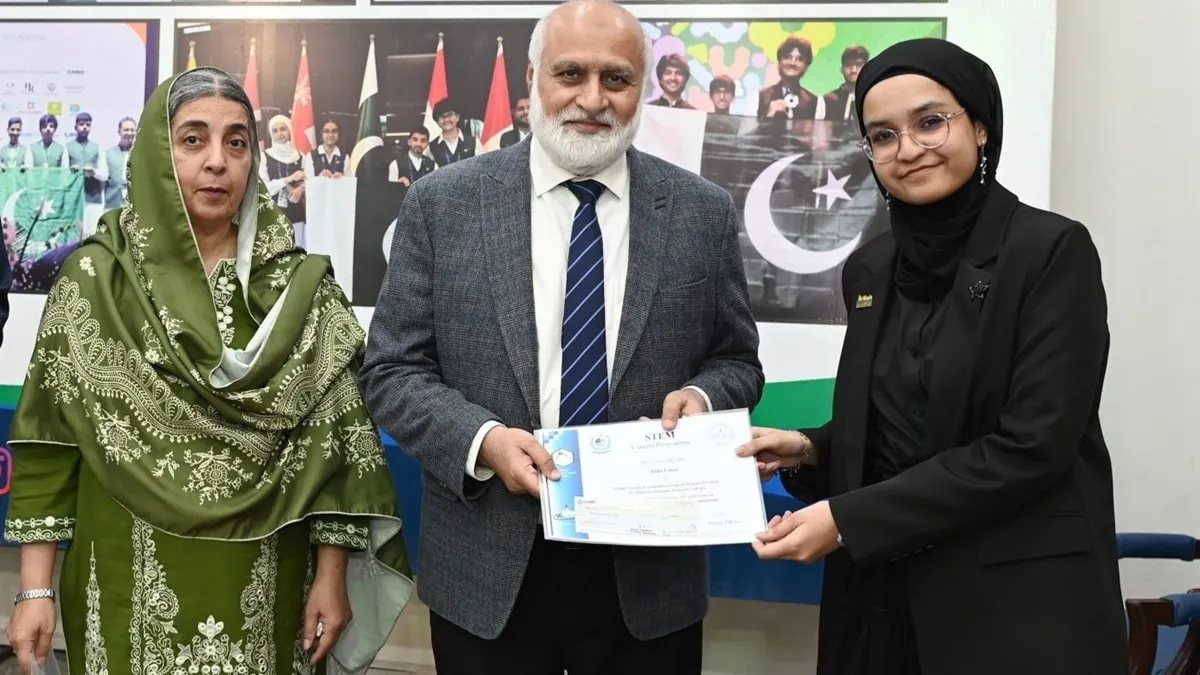
HEC Honors 23 Pakistani Students for International Science Olympiad Achievements
The Higher Education Commission has honored 23 Pakistani students for their achievements at the 2026 International Science Olympiads, where they secured seven medals and several other distinctions. This recognition highlights the dedication of young scholars who competed on global academic stages in fields requiring advanced scientific and analytical reasoning. The event brought together educators, institutional leaders, and families to celebrate these intellectual milestones.
The students represented Pakistan in Biology, Chemistry, Physics, Mathematics, and Artificial Intelligence, winning one silver medal, six bronze medals, five honorable mentions, one Certificate of Merit, and one Certificate of Recognition. Such multi-disciplinary participation demonstrates a broadening academic capability across secondary and higher secondary educational tiers in the country. Preparing for these rigorous global contests demands years of dedicated study, advanced problem-solving practice, and mentorship from specialized academic institutions.
Details of Medals and Academic Categories
Among the achievers, Hassan Atif Cheema secured a silver medal at the International Biology Olympiad. Pakistan also made its first official appearance at the International Olympiad in Artificial Intelligence, marking a strategic expansion into cutting-edge computational disciplines. The inclusion of artificial intelligence reflects evolving global educational priorities and the adaptation of domestic training programs to meet modern technological demands.
The remaining medals and distinctions were distributed across chemistry, physics, mathematics, and the other biological sciences. Each category presents distinct intellectual challenges, often requiring participants to solve university-level theoretical problems and execute complex laboratory or computational tasks under strict time limits. The success of these 23 students places them among the elite young minds of their cohort internationally.
Celebration Event Organized by STEM Careers Programme
The achievements were celebrated at a ceremony organized by the STEM Careers Programme, with HEC Chairman Prof. Dr. Niaz Ahmad Akhtar attending as the chief guest. The STEM Careers Programme operates as a joint initiative designed to identify, nurture, and train talented youth across Pakistan for international competitions. Events like this ceremony serve to validate the hard work of the participants and encourage younger students to pursue paths in science and technology.
The chairman congratulated the students and distributed cash prizes and certificates in recognition of their performance at the international competitions. Financial incentives and formal institutional certificates provide tangible support to students who dedicate substantial extracurricular hours to Olympiad preparation. These awards reinforce the value of academic excellence within the national educational framework.
Institutional Mentorship and Support Networks
He also acknowledged the contributions of parents, teachers, and mentors from PIEAS, COMSATS Lahore, NIBGE-C, and ICCBS at the University of Karachi. These premier scientific and educational institutions play a vital role by hosting training camps, providing laboratory access, and offering expert guidance from active researchers. Mentors from these organizations work closely with selected students to bridge the gap between standard school curricula and advanced university-level concepts.
Parental support remains a foundational element in the success of these young competitors, often requiring logistical and emotional investment over many months of preparation. The collaborative structure involving families, schools, and specialized research centers ensures that talented individuals receive comprehensive backing throughout their preparation cycles.
Future Commitment to Scientific Talent in Pakistan
Prof. Dr. Niaz Ahmad Akhtar reaffirmed HEC and the government's commitment to promoting scientific talent and supporting the next generation of scientists, researchers, and innovators. Institutional backing is crucial for maintaining continuous participation in international events, which often involve significant travel, registration, and training expenses. Sustained investment in human capital through structured programs helps build a stronger foundation for domestic research and technological development.
As Pakistan continues its involvement in traditional sciences alongside newer fields like artificial intelligence, policymakers look to these student achievements as indicators of long-term academic potential. Observers watch for future expansions in training infrastructure and increased outreach to schools in smaller cities to widen the talent pool for upcoming international competitions.