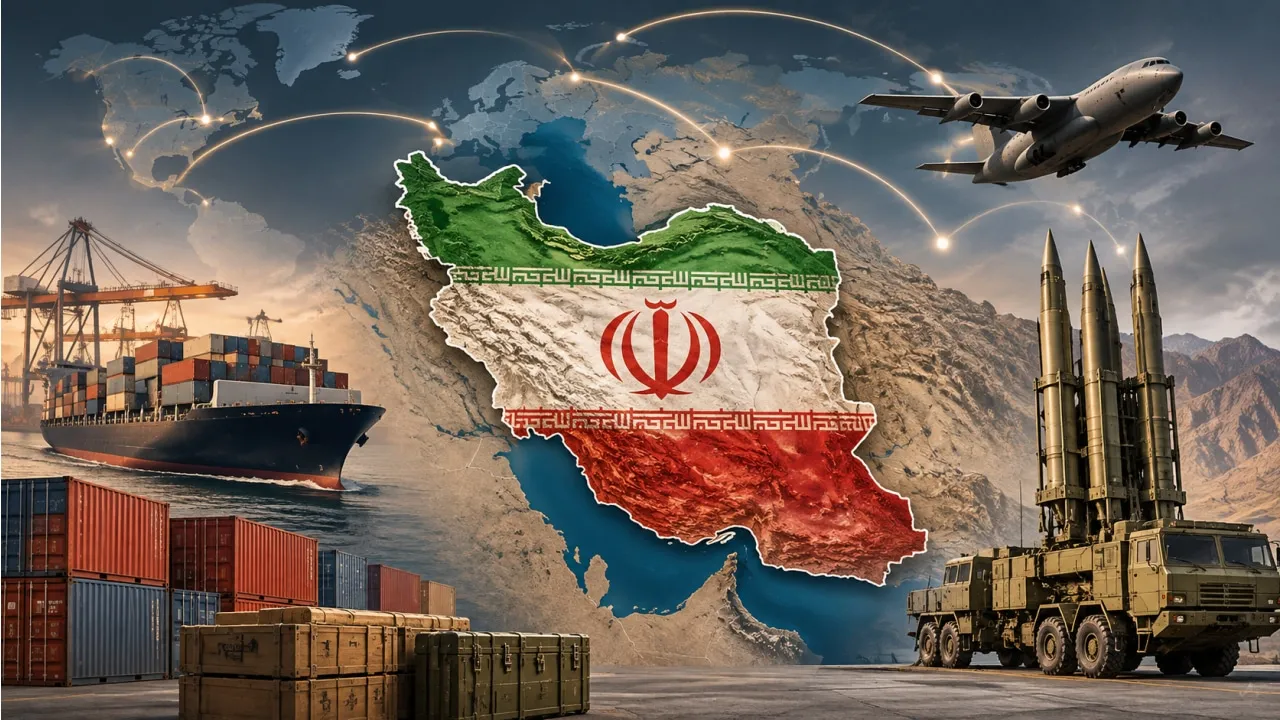
A Reuters investigation found that the Islamic Revolutionary Guard Corps (IRGC) brought in $2.3 billion worth of military hardware through a hidden network of procurement agencies starting in January 2025, using international trade routes to circumvent Western sanctions and maintain its weapons programs.
More than 5,000 agencies connected to Iran's Ministry of Defense and Armed Forces Logistics (MODAFL) were uncovered by the inquiry, operating via foreign intermediaries, shell companies, and financial pathways.
This setup allowed Tehran to acquire explosives, rocket fuel ingredients, weapons components, industrial machinery, and heavy trucks in spite of sanctions and a US naval blockade.
These details explain how Iran kept rebuilding its missile and drone stocks during the ongoing conflict, even while the United States and Israel attacked its military bases.
One Agency Accounts for Billions in Imports
Between January 2025 and June 2026, a military procurement group known as MOD 346428 brought in $2.3 billion in equipment.
The acquisitions featured rocket propellants, explosives, arms components, aircraft engine parts, and heavy-duty trucks adaptable as mobile missile launchers.
Goods arrived via land, sea, and air pathways, with records pointing to origins in China, Russia, Germany, and other nations.
Import activity grew rapidly over recent years. Government customs statistics published in Iranian media show purchases jumping from $442 million in the 12-month period ending March 2023 to $988 million the following year, placing the agency among the top 10 importers in Iran.
Reuters carried out the investigation alongside 240 Analytics, a risk consultancy that traced the groups using Iranian bank records, official papers, corporate filings, and shipping data.
Secret Network Uses Front Companies and Foreign Intermediaries
These agencies share a Tehran address with Iran's Ministry of Defense and Armed Forces Logistics, employing names starting with "MOD" followed by five or six digits.
While most claim an incorporation date of February 11, 1979, when Ayatollah Ruhollah Khomeini assumed power, records show many actually started in 2013 during a period of heavy sanctions and falling oil revenues and currency value.
The system depends on foreign intermediaries and shell companies called trustees to buy items using money from illegal oil sales.
Cross-border money transfers rarely happened. In 97 percent of the reviewed shipments, payments were marked as settled without currency transfer, relying on foreign bank funds held by intermediaries to buy and ship products to Iran.
The inquiry also discovered that the identifiers of these agencies showed up on shipping papers, invoices, and bank accounts, leaving a traceable footprint despite the front companies.
Imports Include Chemicals, Machinery and Heavy-Duty Trucks
Materials useful for missile and drone manufacturing reached Iran through this procurement apparatus.
From January to April 2025, MOD 346428 brought 886 tonnes of chemicals into Bandar Abbas, declared as coming from China. These included sodium chlorates and other perchlorates usable as ingredients for solid rocket fuel.
Precision machinery imports also appeared in the findings, including computer-controlled lathes, electron-beam furnaces, and particle accelerators. Such items have industrial uses but can also build military gear like drone and missile bodies.
Furthermore, the agency brought in hundreds of Iveco trucks alongside thousands of Toyota Hilux and Land Cruiser vehicles. Iran has shown such vehicles in parades and employs them for moving equipment or mounting weapon systems.
Using satellite images, social media footage, and vehicle identification numbers, Reuters tracked some imported Iveco trucks to a customs yard close to Tehran.
Iveco stated it had no control over items moved or exported by third parties lacking a direct contract with the company. Toyota noted it does not operate in Iran and had no awareness of the purchases found during the investigation.
Imports Continued During the War
Military procurement by Iran persisted after the war started on February 28, 2026, continuing despite the US naval blockade.
Import totals initially dropped by 47 percent to $54 million in March compared to the prior month, but climbed back to $77 million by May.
A June 2026 delivery contained $1.9 million in Russian detonators used for firing explosives in drone and missile warheads. Five similar Russian deliveries totaling $7.6 million were found by the investigation dating back to early 2025.
Data additionally revealed that the IRGC bought $27 million in goods originating from the United Arab Emirates after the war began, with almost all coming via sea routes.
The latest delivery from the UAE, described as electronics, landed on June 27, nine days after the US announced a suspension of its naval blockade. The blockade was reinstated in mid-July.
Experts Describe Network as Military Trade Infrastructure
Miad Maleki, a former senior US Treasury official involved in shaping American sanctions against Iran, called the network an essential piece of the nation's military trade framework.
He noted the setup permitted Iran to fund military hardware purchases via overseas oil revenues while minimizing cross-border money movements.
Sanctions and weapons specialists reviewing the Reuters data noted that numerous imported goods could serve Iran's missile and drone programs, though some carry civilian uses as well.
The inquiry revealed that Western governments had not designated the numbered agencies as sanctioned entities, despite existing sanctions against the IRGC.
Reuters reported crossing a subset of about 19,000 import logs against shipping papers, social media clips, and state media reports. The investigation pointed out that certain records lacked thorough shipment details and that specific stated origins and contents could not be verified independently.