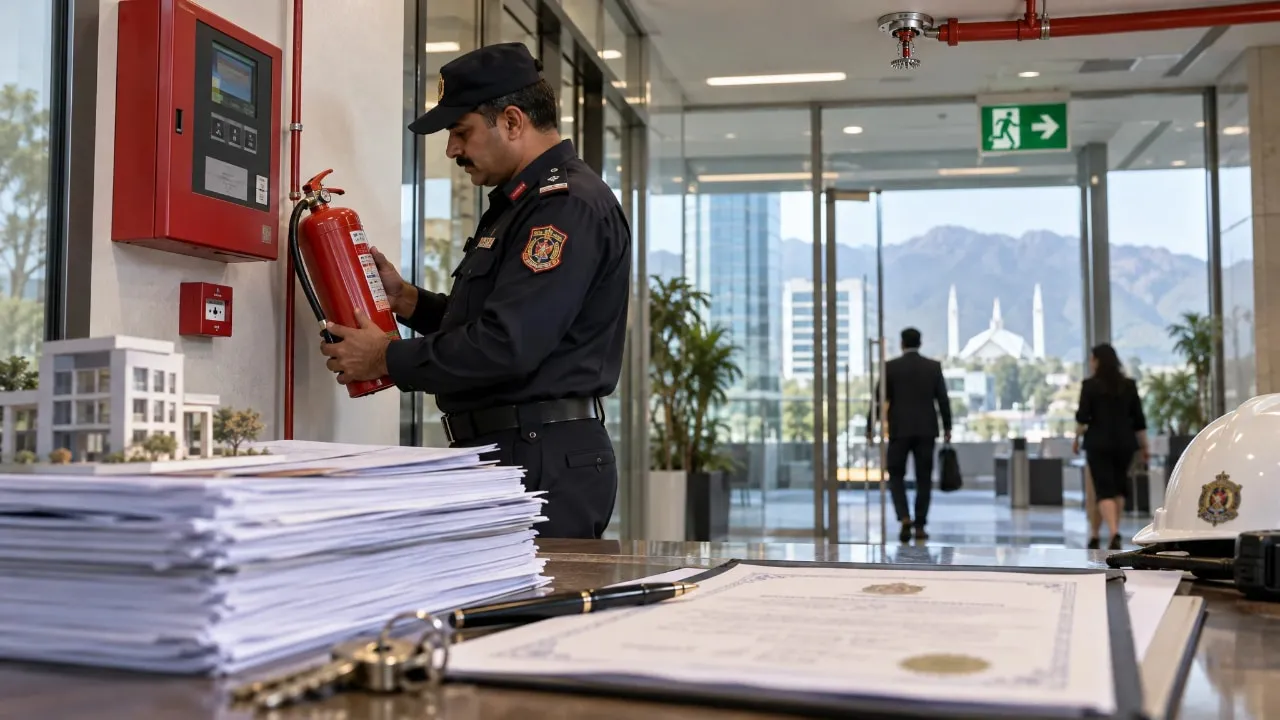
Islamabad Property Transfers to Require Fire Safety Clearance
The Capital Development Authority (CDA) has proposed making fire and life safety no-objection certificates (NOCs) mandatory for the transfer of residential and commercial properties in Islamabad, warning that ownership transfers without safety clearance could endanger lives and property. According to an official letter issued on November 12, 2026, the CDA's Building Emergency Audit Wing has recommended that no constructed residential or commercial property be transferred without obtaining fire and life safety clearance. This new proposal aims to bridge a long-standing gap in the regulatory framework governing real estate transactions within the federal capital.
The wing has sent a formal proposal to the CDA's Land and Estate Wing, seeking the inclusion of fire safety NOCs in the authority's one-window property transfer system. The letter noted that the existing property transfer procedure required NOCs from the Building Control and Revenue departments but did not include fire safety clearance. By integrating the safety audit into the standard transfer workflow, the administration hopes to ensure that every building meets established safety benchmarks before changing hands legally.
Background of Fire Safety Regulations in Islamabad
The push for stricter safety oversight is not entirely new within the municipal administration. The Building Emergency Audit Wing stated that the issue had been raised repeatedly between 2011 and 2026, but the necessary measures had yet to be implemented. Over the past decade and a half, urban growth in the capital has accelerated rapidly, bringing thousands of new multi-story residential buildings and commercial plazas into existence. Despite this massive expansion, enforcement mechanisms for emergency preparedness have often lagged behind actual construction activity.
Historically, property buyers and sellers in the city had to clear dues with revenue collectors and secure verification from building control officials to prove that structures did not violate zoning codes. However, internal checks rarely evaluated whether a building possessed functional fire escapes, working sprinkler systems, adequate water storage for emergencies, or unobstructed exit routes. Officials have pointed out that leaving safety out of the mandatory transfer checklist created a loophole where unsafe buildings could be bought and sold freely, passing potential hazards on to unsuspecting new owners and occupants.
Understanding the CDA One-Window Property Transfer System
The Capital Development Authority operates a centralized system designed to streamline administrative tasks for citizens. The one-window property transfer system serves as the primary portal where individuals submit documents, pay applicable fees, and complete legal ownership changes for plots, houses, and commercial units. Introducing a new requirement into this established digital and physical workflow means that property files would automatically pause until the Building Emergency Audit Wing issues a clearance certificate.
Under the proposed mechanism, inspectors would likely visit properties to evaluate their adherence to fire codes before the Land and Estate Wing approves any transfer deed. This addition would require coordination across multiple departments, including the Building Control Directorate, the Revenue Directorate, and the Law Directorate. Citizens using the one-window facility would need to factor in additional time for safety inspections when planning the sale or purchase of real estate assets.
Assessing Safety Risks in Residential and Commercial Buildings
The audit wing warned that transferring ownership of buildings without verifying fire safety arrangements could expose occupants and property to serious risks. Modern urban centers face unique hazards stemming from high-density construction, electrical overloads, and the use of combustible cladding materials. Without proper oversight, aging wiring or blocked corridors can turn a minor electrical fault into a major disaster, putting dozens of families or commercial employees in immediate danger.
Furthermore, commercial plazas often host multiple offices, retail shops, and food outlets under one roof, increasing the daily footfall and the complexity of emergency evacuation. Residential apartments present similar challenges, particularly when common areas are encroached upon or fire-fighting equipment falls into disrepair due to a lack of maintenance management. Making safety certification a prerequisite for financial transactions creates a strong economic incentive for property owners to maintain their buildings properly.
Legal Steps and Implementation Status
The wing recommended that the relevant CDA departments and Law Directorate review the proposed procedure and take the necessary legal steps for its approval and implementation. Because municipal rules often require formal notification and board approval before changing property transfer bylaws, the proposal must clear several bureaucratic hurdles. Describing the matter as a serious safety concern, the wing urged the authorities to give immediate priority to making the fire and life safety NOC system operational.
At present, the proposal has been submitted for consideration, and the requirement has not yet been formally implemented. Property buyers and sellers can still complete transfers under the older framework while legal experts evaluate the draft amendments. Authorities have not yet specified a definitive date for when the new rule will take effect, but stakeholders across the real estate sector are monitoring the situation closely for future updates.





