How Karachi Public Grounds Are Transforming Into Commercial Sports Venues
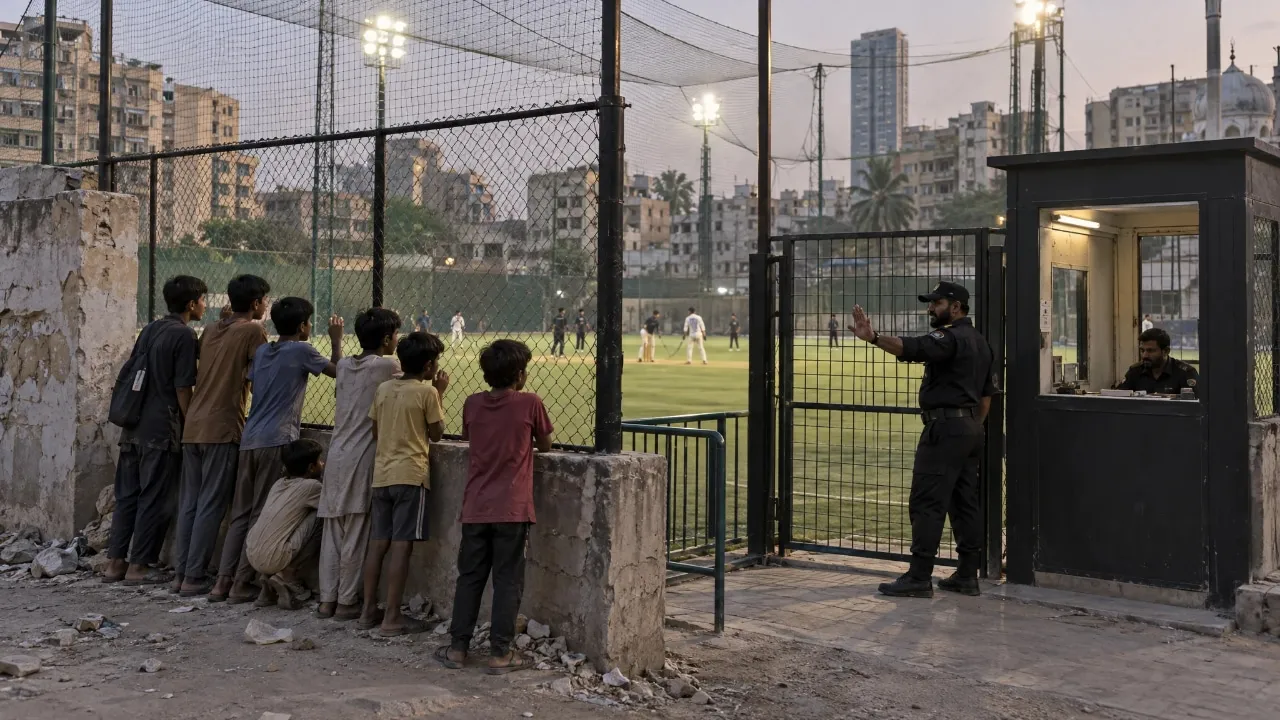
The growing commercialisation of public grounds by the Karachi Metropolitan Corporation and Town Municipal Corporations has raised concerns about the affordability and accessibility of recreational spaces, particularly for children and young people from low-income households. Municipal authorities across the vast metropolis have increasingly entered into contractual arrangements with private operators, altering the fundamental nature of spaces originally designated for community use. Neighborhood parks and open-air sports fields, once freely open to local residents, now feature locked gates, security guards, and commercial rate cards posted at their entrances.
In one Korangi locality alone, four playgrounds sit within a radius of roughly one kilometer, yet local children have limited access to them because the facilities have been put to commercial use, with private operators charging a fee to anyone wanting to play. This heavy concentration of restricted facilities in a single residential neighborhood highlights a broader metropolitan trend. Families living within sight of well-maintained turf fields and concrete courts find themselves locked out unless they can meet the hourly or daily rental rates demanded by private managers.
The Cost of Access Across Karachi Districts
A field assessment of several districts across Karachi revealed that public parks and municipal grounds are heavily used for paid sporting activities, effectively pricing out casual players and neighborhood youth leagues. The commercialization spans multiple sports, including cricket, football, padel, and pickleball, with pricing structures varying significantly depending on the district, the time of day, and the specific amenities offered by the private operators running the sites.
At the Rashid Latif Cricket Academy and Eidgah Ground in Korangi, operators charge Rs6,000 for a three-hour T20 match, while night matches cost around Rs5,000 an hour due to lighting expenses. Moving toward the southern part of the city, Umer Sharif Park hosts commercial padel courts charging between Rs6,000 and Rs10,000 an hour, alongside pickleball courts priced at Rs3,500 an hour. In the eastern district, the HillTop Sports Arena charges Rs4,000 an hour for indoor cricket and futsal facilities.
Larger venues command even steeper rates for longer tournament bookings. The Annu Bhai Cricket Ground in Nazimabad charges around Rs60,000 for a six-hour daytime booking. Meanwhile, the Baloch Mujahid Football Ground in Malir levies up to Rs12,000 for a daytime match, with night rates exceeding Rs30,000. These figures place organized sports entirely out of reach for working-class youth who rely on neighborhood spaces for physical exercise and social recreation.
Impact on Local Residents and Youth Sports Development
Residents say the growing use of public spaces for paid sporting activities is making it increasingly difficult for children and young people to participate in sports without worrying about cost. Neighborhood families report that open areas where generations of children learned to play cricket and football are now cordoned off for paying customers, leaving youngsters with no safe or open spaces in their immediate surroundings.
Local frustration is palpable among residents who watched these municipal spaces deteriorate before private parties took over, only to find themselves excluded once improvements were made. One resident living near Eidgah Ground expressed this sentiment directly, saying, "What good is it when our children cannot play inside it? We could never use it."
Professional athletes and sports veterans have also voiced alarm over the trend. A former national football player termed the practice of charging for access to public facilities unethical, noting that many of the country's finest players historically emerged from modest families and could never have afforded the current hourly fees.
Municipal Authorities Defend Outsourcing and Maintenance Models
Local government representatives and municipal officials defend the public-private partnership model as a practical necessity given severe budget constraints. Korangi Town Chairman Naeem Sheikh explained that the Eidgah ground had been given to a private party for four days a week. He argued that this partial outsourcing had successfully helped maintain the ground over the past two years, preventing the facility from falling into disrepair.
On a broader level, a spokesperson for the Karachi Metropolitan Corporation stated that the corporation did not charge for public-use facilities. The spokesperson added that private parties collected fees under formal contractual arrangements and clarified that the municipal corporation was not a price regulatory authority, thereby deflecting responsibility for the high costs borne by neighborhood residents.
Background and Evolution of Karachi Municipal Management
The management of public parks and sports grounds in Karachi has historically fallen under the jurisdiction of the Karachi Metropolitan Corporation, alongside various district municipal corporations and town committees. Over the decades, municipal budgets have faced chronic deficits, leaving local governments struggling to fund routine maintenance, grass cutting, security, and lighting for hundreds of parks and playgrounds scattered across the city's densely populated districts.
To cope with these financial shortfalls, local authorities increasingly turned toward outsourcing models. Under these arrangements, private entities or sports academies take over the operation, development, and upkeep of municipal grounds in exchange for commercial rights. While this approach has successfully rehabilitated poorly maintained grounds and introduced modern artificial turfs, lighting systems, and boundary walls, it has simultaneously created a structural conflict between municipal revenue generation and public welfare mandates.
Broader Implications for Urban Communities and Public Health
The restriction of access to municipal sports grounds carries significant implications for urban youth development and public health in Karachi. Public parks and open-air grounds serve as essential outlets for physical activity, mental well-being, and social cohesion in densely built urban environments where private recreational facilities are virtually nonexistent for the majority of citizens.
When municipal authorities surrender public spaces to commercial operators, low-income youth are effectively deprived of safe environments to engage in sports. Public health advocates point out that declining physical activity among children and teenagers contributes to long-term health concerns. Furthermore, the lack of accessible recreational infrastructure places additional pressure on marginalized communities, reinforcing urban inequalities where access to basic amenities depends strictly on household income.





