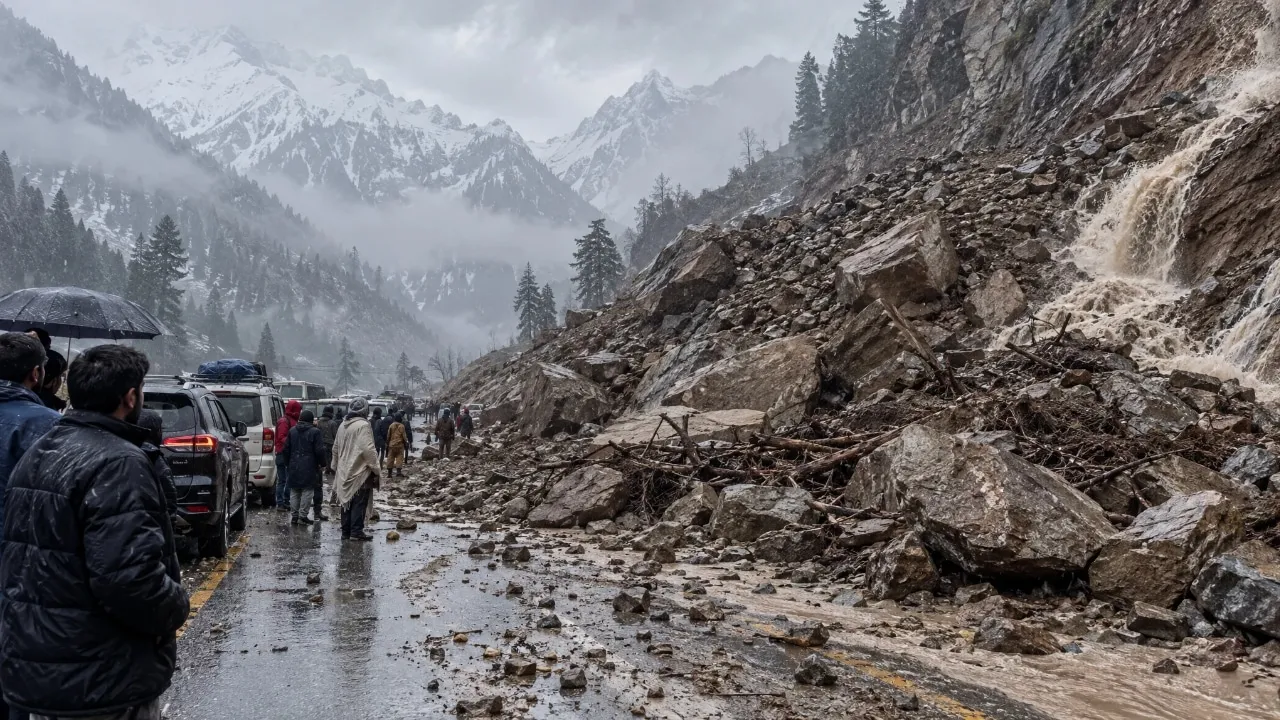
A major landslide near Paras has blocked the Kaghan Highway, stranding many tourists and local residents as rain and snowfall continue across the Kaghan Valley.
Intermittent rain has been reported in the lower parts of the valley, while snowfall continues in Naran and other upper areas.
What Happened on the Kaghan Highway?
The landslide near Paras has completely disrupted traffic on the Kaghan Highway, cutting off road access for travellers and residents. Local reports say many tourists and residents have been stranded after the road closure.
National Highway Authority (NHA) machinery had yet to reach the affected site even hours after the incident, delaying efforts to clear the road.
Geographic Context of the Kaghan Valley
The Kaghan Valley stretches from Balakot in the south to the town of Naran in the north, following the Kunhar River. It is a popular tourist destination known for its alpine scenery, lakes, and trekking routes. The Kaghan Highway, also known as the N-15, is the main arterial road that connects the valley's settlements and provides the only vehicular link for tourists traveling to Naran, Saif-ul-Malook and surrounding areas.
Paras, a small settlement located roughly midway between Balakot and Naran, sits on a steep slope where the road runs close to the riverbank. The terrain is prone to landslides, especially during the monsoon season and when winter snowfall adds weight to the soil.
Why Landslides Occur in This Region
The Himalayan foothills experience a combination of heavy monsoon rains and rapid snowmelt. When rain falls on saturated soil, the shear strength of the earth decreases, making slopes unstable. In winter, snow accumulation adds extra load, and sudden temperature changes can cause thaw cycles that further weaken the ground.
Historical data from the Pakistan Meteorological Department shows that the Kaghan Valley records an average of 120 mm of rain between July and September, and snowfall can exceed 30 cm in the upper reaches during December to February. These conditions have triggered multiple landslides in the past decade, some of which have caused temporary road closures and loss of life.
Role of the National Highway Authority (NHA)
The NHA is the federal agency responsible for the construction, maintenance and operation of Pakistan's national highways. Its mandate includes rapid response to road emergencies, deployment of heavy-duty machinery, and coordination with local authorities for evacuation and rescue.
In the case of the Paras landslide, officials reported that NHA machinery had not yet arrived at the site even hours after the incident. The delay may be due to the remote location, limited access routes for large equipment, and the ongoing weather conditions that hamper movement.
Immediate Impact on Tourists and Residents
Tourists who had travelled to the valley for the winter season found themselves stuck in hotels, guest houses or roadside shelters. Many were on day trips to Naran or Saif-ul-Malook, while others were on longer itineraries that included trekking in the surrounding mountains.
Local residents, including shop owners, transport operators and school children, faced disruption to daily activities. Supplies that normally arrive by road were delayed, and schools in the area were forced to suspend classes until the highway is cleared.
Response Measures and What to Expect Next
Authorities are expected to mobilise earth-moving equipment, rock-cutting machines and bulldozers once the weather permits safe travel to the site. The NHA typically conducts a site assessment, determines the volume of debris, and then plans a phased removal operation.
Residents and tourists are advised to stay in place, conserve resources and follow instructions from local police and disaster management officials. Emergency shelters have been set up in Balakot and other nearby towns to accommodate those who cannot remain in their current lodging.
The timeline for reopening the Kaghan Highway depends on three factors: weather clearance, equipment availability, and the amount of material to be removed. Past incidents in the valley have seen road clearance take anywhere from 12 hours to several days.
Long-Term Measures for Slope Stability
Experts from the Pakistan Institute of Engineering and Applied Sciences have recommended a series of mitigation steps for the Kaghan Valley, including:
- Installation of retaining walls and rock-fall barriers on high-risk slopes.
- Improved drainage systems to divert water away from vulnerable areas.
- Regular geological monitoring using satellite imagery and ground sensors.
- Community awareness programmes on landslide early warning signs.
Implementation of these measures requires coordination between provincial governments, the NHA, and local communities.
Practical Advice for Travelers
Anyone planning to travel through the Kaghan Valley should check weather forecasts and road status updates from the NHA website or local radio stations before departure. Carrying extra food, water, warm clothing and a charged mobile phone is advisable during the winter months when sudden weather changes are common.
In case of an emergency, the national emergency number 1122 can be used to request assistance.





